
Welcome to this latest edition of our Workbench blog and all the news, updates and modelling exclusives from the fascinating world of Airfix.
Workbench regulars will have probably noticed that our recent review edition which featured the Airfix display at this year's Scale ModelWorld Show included details of a model kit which wasn't on the Airfix website at that time, a classic kit which was serving as a little additional bonus show surprise for those visiting the Airfix stand this year. The model in question is our Vintage Classics Bristol Bloodhound kit and as it's now available to pre-order on our website with its own product page, we thought this would be an appropriate time for us to give it a proper Workbench welcome.
In addition to looking at the details behind this kit and the actual missile system which prompted its tooling inclusion in the Airfix range, we will also be seeing why this particular kit holds such a significant position within wider Airfix heritage and why its re-introduction will be seen as big news for many within the modelling community. Benefiting from built model images and featuring the classic artwork file created by Roy Cross in 1971, we're in for a real classic Airfix treat this weekend, as we mark the return of a kit which has a special place in the hearts of a great many modellers.
The impending arrival of the Handley Page H.P.42 Heracles in November 2021 saw Workbench readers asked to nominate other classic Airfix kits they would like to see joining the Vintage Classics range.
Over more than eight years of producing and posting our Workbench blog, we have learnt only too well that our readers are both loyal and knowledgeable, and for those reasons, when we launch an initiative which asked for readers to suggest the heritage Airfix model kits they would like to see re-introduced as future Vintage Classics releases, we knew we were in for a nostalgic trip down Airfix memory lane. Asking this question as something of a throwaway suggestion at the end of a blog which saw us welcoming the Handley Page H.P. 42 Heracles to the Vintage Classics range at the beginning of November 2021, we were completely unprepared for the size of the response we received - it was absolutely unprecedented.
From the first moment the blog was published, the Workbench e-mail address started pinging away merrily, as it began receiving the first of literally thousands of messages on the subject, each one offering their own suggestions as to which model kits they would like to see joining the Vintage Classics range at some point. Some respondents suggested just a single classic kit, whilst others included a list of several different options, and some people even went to the trouble of including a description of why a particular kit had such significance to them and therefore, why they were keen to see it take its place in an Airfix range once more.
Historically, this proved to be the single most popular reader participation project we have ever launched as part of a Workbench feature and in the end, we received so many suggestions that we had to spend time over that year's Christmas break to file, collate and rank each and every one of those suggestions. The fact that each of these suggestions featured a classic Airfix kit meant that this was no chore at all and thankfully got us away from cold turkey sandwiches and re-runs of Home Alone.
The results of this impromptu poll were published in the first Workbench blog of 2022 and was made all the more interesting by the sheer size of the response received - this was quite literally a case of the Airfix modelling community having their say! Before we unveiled the results of the poll, we were pleased to confirm that some of the suggestions received had actually made it into the 2022 range which was only days away, but for obvious reasons, weren't able to be confirmed at that point. Interestingly, others which appeared high on the list of suggestions were subsequently released the following year, and as we aren't all that far away from announcing the new 2024 range, will see several more joining very soon.
When it comes to our Vintage Classics range, it seems that the modelling nostalgia these kits possess not only takes us back to the days of our modelling youth, when life seemed so much simpler, but is also confirmation of just how important Airfix kits were to so many people during their formative years. As Old Father Time has a nasty habit of catching up with all of us, the re-issue of these genuine kit classics immediately transports many of us back to our formative years Airfix style, but also allows new and much younger modellers the opportunity to experience these classic kits for the first time, models which represented the pinnacle of injection moulding technology when they were first released, but are now a thoroughly enjoyable trip down modelling memory lane.
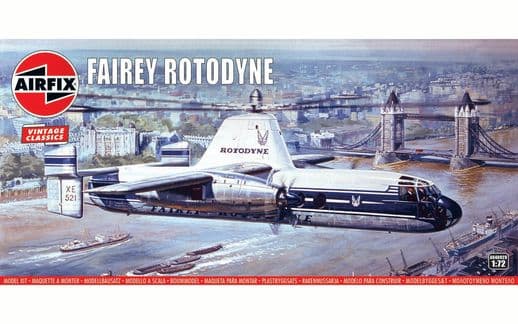
The Fairey Rotodyne feature prominently in our impromptu poll and is now available as part of the Vintage Classics range, if only whilst current stocks last.
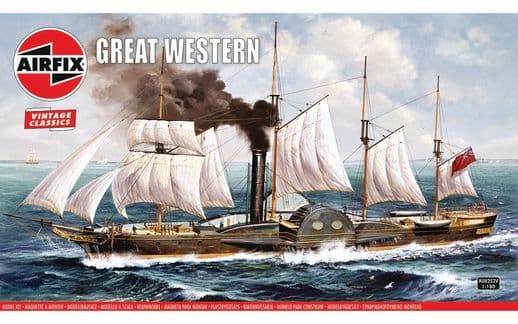
During this exercise, we soon discovered that modellers who were members of particular interest groups were determined to use this as an opportunity to have their say, with ship and warship modellers proving to be particularly vociferous in this regard. Their suggestions ranged from subjects such as Scharnhorst, Iron Duke and HMS Daring (D05), to the Free Enterprise II ferry and the P.S Great Western steamer and as we all now know, the Great Western is now in the range, even though it might not be for too much longer.
Further non-military suggestions came from motoring modellers, who were of the opinion that our extensive back catalogue of classic vehicle kits would and should be welcomed back to the Airfix fold, with the Ford Capri and Triumph TR7 doing particularly well, picking up plenty of individual votes. Sticking with classic motor vehicles a while longer, our heritage motorcycle kits were not left without support and anything with a James Bond connection also showed themselves be a welcome addition to any future range.
Taking a slightly more military and AFV viewpoint, the increase in the number of armoured fighting vehicle kits added to successive Airfix ranges over recent years has underlined the enduring popularity of these kits as modelling subjects, and therefore it came as no surprise that tank suggestions featured prominently in the poll. British Chieftain and Centurion tank kits did particularly well for nominations and bearing in mind the poll came on the eve of the 40th anniversary of the Falklands War, the Scorpion/Scimitar kit also received plenty of mentions.
As you may well have expected, aviation kit subjects featured heavily throughout this exercise, with everything from the TSR-2 to the Fairey Rotodyne being suggested and all we can say on that score is, you're welcome! The recent re-introduction of the Rotodyne has most definitely been one of the most popular additions to the Vintage Classics range to date, but of course we already knew that, because our readers told us so!
Another kit nomination which is now available once more, the Bristol F2B Fighter was one of the two kits included in the first Vintage Classics release of a Dogfight Doubles re-issue.
Getting back to our reader poll, Great War aviation suggestions included such aircraft kits as the Bristol F2B Fighter and the LFG Roland C.II Walfisch, but by far and away the most popular suggestion in this sector was the Handley Page 0/400 bomber, an aircraft which was at the time of service, one of the largest aircraft in the world and definitely the largest produced in the UK. WWII subjects suggested included the Handley Page Hampden, Brewster Buffalo and Ilyushin IL-2 Sturmovik, and rotary fans would be happy to see the return of either the Westland Whirlwind HAS.22, or the Westland Scout, another subject which has strong Falklands War connections.
Moving on to the models which received the most votes overall, we have the Avro Anson I, Hawker P.1127 and an enigmatic pair of Cessnas, the O-1 Bird Dog and O-2 Skymaster, kits which many of us wouldn’t mind having on our own future build schedules. Clearly, several of the kits suggested in our poll have now already joined the ranks of successful Vintage Classics re-introductions and whilst others will undoubtedly follow in the years ahead, which kit proved to be the one most requested by Workbench readers?
Well, that proved to be quite the surprize for us, not only in the choice of subject but also by the impressive margin of its victory - this one absolutely romped home! Our most requested future addition to the Vintage Classics range proved to be the Bristol Bloodhound missile, complete with launcher, Land Rover and support crew, a kit which received hundreds of nominations, both as a standalone kit and in conjunction with the 1/72nd scale Lockheed C-130K Hercules kit. People clearly weren't too fussy about the release combination, they just wanted to get their hands on the Bloodhound. How could we possibly stand in the way of a modeller request possessing such compelling support?
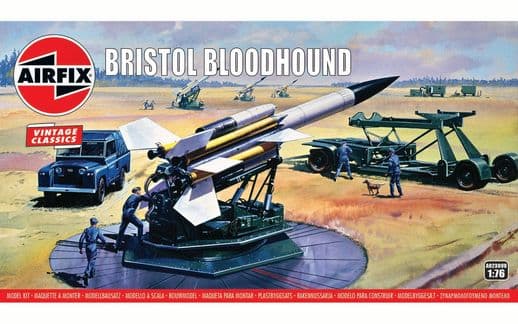
More Roy Cross box artwork magic, this time to herald the arrival of the Bristol Bloodhound kit into the Vintage Classics range, the most heavily requested kit addition to the range, as voted by Workbench readers back in November 2021.
As overwhelmingly impressive as the Bloodhound's victory undoubtedly was, what we obviously couldn't say at that time was that the Airfix development team had already embarked on a project to discover whether the tools for this classic kit were accessible, intact and in a condition which would support a future production run, a process which can often take many months to complete. All the time this was progressing, they would have no doubt had their fingers crossed, fresh in the knowledge that this very kit had just been voted the most requested future addition to the Vintage Classic range, with the project now taking on even more significance for them.
An Airfix classic in every respect of this description, the Bristol Bloodhound kit was first released at the beginning of the 1960s and at that time, must have been a fascinatingly irresistible proposition for the nation's young modellers, as it just had so many interesting features to it. At the time, this kit was marketed as the latest thing in scale modelling authenticity, with adverts back then proclaiming both it's scale accuracy and how designers had given it that faithful to the original look, making them true collector's pieces to own.
It went on to describe how as all Airfix kits are made to a constant scale, how they look proportionally right to each other as subjects, because they are right - you can't beat Airfix for realism or value! How could we ever refuse such captivating marketing as that?
A built model featuring the Bristol Bloodhound kit, staple fare for any modeller with an interest in Britain’s V-Bomber aviation heritage.
The new kit was marketed at the time by the use of what can only be described as a black and white line drawing of the Bloodhound and all its constituent features, dog and all, inviting us to marvel at the fact that the Bloodhound in the foreground of the image was the Airfix kit and how it was difficult to distinguish between this model and the real thing in the background. The only thing was, both appeared to be hand drawn representations, however, I don't think such details mattered to us modellers back then, we simply had to have one of these kits. From an availability perspective, this kit, which was priced at 2/-, could be secured from either your local model and hobby shop, a good toy store, or of course Woolworth, a store where so many thousands of Airfix kits went on to find new owners over the years.
The Bloodhound was re-issued as a boxed series 2 kit in 1971, where its modelling immortality would be cemented by the addition of another new feature, stunning Roy Cross box artwork. To this day, modelling forums cite Roy Cross artwork as one of the most significant aspects of people's modelling journeys and how these beautiful works of art not only dragged us into the hobby, but still manage to drag us straight back there in a wave of nostalgia whenever we catch a glimpse of them.
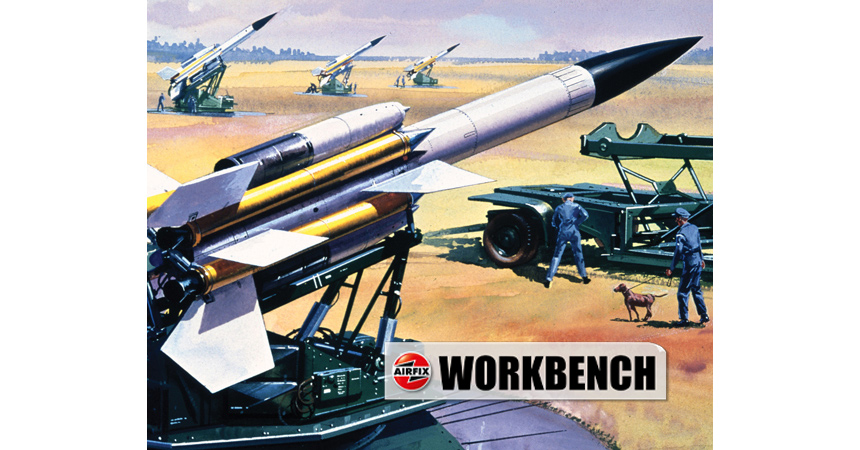
Thanks to our graphics guru Mark, we have been allowed to show this original representation of the Roy Cross created Bloodhound artwork here, showing a new missile having been transported to its permanent launch site by Land Rover and trailer, with that faithful guard dog looking on to check everyone's doing their jobs correctly. Such an iconic piece of artwork, in addition to advertising this appealing kit, it also says much about the protection of the nation at that time and how advancing missile technology was actually bringing into question the continued use of aircraft in a military role.
At the end of the Second World War, there was an understandable reluctance to think about and more importantly, to finance an overhaul of Britain's air defence network, particularly as the great military minds of the day thought another war unlikely for at least the next decade. This thinking changed almost overnight, following the Soviet Union's successful testing of a nuclear device in 1949, with the immediate launch of a programme to establish a coordinated defence strategy for Britain.
A most welcome addition to the Vintage Classics range, the Bristol Bloodhound was the kit voted as the most popular individual model for induction into the range when Workbench readers were questioned back in 2021. Below the fully branded Bloodhound box artwork image are assembly and painting instructions for this much anticipated resurrected Airfix kit classic.
The resultant plan called for the establishment of a powerful chain of radar stations down the eastern spine of the nation, with fighter and missile cover providing a technological shield against any encroaching aircraft coming from the east. Initially utilising what was already in place, this ambitious undertaking was specifically required to maintain the deterrent integrity of the UK's V-Bomber force from hostile aerial attack.
The surface to air missile component of this plan would consist of two types of advanced weapon, shorter range missiles which were intended to be placed close to the airfield bases operating V-bombers with a destructive range of around 20 miles, and longer range missiles which would take more time to develop and introduce. With the project advancing rapidly, the Bristol Bloodhound was a 'Stage 1' missile solution developed during the 1950s, powered by a ramjet and solid fuel rocket arrangement intended to target and destroy any enemy aircraft managing to penetrate the RAF's shield of English Electric Lightning interceptors.
A relatively advanced system, the Bloodhound utilised a powerful Ferranti developed radar detection and guidance system, and was powered towards impact by a pair of Bristol Thor ramjet engines and four additional Gosling solid fuel rockets, all arranged around the rear fuselage of the missile. At launch, the solid fuel rockets would fire and propel the Bloodhound to around Mach 2.2 in around four seconds, allowing the ramjets to power up and maintain the missile's speed for an additional 80 seconds after that, or on to impact. Once launched and on target, it would be virtually impossible for a locked-on enemy aircraft to avoid being destroyed by a Bloodhound.
The Bristol Bloodhound Mk.I was a fixed site missile and whilst transportation of the unit was a relatively simple task and didn't require the use of expensive specialist equipment, once on its launcher, this was effectively its defensive location for the duration of its deployment. Usually deployed in squadrons of around 32 missiles, Bloodhounds were positioned at locations close to bases which were home to Britain's V-bombers, mainly down the east coast of Britain, from Carnaby in the north and Rattlesden in the south (Mk.I Bloodhounds).
Another view of a finished Bloodhound model, a kit which has to be considered one of the most interesting in the heritage Airfix range and one which Workbench readers were keen to see return as a Vintage Classic.
Bloodhound sites would generally be permanent, fully autonomous locations, and could boast their own powerful radar equipment emplacements, tactical control centres, hangars for missile storage and servicing, technical support buildings and accommodation blocks for crews, not to mention the required explosive and fuel storage facilities. It was hoped that such a missile force would deter any Soviet aircraft from attacking UK airspace, therefore maintaining the integrity of Britain's nuclear capable V-bomber force and with it, hopefully preventing the unthinkable possibility of a mutually destructive nuclear exchange.
As missile and radar technologies improved, and as Britain transferred the responsibility for maintaining the nation's nuclear deterrent force to the Royal Navy, Bloodhound units also benefitted from a technology upgrade, even though their strategic importance was arguably diminishing by that point.
Between the original Mk.I variant and enhanced Mk.II, around 780 Bloodhound missiles would eventually be produced, serving with 16 RAF Squadrons between 1958 and 1991, and with a further five overseas nations during that time. A fearsome looking missile, the Bloodhound probably held a similar deterrent potential as the RAF's V-Force bombers and helped to play their own small part in preventing the futility of nuclear conflict throughout the Cold War period. Thankfully, the destructive potential and operational effectiveness of the Bristol Bloodhound was never tested in anger and if we want to inspect one for ourselves, there are several examples on display both here in the UK and in the countries which operated the system.
As requested by Workbench readers, the Bristol Bloodhound is available now and ready for duty defending all those Vulcan builds out there in modelling land.
When it came to subject choice, modellers could always rely on Airfix to deliver on the scale model kit front and the Bristol Bloodhound was a fine illustration of this proud reputation. Making for a truly spectacular finished display piece, this kit offers so much appeal for the modeller as a project and will definitely attract plenty of admiring glances once completed and on display. No Airfix V-Bomber display could call itself complete without at least one Bloodhound missile to protect it, and of course featuring that ever vigilant scale dog.
There is a famous saying that the customer is always right and in the case of our Vintage Classics future model survey conducted a couple of years ago, we simply had to react to your most popular re-issue request. With that being the case, we are delighted to confirm that our classic Bristol Bloodhound kit is available once more and ready to protect our model displays from any unwanted attention.
We are afraid that's all we have for you in this latest edition, but we will be back next Friday with more project development updates and the very latest Airfix kit exclusives. In the meantime, we are always keen to hear your views on all things Airfix and in particular, any thoughts and opinions you may have regarding our Workbench blog. If you would like to drop us a quick line, could we please ask that you use our workbench@airfix.com email for all correspondence.
To re-visit any of the Airfix blogs we have produced over the past seven years or so, please head to our main Workbench hub, where you will find our entire blog back catalogue and all the Airfix design projects we have already covered.
All our dedicated official social media sites can be accessed by clicking the respective link icons at the foot of this page, or by heading to the Airfix homepage. Other useful Airfix links are:
Facebook, YouTube, Twitter and Instagram official sites
Please join us for more Airfix updates next week and thank you for your continued support.