
Welcome to this latest edition of our Workbench blog and all the news, updates and modelling exclusives from the fascinating world of Airfix.
Things just keep on getting better for Airfix fans this year! Even though the unexpected kit announcement air is still a little turbulent following the arrival of our 'Operation Black Buck' Avro Vulcan B.2 kit last week, we have yet another previously unannounced range addition to tell you about in this latest edition of Workbench, this time one coming from the world of Vintage Classics. For anyone with an Airfix modelling background, this latest announcement will probably be big news for them, a true classic of an Airfix kit and one which occupies a significant position within the wider heritage of the brand. First tooled back in 1959, the subject of this kit was something of a transportation phenomenon during the 1950s and 60s, with a British inventor leading the way in this particular field of ground-breaking research. The major question of the day proved to be, is this a boat, or an aeroplane, something ministry officials at the time were having a hard time deciding upon - in actual fact, this was the first truly effective Hovercraft design to be produced.
In this latest edition of Workbench, we are delighted to be welcoming the Vintage Classics SR-N1 Hovercraft to the 2023 Airfix range and intend to mark the occasion in some style. Showcasing original box artwork and looking a little more closely at the history behind this incredible machine, we will also be bringing you a series of photographs featuring a built model sample of the kit, all of which will hopefully underline the significance of this latest range addition and the return of a kit which undoubtedly means so much to so many modellers. We're metaphorically floating on air this weekend, as we welcome the classic SR-N1 Hovercraft back into an Airfix range.
One thing you have always been able to rely on Airfix to do, is to bring modellers kit representations of the machines which have made history.
Although we might be in some danger of showing our age a little here and speaking of things which will mainly be familiar to readers of a certain age, they all do actually still apply to the wider modelling hobby and Airfix in particular. If we cast our minds back to when we were young, when our minds were like little sponges created to absorb every scrap of interesting information they came across, the marketing brains behind some of the nation's best loved brands were only too aware of this fascination and played on our insatiable thirst for knowledge.
Back then, we were truly fascinated by everything from famous explorers to the people behind the most amazing inventions of the day, with history and historic figures playing such an important role in our formative years. Who remembers encouraging their father to fill their car up at a certain petrol station, just so they could get another coin for their ever growing collection, or asking for a particular breakfast cereal because it included a free plastic bust of a famous Indian chief? In addition to these, how many had hand-down cigarette cards featuring classic sailing ships, or more widely, the Brooke Bond tea card series, which covered subjects as diverse as butterflies and dinosaurs to the history of the motor car and aviation?
The one thing all these desirable objects had in common was that they all fed our appetite for history and historical facts and from the 1950s onwards, Airfix was very much a feature of this phenomenon, arguably taking this desire for historical knowledge to another level. From that point, rather than looking at a two dimensional graphic image of a famous car or aeroplane, young minds could have an accurate three dimensional representation of it on our display shelves, something which proved irresistible to many thousands of people. They still had the captivating artwork which had always been so appealing, but now they could also hone their construction skills, with a pleasing model of some truly fascinating subjects at the end of it.
From a pride perspective, there was nothing quite like owning a model kit featuring a celebrated British design achievement and when we were young, seemingly our entire generation had to have their scale representation of such craft. Whether the subject be HMS Victory, a Spitfire or the technological marvel which was the Hawker Siddeley P.1127, these kits fed our imagination and gave us a lifelong appreciation of history, and how we loved them so!
Our latest surprise release announcement for 2023 takes us right back to those thrilling days of our formative years and will present modellers young and old with access to a kit which was the scale representation of an invention which once again saw Britain leading the world. As everyone knows, ships in all their guises have been allowing man to cross the oceans to raid, trade and discover for many centuries, however, the speed of ships has always been relatively slow, limited by the friction between bow and the surface of the water. In order to address this, experiments had been taking place where air was blown underneath a boat, with this cushion of air allowing the craft to slip over the water much more efficiently.
Although holding great promise, technological limitations dictated that little advancement was made until British inventor Christopher Cockerell embarked on his pioneering work during the 1950s. Using nothing more than a domestic hairdryer, Cockerell experimented using two different sized tin cans fixed one inside the other, with an extension allowing the air from the hair dryer to blow through the arrangement, exiting through the thin, circular gap between the two cans. He discovered that this arrangement provided a much greater level of thrust, but could the idea be adapted to power a craft designed to hover on a cushion of air, just above either ground or water?
Full scheme details of the spectacular and truly historic Saunders-Roe SR-N1 in Airfix scale kit form.
Looking like a huge metal Trilobite, the SR-N1 was front page news when it made its first cross Channel journey on the 50th Anniversary of Louis Bleriot's flight.
Having built a prototype model to test his theory, everything worked as intended and encouraged him to seek official sponsors to back further development. With his research data in hand, he approached officials from the British military, however, they failed to see an application for the technology. Worse than this, they had no idea how to categorise the new hovercraft, with the Air Force describing it as a boat and the Navy calling it an aeroplane. Indeed, one senior naval official even went so far as to castigate the invention as not being a sea-worthy vessel and how even a moderate sea would result in its sinking.
Undaunted, Cockerell continued with his work, producing ever more capable designs and scale models which more than proved the viability of his invention. The next step was to approach the Government, who almost immediately gave the project Top Secret status, and provided the funding needed for development work to continue. The Government wanted this work to proceed with the production of a full size prototype, however, without interest from the military, funding for such an endeavour was out of the question. The answer came through industry and the National Research Development Corporation and with funding now secured, the project could proceed to full scale prototype production.
The design and manufacturing work for the project was awarded to the Saunders-Roe company, a forward thinking firm who were actively looking to branch out from their existing commitments, looking at new technologies, with advanced watercraft being a particular area of interest. After producing a series of concept models both for live flights and wind tunnel testing, the prototype hovercraft was ready to take flight.
Powered by an Alvis Leonides radial piston engine, the same unit which powered such aircraft as the Percival Provost trainer and Westland Dragonfly helicopter, the engine drove a lift fan which created a cushion of air, allowing the hovercraft to skim along the surface of the water, literally riding the crests of the waves.
Inducted into the Vintage Classics hall of fame, this is a most welcome surprise addition to the Airfix range.
Named the Saunders-Roe Nautical 1 or SR-N1 for short, this first modern Hovercraft was a truly amazing invention, one which held the nation captivated and represented another technological first for a British inventor. The test programme culminated with a first test run for the prototype hovercraft on 11th June 1959, an event which was attended by the nation's press, all eager to take their first glimpse at this amazing new invention.
The hovercraft did have its detractors, with some viewing it as an expensive folly, and early press reports even describing it as a flying saucer, however, Cockerell was indifferent to the opinions of the sceptics, confident in the knowledge that he was about to win them over. The first test was only intended to be an introductory event for the press, with the SR-N1 scheduled to power up and hover over a section of level ground, whilst the pilot put it through its paces, however, the test went so well and the press were so insistent, that their request for a sea trial of the craft was granted.
This could have been a high profile disaster for the programme at a vital stage in its development, however, the opposite proved to be the case. The hovercraft performed flawlessly by land and sea, to the absolute amazement of every single onlooker. Whilst still referred to as a flying saucer by many members of the press, the description was now less about a weird invention and more about a proud achievement, something which as it continued to impress, held a fascinated world completely captivated. As impressive as this first public outing undoubtedly was, there was more to come from the SR-N1 hovercraft and a date with destiny which was just around the corner.
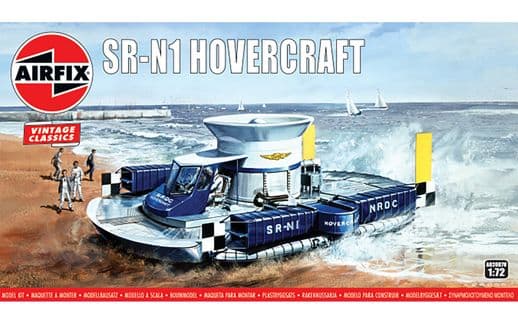
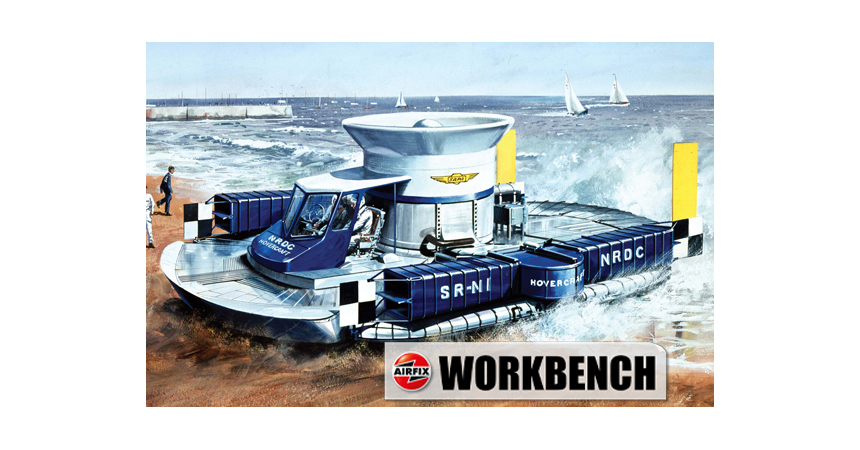
A historic occasion such as this required immortalisation by the hand of Mr Roy Cross, with this stunning box artwork also serving to grace the box of a truly unique Airfix model kit.
With their project having almost as many detractors as it did supporters within the British Government and armed forces, Cockerell and Saunders-Roe were desperate to demonstrate the incredible potential their new hovercraft possessed. To this end, they transported the craft across the English Channel to Calais, in preparation for a record breaking crossing attempt which was certain to grab the attention of both national and international media.
The date chosen for the attempt could hardly have been more symbolic, as Saturday 25th July 1959 marked the 50th anniversary of Louis Bleriot's first manned, heavier than air aircraft flight across the English Channel. Even though Cockerell and his team would be making their flight at a much lower altitude than Bleriot did, the achievement would be similarly significant and definitely captured the imagination of the public.
Setting off early in the morning, SR-N1 successfully completed the 22 mile crossing between Calais and Dover in a little over two hours, longer than anticipated due to the lack of a tail wind, before gracefully making the transition from sea to beach at Dover in front of a huge crowd of onlookers, reporters and photographers. Clearly highlighting the amphibious attributes of the craft, Saunders-Roe Chief Test Pilot Peter Lamb was immediately asked how long it would be before a larger hovercraft would be produced, with everyone now anticipating that faster Channel crossings for passengers were surely just around the corner.
SR-N1 would go on to benefit from several design improvements as her flight testing programme continued, such as the addition of a flexible skirt around the hull of the craft to increase the depth of the air cushion on which it rested, along with the installation of a more powerful engine. Although only designed to carry a pilot and his navigator (even though inventor Christopher Cockerell would invariably also be hitching a ride), SR-N1 would later be used in military trials, safely delivering twenty fully equipped Royal Marines in a simulated amphibious beach assault scenario.
Two more views of the beautifully finished model sample of this historic kit, produce to mark the imminent arrival of the SR-N1 into the Vintage Classics range. As you can see, it's been finished with its four transportation and testing castors in place.
Having ably demonstrated the potential of this new technology, SR-N1 was retired, but not before our King, the then Prince of Wales, had the chance to take her for a spin, or should that be a hover! It has been claimed that the Prince was really taken with the hovercraft and flew it rather 'enthusiastically', suffering a minor incident during his time at the controls. One of the design features of this first hovercraft was when making directional input requests whilst travelling at speed, how it could take a second or two before the hovercraft decided to head in the direction required. This issue was probably responsible for the craft sustaining slight damage to its fuselage structure at the hands of the Prince, however, it was so superficial that it was never repaired. Apparently, it has always been referred to as the 'Royal Dent' since then.
This incredibly historic British invention is now preserved as part of our national heritage and is on public display at the Science Museum, Wroughton.
Even though SR-N1 was an invention which attracted international attention and heralded the dawning of this new and exciting technology, it would probably be fair to say that the fortunes of the hovercraft have somewhat ebbed and flowed since that first historic Channel crossing. Hopes for large hovercraft passenger services between Britain and France were realised in rather spectacular fashion, however, these ended in 2000 as a result of escalating operating costs and increased competition.
A final look at the SR-N1, a fascinatingly unique Airfix model kit.
Hovercraft technology is still current and continuing to advance and it's interesting to note that despite the ambivalence of the British military back in the 1950s, the US Marine Corps have been successfully operating heavy military hovercraft for many years, although they refer to theirs as Landing Craft Air Cushion. These are truly impressive machines and take the story of twenty British Marines standing on SR-N1 to a completely different level, providing the US Marines with a powerful and extremely capable amphibious attack/resupply platform.
From an Airfix kit heritage perspective, it's interesting to note that the original packaging copy supporting the release of our SR-N1 hovercraft kit highlights the fact that the tooling was in development almost in tandem with the machine on which it was based. It clearly refers to the experimental nature of the craft and how the immediate future looked bright for Christopher Cockerell's invention, even mentioning the possibility of much larger passenger and freight carrying Hovercraft possibly being just around the corner.
It appears as if the copywriter at the time was already in possession of development information, as they mentioned deeper hull air skirts and the use of jet turbine technology on future machines. You can just imagine how at the time, modellers were desperate to get their hands on this delightful new kit and to make their own scale tribute to yet another world's first for a British inventor. When it came to Mr Cockerell and his SR-N1 Hovercraft, Britain most certainly ruled the waves, or the cushion of air just above them.
A kit classic if ever there was one, the Vintage Classics arrival of the SR-N1 Hovercraft should now be only days away.
As the latest unexpected kit announcement to join the current Airfix range and the first coming from our popular Vintage Classics range, the return of the SR-N1 Hovercraft will come as a welcome surprise for many and for those of us who modelled throughout the 1960s, 70s and 80s, will know doubt bring back plenty of pleasant memories from those days. Sight of the classic Roy Cross box artwork will also be manna from heaven for a great many Workbench readers this weekend, as will its presentation transition into Vintage Classics range form.
As far as unique kit subjects go, the SR-N1 Hovercraft definitely stands above most others and if for no other reason than that, we're delighted to have it back in an Airfix range.
We are afraid that's all we have for you in this latest edition, but we will be back next Friday with more project development updates and the very latest Airfix kit exclusives. In the meantime, we are always keen to hear your views on all things Airfix and in particular, any thoughts and opinions you may have regarding our Workbench blog. If you would like to drop us a quick line, could we please ask that you use our workbench@airfix.com email for all correspondence.
To re-visit any of the Airfix blogs we have produced over the past seven years or so, please head to our main Workbench hub, where you will find our entire blog back catalogue and all the Airfix design projects we have already covered.
All our dedicated official social media sites can be accessed by clicking the respective link icons at the foot of this page, or by heading to the Airfix homepage. Other useful Airfix links are:
Facebook, YouTube, Twitter and Instagram official sites
Please join us for more Airfix updates next week and thank you for your continued support.