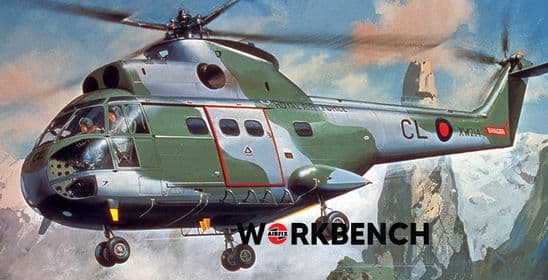

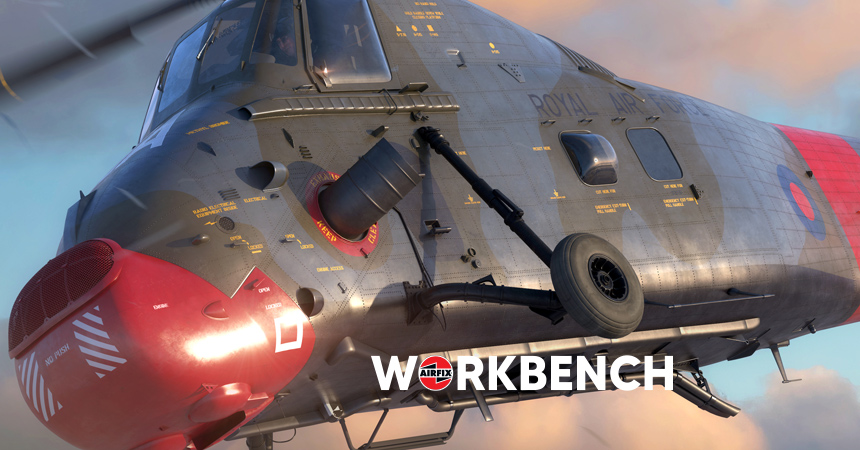
Welcome to this latest edition of our Workbench blog and all the news, updates, and modelling exclusives from the fascinating world of Airfix.
Following on from our Designer Interview edition, which was posted last weekend, we once again return to the subject of new 2025 tooling additions to the Airfix range in this latest edition of Workbench, and the hugely impressive Westland Wessex in 1/72nd scale. Having been allowed a fascinating insight into the design world of talented Product Designer Ethan Barker in our previous edition, we return to the subject of his latest impending new project addition to the Airfix kit range in this follow on feature, as we move from his computer screen to the wider modelling world and modeller workstations everywhere. This latest update will see us taking a more detailed look at the work done in support of his design efforts, as we feature box artwork, scheme details and include images of built models finished using the final test frames from this impressive new tooling.
Adopting our now time-honoured format, we will begin by looking at the incredible rise of the helicopter in the post war era of aviation, before moving on to consider the long service heritage of the Wessex itself, both in British and overseas service. With our usual impressive selection of exclusive imagery to bring you, we will conclude by looking at each of the three scheme/decal options included with the initial release of this appealing new tooling, each one illustrated with images of sample models finished in the respective scheme being covered.
We find ourselves in classic helo heaven once again in this second new Westland Wessex edition of Workbench.
A trio of model Wessex kits looking quite magnificent. Which scheme will you go for?
The period of world history just prior to, and of course during the Second World War, would see incredible advancement in aviation technology, a time which would encompass the introduction of the world’s ultimate biplane fighters, right through to the arrival of the world's first operational jet powered aircraft, and all in just over seven years. As fixed wing aircraft continued to advance and attain ever greater speeds, work was also quietly advancing on machines which employed a more sedate form of flight, rotary air power and the advancement of a dream which had captivated man for centuries.
The flexibility and operational potential offered by an effective helicopter design ensured that development of this technology continued apace during the mid 1930s and in Germany, aircraft such as the Focke Achgelis Fa61 and Flettner Fl 282 Kolibri finally proved that a practical and workable helicopter design was both possible and not that far away.
Ultimately though, it would be American who would make the real breakthrough in helicopter technology, as they took the honour of designing the world's first large scale, mass produced helicopter type, in the shape of the Sikorski R-4, an aircraft which was the brainchild of celebrated helicopter pioneer Igor Sikorski, and one which would go on to see service with the US military during the Second World War. Still a relatively primitive design, the R4 was blighted by the challenges which faced all those involved with early helicopter development, in that it was difficult to control, wasn't overly blessed with power and from a pilot's perspective, was a hands-on aircraft at all times.
These aircraft could only be tamed by the very best pilots in the world at that time, and there was even an in-service joke doing the rounds at the time which suggested that you could always tell a helicopter pilot apart from a fixed wing airman when in their company, because the helicopter pilot would be suffering from a permanent case of the shakes, due to the constant vibration such airmen were forced to endure.
Despite the many remaining challenges helicopter designers had to overcome, the concept had been proven, and the flexibility offered by the helicopter ensured that development efforts were given renewed impetus following the introduction of the Sikorski R-4. As rotary pilots continued to gain more flight experience, more capable machines were already waiting in the wings.
During those early years of helicopter development, it does have to be accepted those involved in that field struggled to overcome two particularly significant challenges, those of effective aircraft control, and engine power to weight ratio. If they could overcome both, the helicopter would truly come of age, and they would have a machine which would provide operators with an aircraft type so flexible that it would be unique in the world of aviation, one possessing almost limitless military and civilian application possibilities.
The next Sikorski design, the S-51 (H-5), addressed many of those outstanding issues and would become one of the most important types in establishing the helicopter as a practical aircraft type. With increased speed, endurance and range, along with much more responsive flight control, the S-51 started to how what the helicopter could do, and being far from perfect, it was a boost for helicopter technology, and the stimulus the industry badly needed at that time. The helicopter’s distinctive, somewhat ungainly profile was dominated by an incredibly long tail boom and large, greenhouse cabin, with the overall size of the aircraft making it a difficult aircraft to operate in confined spaces. Nevertheless, it was an incredibly impressive machine, one which announced that the helicopter was here to stay.
An incredibly distinctive helicopter, the design of the Westland Dragonfly must have been a difficult aircraft to operate in confined spaces, including the deck of a British aircraft carrier.
A truly practical helicopter design was clearly going to be of huge interest to military forces around the world, and in Britain, the Westland Aircraft Company were keen to establish a formal working relationship with Sikorsky, to which end, they signed an agreement granting them the ability to produce Sikorski helicopters under licence for British operators in UK. The first helicopter produced under this agreement was the Sikorski S-51, which in British service was known as the Westland Dragonfly, with a total of 133 Dragonfly's eventually produced for the Royal Navy, Royal Air Force and a number of civilian operators. This is quite an interesting development, as the Dragonfly/S-51 was the first helicopter to be used for commercial applications - a sign of things to come.
Despite the undoubted success of the Dragonfly, the Westland Company were already eying their next helicopter collaboration project, a machine which would arguably be the world's first truly practicable multi-role helicopter and the one which finally confirmed the potential of rotary air power once and for all.
For the helicopter to finally start to realise its huge development potential, what the Sikorski company were striving to produce was a larger, more rugged design, one which possessed the control stability, power and range to transport both troops and supplies over relatively long distances, in a safe and reliable manner. The initial development of their new helicopter design would get underway as a private company venture, a move which clearly highlighted the confidence the company had in the work they were engaged in.
The philosophy behind their design was to produce a machine with greater load carrying capabilities, whilst at the same time ensuring it was easy to both maintain and operate. This work would eventually result in the first flight of the distinctive S-55 (H-19 Chickasaw), a classic helicopter design which would be produced in greater numbers than any of comparable size that had gone before it and one of the world's truly great helicopters.
The incredible artwork of Roy Cross is familiar to many millions of modellers the world over and even though we will all have our own particular favourites, this piece must surely be one of his most famous works. It certainly helped to make the Westland Whirlwind one of our most popular kits.
Featuring design innovations such as the use of hydraulic servos for rotor head control and clever placement of the aircraft's centre of gravity, which allowed the pilot to easily compensate for different load configurations, the aircraft adopted an unusual positioning for the engine, right at the front of the aircraft. With two opening clamshell-type doors allowing unrestricted access to the powerplant, engine maintenance was a relatively straightforward operation and indeed, a full engine change was possible in under two hours, if carried out by a relatively experienced team. This engine positioning also gave the S55 its distinctive appearance and the high mounted cockpit for the flight crew, a feature which afforded then an excellent field of view.
The first true transport helicopter of the US Army, the S-55/H-19 Chickasaw would play a significant role in the establishment of military air mobility and the modern strategic battlefield deployment of troops, weapons and ammunition. They would be used in a similar manner to establish effective Medevac and Search & Rescue capabilities.
Whilst still engaged in the production of the Dragonfly, Westlands negotiated a deal to manufacture and sell the new Sikorski S-55 helicopter from their Yeovil base in 1950, subsequently taking delivery of a completed machine the following year to serve as a manufacturing pattern. The original US design required modification to meet British requirements, a process which was not without its challenges and as a consequence, the prototype helicopter didn’t take to British skies until August of 1953. The first machines subsequently produced for British military service would undertake the non-combat roles of communications and Search & Rescue, whilst Westlands continued their further development of the type. These Westlands produced machines would be known as the Whirlwind.
As with all of the early pioneering helicopter designs, the need to equip these aircraft with ever more powerful, ever more efficient, yet lighter engines proved to be a real technological challenge, however, the incredible potential possessed by the helicopter meant that all this development work was more than worth the effort. Early variants of the Whirlwind were powered by several US or British rotary engine types, however, the introduction of the 1,000 hp Bristol Siddeley Gnome turboshaft would provide a welcome performance boost for the aircraft and allowed it to really show what it was capable of. Westlands would eventually produce over 400 Whirlwind helicopters, with around on quarter of these being sold to overseas operators.
Another beautiful image showing built sample models finished in all three of the scheme options available with the first release from this newly tooled model kit.
With the S-55 (Whirlwind) proving to be such an exceptionally versatile aircraft, and one possessing so many operational possibilities, the Sikorsky Company were already hard at work developing their next major design, a helicopter which was larger and more aerodynamic than its predecessor, and crucially, one which possessed twice its power. The new aircraft held the promise of even greater commercial success, something which encouraged Sikorski to proceed using company funds, certain that they were on to a rotary winner.
Initially, it looked as if their confidence would be misplaced, as both the US Navy and US Marine Corps elected to go with alternative designs, however, subsequent development problems with both of these projects soon had them running back to Sikorsky to register their interest in their new helicopter. The new Sikorski S-58 (H-34) would subsequently serve with every branch of the US military, and including licenced overseas production, more than 2,300 of these helicopters in all variants would be produced.
Making its first flight on 8th March 1954, the Sikorski S-58/H-34 would go on to be regarded as arguably the first truly successful heavy military utility helicopter, one which was coveted by air arms right across the globe.
A look back at last week’s design review, as we include this fantastic CAD screenshot again, one which shows the impressive levels of detail Ethan has managed to incorporate into his tooling design.
Just as they had previously done with the Whirlwind, Westland took an already successful American helicopter design and made it even better, preparing it for life with Britain’s armed forces. The main difference with the new Wessex was its adoption of a turboshaft engine, as opposed to the piston engines used on American machines, which was quite the innovation back then. The Wessex HAS.1 was developed for the Royal Navy as an anti-submarine, search and rescue, and general utility helicopter, an aircraft which was powered by a single Napier Gazelle turboshaft engine, but with the design being flexible enough to accommodate different powerplants in future developments.
In Royal Navy service, the Wessex was required to perform several roles, in all weather and in all conditions, and at the time of its service entry, it was the first large turbine powered helicopter to enter service in the western world. Developed specifically for operation at sea, these original Navy Wessex helicopters were impressive beasts indeed, and featured a host of technologies to aid with their operation aboard Britain’s relatively small aircraft carriers. Featuring rotor blades which could be folded back along the length of the aircraft’s fuselage, and with the entire tail rotor section having the ability to be folded back on itself, the Wessex could easily be stowed beneath deck, with the folding operation taking just minutes.
In addition to this, the heavy use of access and mesh panels, weight supporting platforms for mechanics and the convenient positioning of fluid checking points all helped with the maintenance and general serviceability of the helicopter, meaning that in the majority of cases, a Wessex would normally be available for operational flying, and ready to earn its keep. When the Royal Navy’s HAS.1 Wessex entered service in 1961, it was unquestionably the most advanced aircraft of its type in operational service anywhere in the world, helping to continue the proud heritage Westlands were creating in the field of helicopter production.
Developed for the Royal Air Force, the Wessex HC.2 was an uprated derivative of the original Royal Navy machines, one which used a pair of de Havilland (Bristol Siddeley) Gnome H.1200 turboshaft engines for power, and were distinctive by the large metal dustbin engine exhausts positioned either side of the forward fuselage. Entering service in 1962, RAF Wessex helicopters took on several roles successfully, including troop and supply transportation, ground support and air evacuation duties, however, it would be their use as Air Sea Rescue helicopters which made these some of the highest profile aircraft to see service in the post war era. The Wessex represented the pinnacle of rotary technology at the time of its introduction and could operate from, and into places where other aircraft simply couldn’t go.
A final look at all three scheme option builds together.
The Wessex was able to carry 16 fully equipped troops, or either 4000lb of cargo, including underslung loads, such as a 105mm field howitzer, and were extremely well liked by crews and those needing to use their services. With lots of power available, the Wessex was a particularly stable helicopter, something which not only made it popular with troops packed into its generous cabin area, but also for the many people rescued by these helicopters when they were used in the high-profile search and rescue role.
For the crews charged with undertaking helicopter rescues, the power, stability and capable flight control system of the Wessex made it the ideal platform for this demanding role, and with aircraft being stationed at strategic locations around the UK coastline, the yellow Wessex helicopters of the RAF’s Search and Rescue service would become some of the highest profile, and best loved aircraft to have ever worn the RAF roundel.
An incredibly useful helicopter, the Wessex was larger than light scout helicopters and smaller than the largest heavy lift helicopters in service, so for a multitude of short range, fast paced utility and troop transportation duties, it was the ideal aircraft for the task. As a consequence, these aircraft were worked hard, and when the last RAF aircraft were retired in 2003, these exceptional machines had clocked up a great many hours in the air, and earned an enviable reputation for reliability along the way.
Classic box artwork for a new model kit which is surely destined to become a hobby classic.
When Airfix product designer Ethan Barker was handed the new Westland Wessex project some months ago, he knew he was taking on a significant project, and for him, something significant in his career – his first helicopter model. With a wealth of design experience now behind him, Ethan was determined to create a model kit which paid tribute to the service legacy of this magnificent machine, one which anyone who saw one from either the outside (as a member of the public/enthusiast), or inside (as a member of the British services, or rescue survivor) would be able to appreciate.
During our interview in last week’s edition of Workbench, Ethan described to us how he was determined to include all the impressive detail he saw when sitting inside a beautifully preserved example of the helicopter at the very start of this project, almost his attempt to cram 1/48th scale levels of detail into this smaller 1/72nd scale kit.
If you missed last week’s Wessex design interview blog, you could use this Westland in Scale link to be taken straight there, where you will discover some of the secrets and travails behind the design of the new kit.
Successful helicopter kit releases are no stranger to the Airfix range, and Ethan had been in position when one of his colleagues designed the hugely successful Westland Sea King kit in 1/48th scale, also witnessing the incredible reception the new Boeing Chinook received when joining the range only last year. Although updated in 2015 (the first year of Workbench blog production), the 1/72nd scale Sea King had been a feature of the Airfix range since 1969, and as the aircraft which replaced the Wessex in the high-profile Search and Rescue role, has always been a particular favourite with modellers.
Even our Vintage Classics range has been blessed with several rotary releases in recent times, including the Westland Whirlwind and Bristol Belvedere, with the Puma HC.1 destined to join them later this year. It would be fair to say that helicopter modelling subjects are definitely holding their own when it comes to hobby support, and the impending arrival of this impressive new Westland Wessex kit is only going to continue that popularity.
Let’s now take a look at the three scheme options which are included with this first release from the Wessex tooling.
No.2 Flying Training School has a rich history in providing training support for service pilots, originally forming at Duxford in 1920, but going on to establish connections with the county of Shropshire in later years. Operating first from RAF Tern Hill in the county, the school was charged with providing advanced training for helicopter pilots, operations which would see them moving to nearby RAF Shawbury later that same year, and airfield it would call home for over 20 years, and the start of a helicopter training legacy which continues to this day.
Shawbury can also boast a proud tradition in providing training support for military airmen, one which stems back to the Great War and a time when the Royal Flying Corps were desperately trying to establish a cohesive training service to support the growing importance of powered military aircraft.
During the Second World War, Shawbury was activated once again in a flying training role, whilst also becoming a relief landing ground for the many aircraft operating over the area. In 1944, the airfield also became home to the Central Navigation School, and after the war, welcomed the School of Air Traffic Control to Shropshire, in addition to becoming the home of No.27 MU, whose members worked to provide aircraft storage and scrapping support for the Royal Air Force.
As we have already confirmed, 1976 saw the arrival of RAF helicopters and No.2 Flying Training School, with their Gazelle and Wessex helicopters becoming regular sights over and around this area. Despite the fact that No.2 FTS disbanded in 1997, the airfields association with helicopters and helicopter training continues to this day, as it’s now home to the Defence Helicopter Flying School, a unit which provides training support for all branches of Britain’s military, a helicopter association which now spans almost half a century.
Full scheme details and built models finished in this No.2 Flying Training School presentation of Wessex XR505.
The location of RAF Shawbury could hardly be more appropriate for helicopter training activities, as it’s situated in the middle of a sparsely populated area of farmland, with vast expanses of open countryside to the west and south, were Wales and Herefordshire are situated. Whether rotary students are practicing manoeuvres around the airfield, or flying cross country through the adjoining countryside, they will be able to do so without too much outside interference, hopefully using their time at Shawbury to secure a posting an operational helicopter unit, or prove proficient enough to be ‘creamed off’ and sent directly to be trained as a helicopter instructor.
This particular Wessex is a fine example of an RAF HC.2 machine, and one which appears to have been particularly fond of attending Airshows during its service career. Built during 1963, she would make her first flight on 1st October that same year, before embarking on a busy service life, which would later include the training of new medium lift support helicopter pilot training at Shawbury.
This aircraft appears to have been a popular subject with the nation’s enthusiast photographers, with 1995 being a particularly busy year for her, as she was photographed on static display at both of the UK’s largest Airshow events, those at Mildenhall and Fairford. She also carried the name ‘Aries’ on her sliding cabin door in many of the pictures available online, but if anyone has any information regarding the name and when or why it was applied, we would be interested to hear from you.
This aircraft was sold to the Uruguayan Navy in 1998, where she is thought to have become the last ‘in service’ Wessex to fly in the world, but we’ll have more about that in just a moment.
We always say that every aircraft has an interesting story to tell, and this one happens to be a particularly noteworthy example of that. Despite being in a Uruguayan Navy scheme, this is the very same aircraft as featured in the previous scheme, but after she had been retired from RAF service and sold to a new operator on the other side of the world.
The armed forces of Uruguay approached Britain with a view to purchasing some of their retired Wessex helicopters in 1997, and with a deal agreed, subsequently sent pilots and ground crews to the RAF base at Sek Kong, Hong Kong that same year, where they received instruction on flying and maintaining these powerful helicopters. It appears that six of these Hong Kong based former RAF Wessex helicopters were sent to Uruguay by sea, arriving in Montevideo harbour later that same year, at the beginning of their new careers. All the aircraft were delivered wearing their standard RAF camouflage and still displaying their serial numbers, but with the aircraft destined for service with both the Uruguayan Navy and Air Force.
The Uruguayans would also come back for a second batch of retired RAF Wessex helicopters, of which this aircraft, XR505 was part. These aircraft were in storage at RAF Shawbury at the time, and once they had been serviced and prepared for their new owners, they were again shipped to South America. Interestingly, due to the age of the aircraft, a reducing number of available spare parts and the distances involved, it appears that Westland refused to provide support of the aircraft sold to Uruguay, who were forced to ask Sikorsky for ongoing support directly.
Westland Wessex HC.2 XR505 in the scheme she wore during her years in South America. She would be the last flying military operated Wessex in the world.
Once in Fuerza Aérea Uruguaya service, XR505 slowly started to lose her RAF camouflage scheme, and by the end of her service life, was presented in a smart all-over blue-grey scheme with the word ARMADA carried down both sides of her fuselage, and also sporting a large Uruguayan flag on her tail. Interestingly though, the vast majority of her stencil detailing was still in English, highlighting the fact that she had an interesting international service story to tell.
Whilst in service with the FAU (Fuerza Aérea Uruguaya), Wessex XR505 took part in ‘Exercise Southern Exchange 2009’, where she deployed aboard the US Navy Amphibious Assault Ship USS Oak Hill (LSD51). The exercise combined the naval and amphibious forces of the US and several South American nations, including those of the Fuerza Aérea Uruguaya, with the crew of Oak Hill complimented by service personnel from around twenty different nations. During the exercise, the multinational force engaged in all manner of combat simulation activities, such as mission and damage control planning, first aid and medical, in-port security and search & seizure operations. They also conducted mine avoidance missions, where the South American helicopters operating from the ship were heavily involved.
Another interesting story relating to this particular helicopter involves our beloved King Charles. During a visit to Uruguay in 1999, the then Prince Charles was interested to come across this former RAF Wessex, and after asking if he could look at the aircraft’s data plate, announced that he had flown it during his time serving with the Royal Air Force.
XR505 would ultimately be the final Westland Wessex in Uruguayan Navy service, and quite possibly the last military Wessex in service anywhere in the world, making her quite the airframe. Following her withdrawal from service, she was simply pushed into a hangar at Laguna del Sauce air base, where she is thought to still be to this day, a fascinating Wessex time capsule of an aircraft possessing a rather unique history.
Westland Wessex HC.2 XR500 made its first flight on 19th August 1963 and was one of a batch or four Westland produced helicopters delivered for service trials in advance of the type’s acceptance into Royal Air Force service. She was evaluated by the Wessex Intensive Flying Trials Unit at RAF Odiham, a unit engaged in preparing the aircraft for its full squadron introduction, and the service introduction of one of the most advanced helicopters in the world at that time.
She would later be one of the founding aircraft of the re-forming RAF No.18 Squadron, a unit which had the distinction of being the first operational squadron to receive the Westland Wessex HC.2, in January 1964. Later still, she operated with No.78 Squadron and from 1967 onwards, operate from the vital overseas base at Sharjah in the Trucial States (now part of the United Arab Emirates), working in conjunction with other RAF units to help ensure the ongoing stability of this volatile region.
These hard working helicopters would be engaged in transporting troops and supplies around the region, whilst also being on hand to provide flexible airborne support whenever they were called upon. She would end her days serving with No.28 Squadron operating from the rather rudimentary surroundings of RAF Sek Kong, in the New Territories region of the Sek Kong Valley, north of Hong Kong itself, but regularly deploying to the famous airfield at Kai Tak.
Once in the Far East, this would unfortunately be the region where Wessex HC.2 XR500 would end her days, following a training accident in Mirs Bay.
It was during one of those deployments that the aircraft was involved in a serious incident – whilst engaged in a winching practice exercise in Mirs Bay during foggy conditions, the aircraft struck the water and ditched, fortunately without serious injury to her crew. They were rescued and their helicopter subsequently recovered, however, she was deemed to be beyond economical repair, and would end her days on the dump at Sek Kong airfield.
For a new model tooling which will be of interest to a great many people, the three scheme options on offer with this debut release are all incredibly appealing in their own way, each looking absolutely magnificent, and each serving to underline the operational effectiveness of this incredibly versatile helicopter. Whether you decide to go for one of the linked schemes connected to Wessex XR505, or the advanced production aircraft which would end its days (quite literally) in the Far East, you really can’t go wrong, they all look fantastic.
Importantly, by the time we post next weekend’s blog, we expect this stunning new kit to be in our warehouse, and soon to be winging its way to modellers all over the world from that point onwards. Having spent the last two weeks talking with Ethan about its design work on Wessex and discovering the details behind the schemes in this edition, I have to say that I definitely can’t wait to get my hands on one (or maybe a couple!).
We're afraid that's all we have for you in this latest edition of the Airfix blog, but we will be back next Friday with more project development updates and the very latest Airfix kit exclusives. In the meantime, we're always keen to hear your views on all things Airfix and in particular, any thoughts and opinions you may have regarding our Workbench blog. If you would like to drop us a quick line, could we please ask that you use our workbench@airfix.com email for all correspondence.
To re-visit any of the Airfix blogs we have produced over the past TEN years or so, please head to our main Workbench hub, where you'll find our entire blog back catalogue and all the Airfix design projects we have already covered.
All our dedicated official social media sites can be accessed by clicking the respective link icons at the foot of this page, or by heading to the Airfix homepage. Other useful Airfix links are:
Facebook, YouTube, Twitter and Instagram official sites
Please join us for more Airfix updates next week and thank you for your continued support.