
Welcome to this latest edition of our Workbench blog and all the news, updates, and modelling exclusives from the fascinating world of Airfix.
Well, that’s it – the clocks have moved backwards and we now find ourselves well and truly on modelling saving time! With that being the case, we must also be about to enjoy the latest instalment of the modelling extravaganza we know as Scale ModelWorld, and our preparations for attendance at this year’s show have certainly had an impact on planning for this latest edition of Workbench. You can look forward to another dual posting weekend for the blog, however, in both cases, we will be re-visiting relatively recently released kits, but allowing us to share built model images which have only become available over the past few weeks. In addition to this, we implore Workbench regulars to keep an eye on the Airfix website over the coming few days, as there may or may not be a couple of additional blog posts, which may or may not have links to our attendance at this year’s Scale ModelWorld show – how very cryptic!
For this second blog posting of the week, we’re featuring the latest release from our beautiful 1/48th scale Gloster Meteor F.8 tooling, a kit which is now only available in limited quantities. This release includes scheme options featuring two aerobatic display team liveries and we’re delighted to say that we will be featuring built model images of models finished in both schemes, and they look fantastic. The other blog posting for this weekend sees us revisiting a kit which is making just its second range appearance since the tooling was first announced back in 2020, an aircraft which was so important to Britain’s war effort during the Second World War, that it was ordered straight from the drawing board - the Bristol Beaufort.
As always, both updates will be posted separately and can be accessed by visiting the main Workbench blog homepage, where almost ten years of Airfix blogs can now be accessed.
We’re on Scale ModelWorld countdown this weekend and you know that always means lots of lovely Airfix models to see!
An aircraft possessing such rich aviation heritage, in this larger 1/48th scale, the Gloster Meteor really does make for a fantastic model build project.
As one of the most important fighting aeroplanes in the history of the Royal Air Force, the Gloster Meteor is always compared to the iconic Supermarine Spitfire, the fighter aircraft which preceded it into service, almost as it the Spitfire was passing the baton of Britain's air defence responsibility on to the Meteor and the amazing new technology it possessed. This relationship between the two aircraft is only further enhanced when realising that the first flight of the Gloster Meteor took place on exactly the same day and month that Supermarine's ground-breaking new Type 300 (fledgling Spitfire) took to the air from Eastleigh aerodrome in 1936, and only seven years later. That date was 5th March and in the world of British aviation, it was significant in witnessing the first flights of two hugely important aircraft for Britain.
With the first flight of the Gloster Meteor prototype taking place on 5th March 1943, we can clearly see that work on perfecting Britain's entry into the world of jet propulsion technology took place throughout a particularly challenging period of the war for the nation, a time when it was more about staying in the fight than actually securing any significant victories. The pioneer of jet propulsion in Britain was Frank Whittle, a pilot officer in the Royal Air Force, who was convinced of the technological limitations of piston engines and their propellers and consequently, their long-term use in future aircraft propulsion development. As the world’s military aircraft would be required to fly ever faster and at higher altitudes in future, this existing technology was already approaching its zenith would ultimately prove inefficient in supporting such development.
Unfortunately for Whittle, his rather radical opinions were being expressed at a time when the clouds of war were gathering ominously across Europe and as a consequence, military officials were understandably distracted. A truly brilliant designer and engineer, Whittle presented his ideas to the Air Ministry, however, due to the reasons mentioned above, the prospect of having access to incredibly powerful new engine technology didn’t appeal to them at that time and worse than this, they actually didn't appear to be all that impressed. Disappointed but undaunted, Whittle simply patented the idea himself and continued development work on his exciting project.
Box artwork created for the initial release from our new 1/48th scale Gloster Meteor tooling back in 2016 shows the beautifully clean lines of this later F.8 development of Britain's first jet powered fighter.
Whittle's continuing efforts soon reached a stage where he needed to test a working jet engine and then onto the significant challenge of actually getting his engine technology into the air. Working in collaboration with the Gloster Aircraft Company, the significant progress made soon rekindled interest from the Air Ministry, who were now keen to finance the production of a concept aircraft, to see if this jet project had any operational potential. That aircraft would be the single engined Gloster E28/39 Pioneer (W4041/G), an aircraft which made its first flight from RAF Cranwell on 15th May 1941, a day which would witness the first flight of a British jet powered aircraft. The Whittle/Gloster collaboration had claimed a significant first for British aviation.
With the concept proven, the race was now on to design, test and introduce Britain’s first jet powered fighter aircraft, but during wartime condition and under the very highest levels of national security. One thing the flight trials of the E28/39 showed was that the power output from this first jet engine design was relatively modest and proved sluggish to respond to both acceleration and deceleration requests. For this reason, it was quickly decided that the new jet fighter project should be progressed as a twin engined design for reasons of redundancy and operational efficiency. It was felt at that time that a single engined design would not produce enough power for a service combat aircraft and therefore, in combination with the relatively primitive nature of the technology, a twin engined aircraft would be the most appropriate way to proceed.
TOP SECRET project. The Airfix team scanned a preserved example of the Gloster Meteor which was on display at IWM Duxford, but the trick was to get all the information they needed without alerting any interested parties in the museum on the day as to the purpose of our interest - all very clandestine.
It goes without saying that everybody associated with this Top Secret project could never speak of the work they were involved with and for an undertaking of such national importance, a codename was most definitely required, and that name would be ‘Rampage’. Flight testing of the new aircraft took place at a stage in the war when British forces were engaged in attempting to deliver Tripoli from Axis control and when the first all American air raid from bases in the UK was unleased against a German target.
Under circumstances such as these, you might think that reports of an extremely fast new aircraft flying in British skies might have caught the imagination of the general public, particularly if that aircraft was reported to be doing so without having propellers, however, the development team proved to be particularly proficient in keeping inquisitive eyes away from the project. In addition to this, employees were also fearful of being implicated with the leak of any information related to the project, so therefore, the nation was blissfully unaware that the Royal Air Force were close to entering the jet age.
Throughout the development of Britain's first jet powered fighter, it was intended that this exciting new aircraft would be going by the name ‘Thunderbolt’, however, the introduction of the American Republic P-47 fighter of the same name towards the end of 1942 necessitated an immediate change of plan. For a speedy new fighter powered by the latest cutting edge jet technology, there could really only be one name, and that was ‘Meteor’. With the project now showing great potential, Whittle and the Gloster Aircraft Company were put under immense pressure to deliver their new jet fighter at the earliest possible opportunity, with War Production Minister, Lord Beaverbrook, instructing that the project be given ‘unique importance’ status and to take priority over all other projects.
Unfortunately, the advanced nature of this technology and problems with the mass production of the jet engines the aircraft used would result in significant delays being experienced and whilst engine run and aircraft taxiing trials would take place during 1942, the first Gloster Meteor would not take to the air until March of the following year.
Embarking on the flight test and evaluation program of a new breed of fighter aircraft when Britain was at war must have been an absolute nightmare for the Meteor development team, and really must have required spectacular levels of organisation.
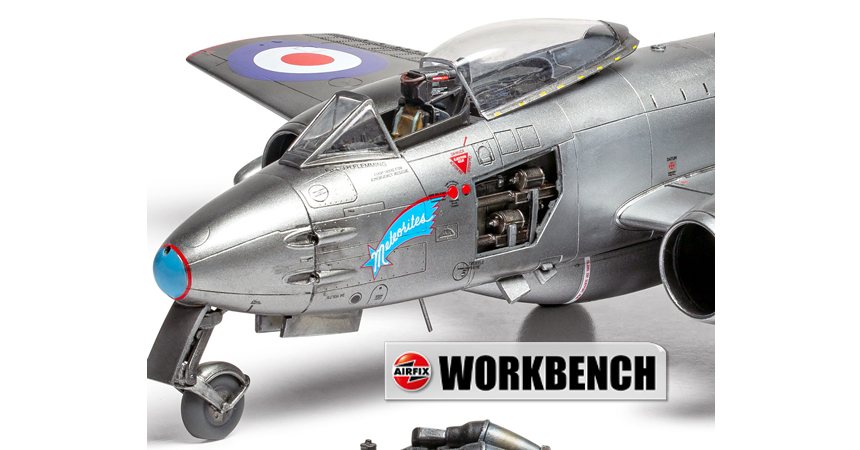
Built model closeup featuring a kit finished in the second scheme option included with this release, an aircraft which displayed with the ‘Meteorites’ of the Royal Australian Air Force.
Meteors galore – how on earth are we going to chose between these two beauties?
On days when Meteor test flights were due to take place, all other flying activities at the airfield were halted and all non-essential personnel dismissed and allowed to go home - this in itself must have seemed highly suspicious to them. Once all non-essential staff were off the airfield, the local constabulary would begin closing all surrounding roads to traffic and pedestrians alike, and at both the beginning and the end of any flight testing session, flares would be fired by the flight controller to put everyone on standby.
Wherever possible, Meteor test flying would take place on days when cloud cover was low, as this would also help to conceal the identity of the strange new aircraft from the prying eyes of unauthorised personnel, however despite all of these measures, surely many local people must have noticed the strange sight and perhaps of even greater significance, the unusual sound of an aircraft they must have believed to have been an incredible new wonder weapon. The Police would only be instructed to release their road closures once the test aircraft was safely back in its hangar, but after the first couple of times this had happened, surely the curiosity of the local population would have been aroused. I wonder if anyone sought to find local gaps in the security cordon for a little peek at what was going on?
From a historic perspective, it would be interesting to understand just how many 'unauthorised' people were aware of those secretive Meteor test flights and what they thought of this strange new aircraft which didn't appear to have any propellers. Thankfully, as a priority project, the development team received enough support to ensure they didn't have to keep their work secret for too long and following the successful completion of this first British jet test program, the new Gloster Meteor F.1 fighter was almost ready for the RAF.
Due to the many significant differences between this new jet powered aircraft and the traditional piston engine powered aircraft which equipped RAF units, the Tactical Flight was established at Farnborough in order to facilitate the transition to squadron service and eventual use by squadron pilots of the Royal Air Force. During these trials, every aspect of Meteor operation was fully explored, including any potential limitations of the new technology and subsequent tactical integration of a jet fighter into service. Incredibly, despite the fact that this represented totally new aviation technology, the Meteor's test and evaluation program was negotiated without too much difficulty and the RAF’s first jet fighter was cleared for immediate service use. In hindsight, this proved to be both premature and a little short sighted, as early Meteor operations would claim the lives of many Meteor pilots.
This beautifully detailed kit includes the option to have the aircraft’s Rolls Royce Derwent engine exposed.
As we all now know, the unit taking the honour of being the first jet powered squadron in the Royal Air Force was No.616 (South Yorkshire) Squadron (Royal Auxiliary Air Force), based at Culmhead, in Somerset, a unit which had just converted from the Spitfire Mk. VII. The scene was now set for the first jet versus jet engagement, as Meteors would now surely be pitched against the Luftwaffe's new Messerschmitt Me262, however, that fascinating gladiatorial duel of aviation technological was ultimately destined not to happen, as RAF officials were nervous about their new jet potentially falling into enemy hands.
That being the case, historians and enthusiasts alike are left to surmise what the outcome of such a jet combat meeting would have been, with both aircraft having strengths and weaknesses which on paper at least, would have made this a contest which was too close to call. Aerodynamically at least, the Messerschmitt Me 262 was the more advanced design and it could be argued that it was a more mature aircraft, even in those early days of jet power. Its guns were more reliable in operation and significantly, it was a clear 100 mph faster than the Meteor, although this was mainly down to the fact that Meteor pilots had restrictions imposed on them when it came to engine performance.
The engines may have powered the Me 262 to greater speeds than the Meteor, however, they were incredibly delicate and in many cases, needed to be change after just ten hours use or less. In addition to this, both the specialist fuel and metals the engines used were in short supply by that stage of the war, meaning that only a handful of full strength Me262 jet fighter sorties were ever mounted against Allied air forces, nowhere near enough to make a difference to Germany's dire situation.
What isn’t in question is the fact that when both aircraft were up to speed, they were both exceptionally capable aircraft and though neither could be described as an air superiority fighter, both represented the dawning of an exciting new era for aviation.
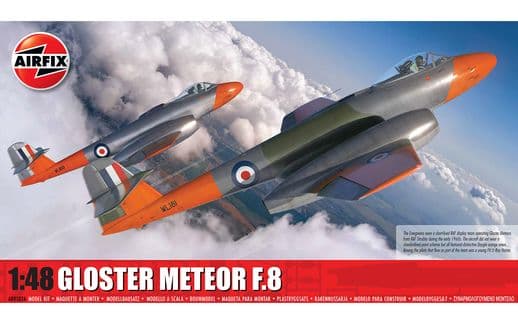
For this fourth release from the 1/48th scale Gloster Meteor tooling, our box artwork shows two of the Meteor F.8 jets of the RAF College of Air Warfare's Evergreen Display Team, practicing some formation aerobatics in the skies over Lincolnshire ... what a spectacular aviation sight.
In addition to being a significant aircraft in the history of British aviation, the Gloster Meteor also holds a particularly prominent position within the history of our Workbench blog. Can you believe that its now over eight years since news of our 1/48th scale Gloster Meteor new tooling project was announced in a Workbench blog, only the third edition of the blog ever published on the Airfix website. Since that date, the regular posting of project updates allowed us to follow the new model as it negotiated the various stages of its development, checking in on a first look at test frames produced from the new tooling, looking at the scheme options accompanying the initial release of the new kit and finally, unveiling of the ever popular box artwork, something which has always been popular with the Workbench audience.
Since that date, our design team have also introduced a newly tooled Meteor kit in 1/72nd scale, but as this update concerns that kit's big brother, we won't be discussing that particular kit further in this update.
This latest release from our 1/48th scale Gloster Meteor tooling is only the fourth release from this relatively new tooling, as we return to the F.8 variant of this famous jet fighter as our subject, a development which is described historically as the 'mature' Meteor, a variant which marked the aircraft's high point as a fighting aeroplane. When the Meteor first entered RAF service in July 1944, it wouldn’t be unfair to say that these early machines were rather primitive as combat aircraft and even though they were used operationally, there was much more to come from the Meteor.
Benefitting from almost constant development during its service life, the early marks of Meteor were all based around those first aircraft to enter service, however, the service arrival of the later F.8 variant in 1950 saw the Meteor maturing into a truly exceptional early jet, one which would not only see service with the Royal Air Force, but also with several other air arms across the world. Looking to keep pace with the latest breed of new jet fighters entering service with the major world powers, the Gloster Aircraft Company wanted to equip the Meteor with greater power and operational effectiveness, whilst at the same time keeping costs to a minimum by utilising as many of the existing F.4 tooling jigs as they could.
The Meteor F.8 featured a lengthened fuselage which gave this variant a sleeker, more cultured appearance than its predecessors, with other identifying features being the adoption of redesigned horizontal and vertical stabilisers and an impressive new high visibility ‘blown’ cockpit canopy. From the perspective of power, this new variant was mated with Rolls Royce Derwent 8 engines, with each one possessing 3,600Ibf of thrust and the Meteor with greater power and increased responsiveness.
With this new variant benefiting from additional strengthening, it allowed the F.8 variant to be the first to be equipped with ejection seats, something many pilots flying the earlier variants of the aircraft definitely wished they had had the benefit of, as those early Meteors attracted a rather poor safety record and claimed the lives of many unfortunate airmen. Offensively, this latest variant was also capable of carrying two 1000Ib bombs or sixteen unguided rocket projectiles, providing the Meteor with a welcome and rather effective ground attack capability.
The Meteor F.8 was arguably the most effective variant of Britain’s first jet fighter, and for five years following its service introduction in 1950, would form the backbone of the RAF’s fighter defence force, a jet powered equivalent of the Spitfire’s which had protected Britain’s skies during the Battle of Britain just ten years earlier. With 1,183 aircraft eventually built, the F.8 was both the final single seater fighter variant of the Meteor and the most heavily produced, arguably making this one of the most important British aircraft of the post war era.
For all the aircraft’s many positives, it also has to be acknowledged that the Meteor’s introduction was not without some challenges, and it would be forced to endure something of a troubled service record. With the adoption of new technologies, pilots had to quickly make the transition from powerful piston powered fighters to jet powered flight and whilst this offered many operational improvements, management of the jet engines proved extremely challenging for pilots, and in some instances, fatal.
Despite careful management of the transition from piston to jet power, the sluggish responsiveness of the engines to pilot power input requests during take-off and landing resulted in the Meteor gaining an unwanted reputation, with many pilots misjudging these vital phases of flight with their lives. During its Royal Air Force service, almost 900 Meteors would be lost as a result accidents, with its poor safety record resulting in pilots and ground crews giving the aircraft the rather terrifying nickname of ‘The Meatbox’.
Gloster Meteor F.8 WL181 was one of the final batch of F.8 variant Meteors produced by Armstrong Whitworth at their Baginton factory during early 1954, with serial allocations issued from WL158 to WL191. She was subsequently delivered to the Royal Air Force at No.20 MU Aston Down at the end of May the same year in preparation for service acceptance and by the summer, had joined the Station Flight at RAF Tangmere and the start of a seventeen year RAF career. In addition to spending time with No.34 Squadron, it appears this aircraft also spend quite some time in the care of various Maintenance Units across the country, although records as to why she made so many visits are hard to come by.
In March 1960, WL181 joined the aircraft assigned to the Collage of Air Warfare at RAF Manby in Lincolnshire, an important location for some of the most accomplished minds in the Royal Air Force at that time. With concurrent courses running to prepare senior service personnel for the next stage of their careers, training other pilots and navigators in the most technical and demanding areas of their craft, Manby was a location for the RAF's elite and whilst flying did take place at what was an extensive base complex, the emphasis was very much on knowledge and the best instructing the best.
With some of the RAF's most accomplished airmen spending time at Manby, it will come as no surprise to learn that the station also boasted its own aerobatic display team, 'The Evergreens' and whilst not much is known about the team and the reason for its name (was it made up of seasoned veteran pilots), it is known that Gloster Meteor WL181 was one of the aircraft assigned for their use. The team represented the College at Airshows and events around the country quite extensively between 1962 and 1964, and it's thought that three Meteors were used, each one wearing slightly different interpretations of RAF fast jet training colours of the day. One interesting fact is that renowned display pilot Ray Hanna, former leader of the Red Arrows and a man who would later be known as the world's finest Spitfire display pilot, was one of the Evergreen Display Team pilots whilst stationed at Manby.
Meteor WL181 would end her RAF career as one of the aircraft on charge with the Advanced Jet Refresher Squadron at nearby RAF Strubby, until retired to No.5 MU at Kemble in the summer of 1965. She was finally struck off charge in November 1971 and sent to RAF Acklington, where she was destined to be used as a winching load for the Westland Whirlwind helicopters of RAF No.22 Squadron.
It didn't take long before the aircraft was seen languishing on the fire dump at Acklington and with the closure of the base in 1974, her future seemed bleak to say the least. Thankfully, WL181 was purchased by the North East Air Museum before she could be scrapped and in May 1975, was dismantled to make the short journey to the museum site and a much brighter future. The aircraft is now in fine condition and lovingly cared for by the staff and volunteers at the North East Land, Sea and Air Museums, on the site of the old RAF Usworth and Sunderland Airport.
This handsome scheme option is certainly an unusual one for our 1/48th scale Meteor kit to wear and certainly begs the question, 'Could this have been one of the aircraft flown by Ray Hanna during his time with the Evergreens?'
One of the most significant features of the Gloster Meteor's aviation legacy was how this relatively simple, yet extremely capable early jet fighter allowed many smaller air arms to enter the jet age effectively and whilst not labouring on its accident rate which wasn’t good, but for a number of reasons, proved to be relatively simple to operate and maintain. Even though the Meteor was used extensively by the Royal Australian Air Force, it would be fair to say that Britain's first jet fighter wasn't their first choice of aircraft.
Although former RAF Gloster Meteor F.3 EE427 would become the first jet fighter officially brought on charge with the RAAF back in June 1946, the first jet fighters purchased and operated by the Royal Australian Air Force would actually be de Havilland Vampires in 1949. Despite this, the RAAF would soon operate the Gloster Meteor extensively, but mainly due to their significant contributions during the Korean War.
Initially entering the conflict operating ageing North American Mustang fighter bombers, the Australians were desperately looking to purchase a capable new jet fighter to upgrade their operational capabilities, with either the North American Sabre or Hawker Hunter being their preferred options. Unfortunately, neither aircraft were available at that time and indeed, only the British Gloster Meteor was available in the quantities they required, so this turned out to be something of a fait accompli. Over the course of the following few months, 93 Meteor F.8 and 4 T.7 trainers were delivered to the RAAF for service in Korea and on 29th July 1951, No.77 Squadron RAAF made history as the first Royal Australian Air Force unit to take a jet aircraft into combat.
In Australian hands, the Meteor would write a glorious chapter in its operational history. Despite being pitched against the superior dogfighting capabilities of the new Soviet MiG-15 fighter, the Meteors of No.77 Squadron RAAF made a huge contribution to the war effort, taking a heavy toll of enemy equipment and support infrastructure in the process. During three years of fighting in the Korean War, No.77 Squadron flew an astonishing 18,872 sorties, initially with their ageing North American Mustangs, before converting to the Gloster Meteor.
By the end of the war, Meteors of the Royal Australian Air Force had flown 4,836 missions, destroyed 3,700 buildings, 1,500 vehicles and numerous bridges, locomotives and railway carriages, as they became ruthlessly proficient in the role of ground attack using air launched unguided rockets. They also accounted for at least six enemy MiG-15 fighters in aerial combat, however, these achievements came at a heavy cost, as thirty-two Meteors were lost, with many of their pilots paying the ultimate price for their devotion to duty.
Once the remaining Australian Meteors returned home, pilots of the 75th Fighter Squadron at Williamstown, New South Wales quickly established an aerobatic display team both to promote base activities and those of the wider Royal Australian Air Force. Named the 'Meteorites', the team consisted of three Gloster Meteor F.8 jets which carried the serials A77-870, A77-875 and A77-882, with the team being led by accomplished pilot F/Lt J.H. Flemming. The aircraft sported smart blue tails, wingtips and nose, with a Meteorites logo also carried on either side of the aircraft's nose.
The team performed their first display at RAAF station Williamstown's Air Force week in September 1956 and over the course of a hectic few months, they would go on to perform 23 displays across this vast nation. In February the following year, it was all over - the team leader was posted to the Central Flying School as an instructor and as the RAAF were in the process of re-equipping Meteor squadrons with licence built versions of the North American Sabre, it was decided to cease team activities after their short, but glorious display career. No.75 Squadron would have the distinction of being the last unit to operate the Meteor in RAAF service.
As you might expect, the name 'Meteorites' was rather popular with teams operating the Gloster Meteor for display purposes, with instructors from the Royal Air Force Central Flying School forming their own Meteorites display team during the early 1950s. The team consisted of four two-seat T.7 training variants of the Meteor and throughout the 1952 and 1953 display seasons, they were the official display team of the Central Flying School. Team leader Flight Lieutenant C.R. Gordon had the distinction of being the flight instructor charged with training the Duke of Edinburgh.
The latest release from our 1/48th scale Gloster Meteor tooling in all its fully branded box artwork glory. The early years of jet aviation are a source of such fascination for many enthusiasts and this latest release certainly provides modellers with something just that little bit different.
Our beautiful 1/48th scale Gloster Meteor F.8 kit benefits from a pair of interesting and unusual display team livery options in which to finish your model, however this appealing kit is now on our warehouse endangered list and is only available in limited quantities. As we all start to think about our coming winter build schedule, can you think of a classier project to spend your time with than this beautiful larger scale Meteor?
We are afraid that's all we have for you in this latest edition, but we will be back next Friday with more project development updates and the very latest Airfix kit exclusives. In the meantime, we are always keen to hear your views on all things Airfix and in particular, any thoughts and opinions you may have regarding our Workbench blog. If you would like to drop us a quick line, could we please ask that you use our workbench@airfix.com email for all correspondence.
To re-visit any of the Airfix blogs we have produced over the past seven years or so, please head to our main Workbench hub, where you will find our entire blog back catalogue and all the Airfix design projects we have already covered.
All our dedicated official social media sites can be accessed by clicking the respective link icons at the foot of this page, or by heading to the Airfix homepage. Other useful Airfix links are:
Facebook, YouTube, Twitter and Instagram official sites
Please join us for more Airfix updates next week and thank you for your continued support.