
Welcome to this latest edition of our Workbench blog and all the news, updates and modelling exclusives from the fascinating world of Airfix.
The title of this latest edition of our weekly blog update may be something of a giveaway, but will nevertheless be of great interest to a huge section of the modelling community, those who have an interest in the ships of the Royal Navy and displaying scale representations of them. Although we have no intention of being responsible for sparking yet another interservice seniority debate, we will help to mark the impressive maritime heritage of the Royal Navy by looking at two soon to be released additions to our Vintage Classics range, kits which chart the post war development of the Royal Navy's surface fleet and how it evolved to meet new and technologically superior threats to naval operations. Of course, helping us to tell that story, we will be able to call on some classic Airfix box artwork which will undoubtedly bring back happy memories for many of us.
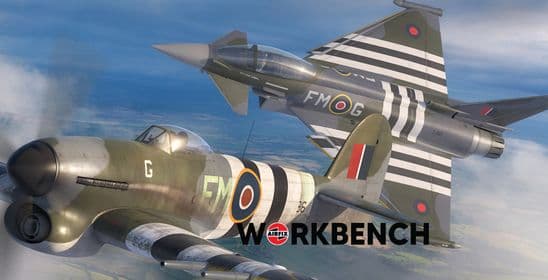
Following on from a spectacular Bank Holiday weekend of national celebration in commemoration of Her Majesty the Queen's Platinum Jubilee, we will be taking a quick look at how the current Airfix range pays tribute to one of the star acts of these celebrations and by all accounts, a particular favourite of one younger member of the Royal Family - the Red Arrows. With the Airshow season now in full swing, we will see how modellers of all ages and abilities can create their own scale tributes to Britain's famous aerial ambassadors and how in this day and age, you don't always need glue and paint in order to do so.
We will be posting this as a separate blog, so it is a little easier to find for everyone, but for now, let's just hope that our sea legs are firmly intact.
Warships have to be considered to be some of the most impressive structures produced by man and as such, have always been popular modelling subjects.
As an island nation, Britain has long depended on the sea for trade, food and supplies, whilst at the same time relying on it as a natural barrier against attack. Indeed, if this island was to come under the threat of hostile incursion or invasion, that threat would be coming from the sea and would therefore require the use of ships and as such, it is not surprising that a nation which was once fearful of shipborne attacks would learn to embrace the sea and for long periods could even be described as ruling over it.
Described as the Senior Service, the Royal Navy is traditionally the oldest branch of Britain's armed forces and can trace its establishment back to the reign of King Henry VIII, with its traditional rivalry with the Army still being the subject of some debate to this day. Military historians often agree to disagree that this service pecking order is settled by the fact that the Navy was the nation's first permanent force, with land armies being traditionally raised as and when they were required. Once that uncomfortable argument has been traversed, there can be no argument that Britain's unrivalled naval prowess enabled this small island nation to have influence far beyond its own borders, increasing both the wealth and standing of Great Britain on a global stage.
As much as a strong navy is about deterring potential enemies from challenging your position by launching the most capable fighting ships available, it is also about protecting your merchant shipping lanes, allowing the free passage of these vessels and bringing great wealth to the companies operating them. On the eve of the Great War, Britain had established a network of naval bases across the globe and could boast the most powerful navy in the world. This not only gave Britain huge influence on the world stage, but also made the Royal Navy the sea power yardstick by which all other nations would be judged and if you wanted to challenge their position, you would have to come with all guns blazing.
With formidable warships such as HMS Warrior and HMS Dreadnought introducing revolutionary technologies to naval sea power, further raising the stakes in this fascinating seaborne arms race, the Great War held the ominous prospect of the first mighty clash between large numbers of the world's most powerful warships. Whilst the Battle of Jutland did witness a ferocious clash between the British and German navies, it would ultimately be the deterrent threat posed by Britain's Home Fleet and a hugely effective naval blockade which virtually starved Germany into an inevitable armistice at the end of WWI.
Between the two world wars, naval power continued to evolve, resulting in some of the most powerful warships ever conceived patrolling the worlds sea lanes, however, despite possessing awesome destructive power, they had now also become huge targets for new threats from both above and below the waves. New kinds of smaller, highly specialised ships would be needed to protect capital ships from attack by submarines and aircraft, and as the war at sea entered a new phase, the aircraft carrier would quickly hold the balance of power in any major naval engagement.
The combination of classic Airfix kits and iconic box artwork is the reason why our Vintage Classics range is now so popular with modellers.
As the world settled into the post WWII Cold War era of relative peace but brought about by a terrifying nuclear arms race, the pace of naval advancement showed no sign of abating, even though the Royal Navy had now lost its position as the world's largest and most influential naval power. With a need to modernise, but with the country in a perpetual period of financial austerity, it was decided that the Royal Navy should benefit from the addition of a fleet of 8 guided missile destroyers, the first ships of their kind to ever see Navy service. Destroyers have a vital role to play in the defence of the fleet, being fast and manoeuvrable warships, whilst at the same time possessing impressive endurance to remain on protective station for long periods. Their role was to escort and protect larger ships of a task force or convoy from air, surface and submarine threats, a first line of defence before the larger ships could be targeted.
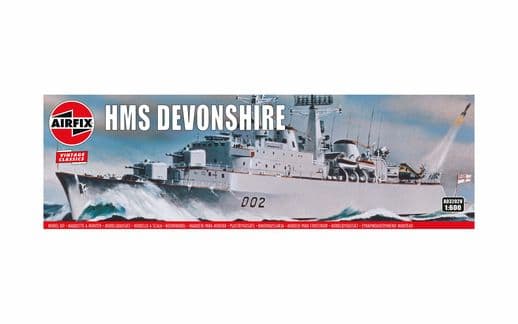
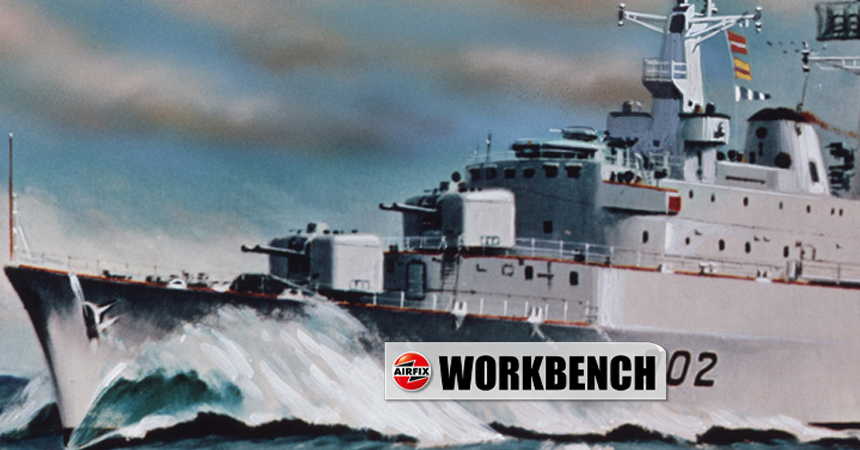
During the Second World War, Destroyers became renowned for their aggressive tactics in putting themselves between the ships in a merchant convoy and the terrifying threat posed by U-boat wolf packs, pursuing a detected U-boat until it was either destroyed, or forced to break off its attack. This new breed of County-class Destroyers would be larger than their wartime predecessors and would be bristling with the latest technology, both from a detection and offensive perspective. HMS Devonshire (D02) was the first of these new ships, launched on 10th June 1960 and delivered to the Royal Navy two years later. Although originally intended to be a fleet of 10 vessels, the order would later be reduced to 8 ships, however, their introduction would provide the Navy with a significant capability upgrade.
The County-class Destroyers were built around a new concept of equipping a warship with a guided missile system, one which was intended to target and destroy high-flying attack aircraft at great distances, well before they could launch their stand-off munitions (cruise missiles) aimed at the larger ships the destroyer was protecting. The system around which they were designed was the Seaslug, a first generation surface to air missile designed by Armstrong Whitworth - the missiles were tested at sites around the UK and later at the famous RAAF Woomera Range in South Australia.
When first introduced, it was claimed that the Seaslug was an extremely high performance weapon, one which could impressively boast a single-shot kill probability of 92 percent, figures which clearly delighted the Navy. Quite a large missile, the Seaslug incorporated 4 booster rocket motor tubes around the body of the missile which provided the initial launch boost, separating quickly following launch, leaving the main motor to power the missile onwards to the target. The missile launch system was mounted at the stern of the County-class ships on a deck lower than the helicopter landing pad, with these vessels retaining the extremely sleek profile associated with naval destroyers.
For enthusiasts of British warships, the return of our HMS Devonshire kit will be welcome news, particularly as it marks a series of ships which bristled with the latest technology, but would have a relatively short service life.
A built sample of the HMS Devonshire kit, complete with its Seaslug launcher and Wessex helicopter.
When HMS Devonshire was commissioned in 1962, she was the first of her class and would go on to be the first Royal Navy ship to fire a Seaslug missile (not including test ship firings). The first four ships were referred to as Batch 1 vessels and were equipped with the first Seaslug Mk.I system, with the final four being classified County-class Batch 2. These later ships would benefit from more capable target acquisition equipment and a second generation of Seaslug missile, which were intended to make it more accurate, but would actually post lower success probability statistics than the original missiles.
It was envisaged that the missiles would eventually be equipped with a tactical nuclear warhead and indeed several options were trialled, but never deployed operationally - this desire is very much evidenced in the design of the County-class Destroyers, as they featured operations rooms which were positioned five decks into the bowels of the ships, intended to give the command crew maximum protection in the event of the ship entering an area of nuclear fall-out. This room was connected to the bridge by a lift, should its use be required.
It was intended that HMS Devonshire would be upgraded to Batch 2 standard, however, continuing budgetary constraints dictated that this didn't happen and worse than this, the ship was scheduled for decommission much sooner than had originally been anticipated. Decommissioned in 1978, she would spend the next six years languishing in Portsmouth harbour, as a proposed sale to the Egyptian Navy seemed likely, but eventually fell through. For a ship which occupied such a significant position in the post war history of the Royal Navy, she would meet with a rather ignominious end as a target ship, sunk by HMS Splendid in the North Atlantic on 17th July 1984, only days after serving as a floating target during Sea-Eagle anti-ship missile trials.
Two County-class Destroyers would take part in the Falklands war of 1982, Antrim and Glamorgan, both of which were Batch 2 vessels. Antrim's Wessex helicopter 'Humphrey' rescued 16 SAS troops from Fortuna Glacier, with the ship also heavily involved in the detection and disabling of the Argentinian submarine Santa Fe. The Seaslug missile would only be used once in a combat situation and this was when HMS Antrim fired a missile during the Falklands War, however, it was later reported that it proved to be something of a disappointment and not one the task force could rely on in this deadly situation.
How the classic box artwork looks when applied to current Airfix product presentation.
Glamorgan was hit by a land launched Exocet missile towards the end of the conflict and whilst lives were tragically lost, the quick actions of her captain in turning the ship to face the missile, thus presenting less of a target, undoubtedly prevented those casually numbers being far greater.
Helping to preserve the relatively short lived legacy of the Royal Navy's first County-class Destroyer, our 1:600th scale model kit of HMS Devonshire was originally tooled back in 1963, just one year after the ship on which it was based entered Royal Navy service. The distinctive pack artwork was produced by renowned marine artist William Howard Jarvis in the same year and will no doubt be familiar to many Workbench readers. We are delighted to confirm that this stunning piece of Airfix nautical nostalgia is about to take its place in our Vintage Classics range and how HMS Devonshire and the County-class Destroyers are about to set sail (in model form) once again.
This Roy Cross classic has to be considered amongst his most iconic Airfix artwork and one which probably encouraged many modellers to take the plunge and take on their first warship build.
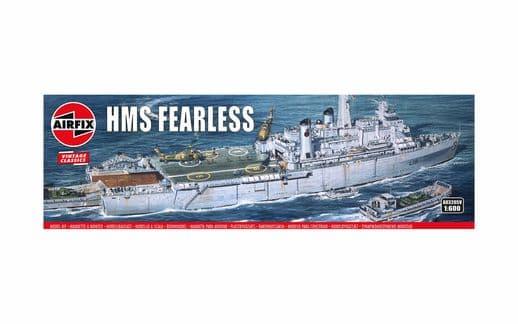
When it comes to British warships of the post war era, there are few which come close to matching the service record and public recognition earned by HMS Fearless, a vessel which represented Britain both militarily and in a humanitarian capacity for 37 years. Its position of naval prominence brought Fearless to the attention not only of the wider British public, but also the modellers amongst us, as she was incorporated into the Airfix kit range in 1968 and for many of us, will always be remembered by the beautiful box artwork this kit featured, produced by the famous hand of that Airfix legend, Mr Roy Cross. What made this particular kit all the more appealing was its working features, something which really did capture the imagination of a young modeller in the 1970s, possibly even encouraging them to tackle their first ship build.
HMS Fearless was to be the first purpose built Amphibious Assault Ship for the Royal Navy, the first of two such vessels which were intended to provide the Navy with highly effective assets for service in a modern world. Referred to in naval terms as an LPD (Landing Platform Dock), she was a modern development of the vessels which proved so crucial during the D-Day landings towards the end of the Second World War. The first purpose built ship of her type to be used by the Royal Navy, Fearless would also have the distinction of being the last steam powered surface ship in service with the force.
Fearless and her sister ship HMS Intrepid (launched the year after) provided Britain and the Royal Navy with an incredibly flexible and highly mobile assault force, able to replenish at sea and therefore capable of steaming to military hotspots anywhere in the world. Her internal vehicle decks could carry 400 troops and their equipment, in addition to up to fifteen Challenger tanks, but this could be increased to 700 troops if tanks were not carried. The stern of the ship could be submerged by flooding the ship's ballast tanks to allow the operation of four LCU landing craft, delivering troops and vehicles to the landing beaches quickly and effectively, immediately returning to reinforce the beachhead with more troops. A large flight deck increased the effectiveness of the ship still further, with helicopters usually up to the size of a Sea King further enhancing the flexibility of the ship’s delivery and offensive capabilities.
Painting instructions included with the Vintage Classics re-issue of HMS Fearless.
During the Falklands War, HMS Fearless played a significant role as part of the British Naval Task Force, acting as the amphibious force command ship for the operation, utilising her modern satellite communications equipment to coordinate Britain's response to this invasion. During the air operations, Fearless' Bofors guns would claim at least two Argentine Air Force/Navy attack aircraft destroyed during the conflict and following the surrender of Argentine forces on the Islands, Fearless would play host to a number of high ranking Argentine Army officers, underlining the importance of her role.
In a notable service career which spanned more than 35 years, when HMS Fearless was not representing the Royal Navy on a global stage, she might even be found rescuing James Bond and Anya Amasova in their escape pod from the ocean around Malta, at the end of the movie ‘The spy who loved me’, underlining her status as one of the navy's most versatile and instantly recognisable ships.
She would be out of commission for three years from 1985 as she underwent a significant refit, where much of her equipment, particularly her defensive armament, was upgraded. From 1991, she provided invaluable support in the sea training of future naval officers, as she was the vessel where they would learn what was required if they were to command a ship at sea, but all the time ready to answered the operational call, should an emergency deployment be required. Even when she was eventually decommissioned in 2002, HMS Fearless would continue to make the headlines, as she became the first Western warship to be disposed of in an environmentally responsible manner. There is no doubting the HMS Fearless certainly left her mark in the annals of Royal Navy history.
Our HMS Fearless kit wearing its current Airfix box presentation.
Providing a welcome dual Royal Naval addition to the Vintage Classics range, both our HMS Devonshire and HMS Fearless kits are due to arrive in our warehouse next month and whether you intend to rekindle pleasant memories of building these classic kits during your formative modelling years, or tackling them for the first time, the experience will be filled with Airfix nostalgia, even if just by admiring the stunning 1960s produced box artwork which graces both releases. One of the traditional benefits of being an Airfix modeller has been the sheer diversity of kit subjects on offer to us and although ships may not be your usual modelling subject of choice, these behemoths of the oceans always provided an enjoyable modelling diversification.
That’s all we have for you in this latest edition, but we will be back with more project updates for you next week. As always, we are interested to hear your views on all things Airfix and particularly in relation to our Workbench blog, so if you ever feel like dropping us a quick line, please use our workbench@airfix.com contact e-mail address.
All our social media sites can be accessed by clicking the respective link icons at the foot of this page, or by heading to the Airfix homepage. Other useful links are:
Please join us for more Airfix updates next week and thank you for your continued support.