Welcome to this latest edition of our Workbench blog and all the news, updates, and modelling exclusives from the fascinating world of Airfix.
In maintaining our time-honoured tradition of following all the latest Airfix model kits from announcement through to release, recent developments have meant that we have our work cut out this week, as we find ourselves with no fewer than three new kit releases to report on and welcome to the 2024 range. The common theme throughout all three though is our newly tooled 1/72nd scale Messerschmitt Bf 109F, a variant of this famous fighter which is thought by many aviation enthusiasts to be the purest fighter version of the Bf 109 series and unquestionably the most attractive. Just like the Spitfire, the Bf 109 was continually developed throughout the Second World War, usually in conjunction with the latest version of the Daimler Benz engine which powered the fighter, but always with the intention of making it even more effective in the combat arena. With the Bf 109 series usually being known for their angular appearance or exhibiting lumps and bulges where additional equipment needed to be attached, the ‘Freidrich’ is unquestionably the most cultured variant of the fighter.
As we embark on something of a Messerschmittfest this week, we will not only be looking at the beautiful new Messerschmitt Bf 109F-4 Starter Set which has just been released, but we will also be looking at the two other kits which feature this newly tooled kit, both of which are presented in our popular Dogfight Doubles series. In addition to both kits featuring poly cement, brushes and a selection of paints, both also feature examples of Allied fighters the Bf 109F may have encountered in aerial combat, because we knew we had to give modellers something for their new Messerschmitts to chase. You can also look forward to box artwork images in all their glory and scheme details behind all five of the kits these releases include.
One of the most famous fighting aeroplanes in the history of aerial warfare, or our scale representation of it, is the subject of this week’s bumper edition of Workbench.
Whilst the Battle of Britain was raging, the Luftwaffe were preparing to introduce the next major variant of their feared Messerschmitt Bf 109 fighter.
Even whilst the savage dogfights were still taking place between the Luftwaffe and RAF Fighter Command in the skies above southern England during the summer of 1940, design technicians at Messerschmitt were already at the advanced stages of developing an even more capable version of their much feared fighter. Having sought the input of fighter pilots who had served throughout the Polish campaign and onward to the Luftwaffe’s strike west, Messerschmitt designers embarked on a major project to develop a new, even more capable variant of the Bf 109 in early 1940 and by the end of that year, pre-production examples of the new fighter were already taking to the air. Powered by the latest 1175hp Daimler Benz DB601E engine, the Bf 109F ‘Friedrich’ also introduced a host of other improvements and design changes which were to give this variant not only a combat advantage, but also a very different appearance.
Featuring a lengthened, more streamlined cowling to house the new engine, this was a much more refined design than its angular predecessor and with its much larger spinner, shorted propeller blades and retractable tail wheel, this new variant had the appearance of more cultured Messerschmitt in every respect. The wings would also be the subject of redesign, with wing armament deleted completely on the new model to increase the strength of the wings and the square wing tip design of the ‘Emil’ replaced by rounded tips on the ‘Friedrich’. Fast, highly manoeuvrable and hard-hitting, the Bf 109F was a lightweight fighter pilot’s aeroplane and the Luftwaffe’s airmen loved them. More than a match for the latest variant of Spitfire, the Bf 109F would become the mount of aces, a true dogfighting aeroplane in every sense of the word.
The Friedrich would join combat units from spring 1941 and would go on to see extensive service on both the Western and Eastern Fronts, in addition to serving above the deserts of North Africa, and a great many pilots would use this aircraft to build impressive victory tallies. In North Africa, celebrated ace pilot Hans Joachim Marseille used the ‘Friedrich’ to achieve the majority of his 158 aerial victories and it was claimed that he was so attached to the fighting qualities of his Bf 109F fighter, that he flatly refused to upgrade to the latest ‘G’ variant when they became available, until directly ordered to do so by his superiors.
A trio of built model images all featuring our recently released Messerschmitt Bf 109F Starter Set kit, resplendent in the scheme of a fighter flown by Staffelkapitän Oberleutnant Wolf-Dietrich Huy.
Marseille felt that as a dogfighting aircraft, the new Gustav was too heavy and less manoeuvrable than the current variant of the fighter he had been using to such devastating effect in North Africa, both factors which he thought would remove his combat advantage. There were also reports that the latest Daimler Benz DB605 engine which powered the new G variant was prone to reliability issues and overheating, additional factors which didn’t appeal to the ‘Star of Afrika’.
The only aspect of the Messerschmitt Bf 109F’s design pilots wished could be further improved was its lack of firepower, even though they realized that the subsequent increase in combat weight would adversely affect the aircraft’s almost legendary manoeuvrability. Unfortunately for the Luftwaffe, the war was evolving at quite a rate by this stage and with USAAF bombers regularly attacking targets deep into Germany and in large numbers, the Luftwaffe needed an even more powerful fighter, one which could operate at higher altitudes and was able to bring much greater firepower to bear against the bombers. That aircraft would be the Bf 109G ‘Gustav’ which replaced the Friedrich.
This most manoeuvrable of all the Messerschmitt Bf 109 series of fighters would be forced to give way to a more ‘universal’ variant, one which may well have been more powerful in every respect, but one which was also significantly heavier than its agile predecessor. Although the ‘Gustav’ would become by far the most heavily produced variant of the Messerschmitt Bf 109 series of fighters, the most cultured, the most manoeuvrable and the best dogfighting variant of this famous fighting aeroplane was unquestionably the Bf 109F ‘Friedrich’.
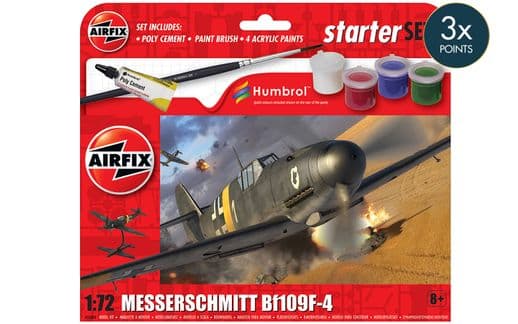
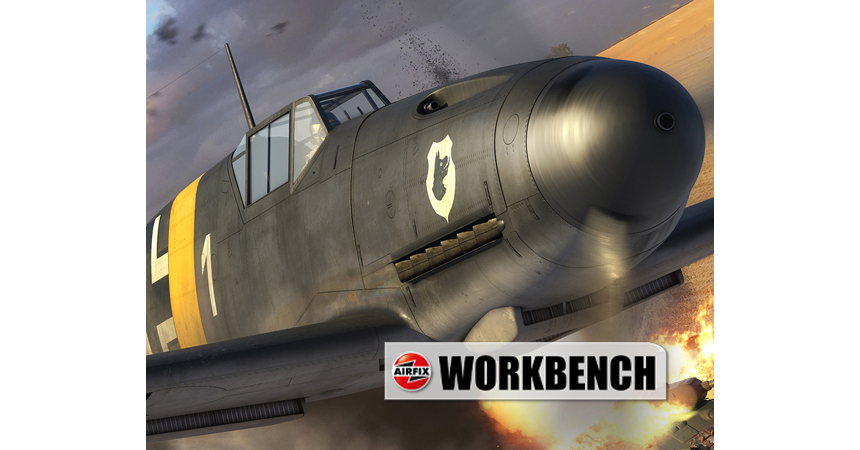
Smart new box artwork accompanies the release of this impressive new addition to the Starter Set range.
Despite the fact that the Bf 109F is regarded by many as the most attractive variant of this most famous fighter and significantly, also regarded by some of the Luftwaffe’s most successful aces as the best dogfighting variant of the aircraft, the modelling world has not exactly been spoilt for choice when it comes to kit options over the years. Particularly in 1/72nd scale, the angular and purposeful ‘Emil’ variant which contested the Battle of Britain has been extensively covered by model manufacturers, as has the ‘Gustav’ which proved to be the most heavily produced variant of the fighter, but from a modelling perspective, the ‘Friedrich’ has remained relatively anonymous.
Thankfully, the recent release of our newly tooled Messerschmitt Bf 109F Starter Set has addressed that situation in some style and modellers will now have the opportunity to add this most attractive variant of the Bf 109 fighter series to their built model displays, not to mention some really appealing scheme options to consider. With a particularly sinister looking scheme accompanying the initial release from this new tooling, let’s take a look at the details behind this scheme now.
Wolf-Dietrich Huy joined an aggressively expanding Luftwaffe in July 1939 and despite showing himself to be a particularly accomplished fighter pilot, didn’t achieve his first aerial victory until 31st May 1940, when he shot down an RAF Spitfire over the beaches of Dunkirk. In a move which was a reflection of the regard in which he was held, Huy was appointed Staffelkapitän of the newly created 7./JG77 (7th Squadron of Fighter Wing 77) in August 1940. This unit would mainly be tasked with flying ground support missions for troops fighting in southern Europe, meaning they became as proficient at bombing and strafing as they were in aerial combat.
Although Huy had earned a reputation as a confident fighter pilot, he would also develop a particular proficiency for attacking Allied shipping in the Mediterranean, flying his distinctive Messerschmitt Bf 109F-4 ‘White 1’. He would use this aircraft to lead an attack against British shipping on 22nd May 1941, including a concerted attack against the Battleship Warspite and close inspection of the rudder of Huy’s Messerschmitt provides clear indication of his successes in an anti-shipping role.
Following his maritime successes in the Mediterranean, Huy and the rest of JG77 were withdrawn for a period of re-establishment and rest, prior to their involvement in the coming invasion of the Soviet Union. Combat operations in the East would see Huy increase his victory tally significantly, even though he wouldn’t have everything his own way. With many a Soviet aircraft falling to the guns of his Messerschmitt, the tables were turned on 23rd January 1942, when his aircraft sustained damage following combat with a Soviet P-39 Airacobra and he was forced to crash land his aircraft, luckily without suffering injury.
Although this is a relatively simple scheme, it really does suit the sinister appearance of this most famous fighting aeroplane.
During the Soviet offensive to relieve Sevastopol, Huy would claim his own 38th aerial victory, but significantly, also the 600th victory for JG77, an achievement which would earn him the Knight’s Cross of the Iron Cross with Oak Leaves, an award he received from the Führer himself.
With the war in North Africa turning significantly in favour of British and Commonwealth forces, JG77 were withdrawn from the Eastern Front and selected to relieve JG27, who were exhausted following months of fighting in desert skies. On 28th October 1942, Huy would claim his 40th and final aerial victory, when he shot down an RAF Spitfire over El Alamein in an engagement which saw heavy fighting with the Desert Air Force. The following day, Huy would find himself the victim of an RAF Spitfire and whilst he was able to successfully bale out of his stricken Bf 109G-2 fighter, he was taken prisoner by British troops and would spend the rest of the war as a POW.
Huy would score 37 of his aerial victories whilst flying combat operations over the Eastern Front and would amass more than 500 combat sorties during his service career. He would survive the war and go on to live a long life, making his final sortie at the grand old age of 85.
The scheme presented with this Messerschmitt Bf 109F-4 may be a relatively simple one for a Bf 109, however, it really does suit the reputation and sinister appearance of this most cultured variant of Germany’s famous fighter. It’s also one of the more unusual schemes to be found on a Luftwaffe Bf 109 from the Second World War.
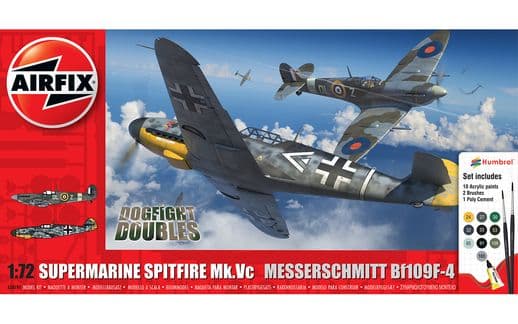
A thrilling air combat image graces the box top of this latest Dogfight Doubles release, a kit which pitches the new Messerschmitt Bf 109F-4 tooling against the Spitfire Vc.
From the perspective of aviation history, perhaps the most enduring story relating to the air war during the Second World War was the long running struggle between the Spitfire of the Royal Air Force and the Messerschmitt Bf 109 of the Luftwaffe. Because both aircraft were closely matched and pitched against each other during what was arguably the most famous aerial engagement of the war, many people consider the contest between these two famous aircraft as the most significant in the history of warfare. Whilst this duel is undoubtedly a fascinating one and Spitfire pilots could indeed come into contact with Messerschmitt Bf 109s right through to the final days of WWII, the aircraft in service at that time were very different to the ones which contested the Battle of Britain in 1940.
As two of the most effective fighter aircraft in the history of flight, perhaps the most impressive feature of both the Spitfire and the Bf 109 was how the basic design of these aircraft was capable of supporting almost constant development, something which allowed their respective design teams to upgrade their aircraft to maintain their combat effectiveness throughout the war. In fact, this ability created a fascinating development race which saw both the Spitfire and Messerschmitt Bf 109 constantly vying for supremacy over the other, and even though the rest of the aviation world was also advancing at the same time, the contest between these two old adversaries proved to be the one which captured the world’s imagination.
When the new and improved Messerschmitt Bf 109 ‘Friedrich’ was introduced, it gave the Luftwaffe an edge against the Spitfire Mk.I and Mk.II variants of the fighter in service at that time, however, Supermarine had not been idle and they were working on their own new variant of Spitfire. The first Bf 109F fighters started to appear towards the end of 1940 and certainly gave the Luftwaffe a combat edge, albeit a modest one. The introduction of the Spitfire Mk.V did bring the two aircraft much closer together performance wise, with the Spitfire proving better in some combat scenarios, whilst the Messerschmitt still had the edge in others and indeed, as a small and incredibly lightweight fighter, in the hands of a skilled pilot, the Bf 109F would remain competitive against most Allied fighters throughout the Second World War.
The Bf 109 ‘Friedrich’ would become the primary Luftwaffe fighter throughout 1941 and into early 1942 and with the upgraded F-4 variant, retained a modest combat edge over the Spitfire, particularly when it came to the aircraft’s impressive rate of climb. By this time however, the Messerschmitt would have a new partner in crime in the shape of the fearsome Focke Wulf FW 190 and Spitfire pilots were in for double trouble.
As Robert Wardlow Oxspring's father was a decorated airman during the Great War, it seemed fitting that the gathering clouds of war in the late 1930s encouraged him to follow in his footsteps and having safely negotiated his RAF basic training, was later posted to No.66 Squadron at Duxford in December 1938. He was still serving with the unit at the start of the Battle of Britain and with his well-honed flying abilities, would score some notable successes during this aerial struggle, claiming at least eight Luftwaffe aircraft destroyed and a further six either damaged or shared destroyed. He would himself be shot down by Messerschmitt Bf 109 fighters over Tonbridge Wells on 25th October 1940 and whilst his fighter was destroyed, he managed to safely bale out, if sustaining slight injuries in the process.
Following a period of recouperation and time serving in an instructional role, Oxspring returned to operational flying as Commander of No.91 (Nigeria) Squadron at Hawkinge, where his personal Spitfire AB216 was one of the most distinctive of the unit's aircraft. The Squadron benefitted from the significant fund raising efforts made by the people of Nigeria and several of the Squadron's Spitfires proudly took the name of the nation into combat with them. The aircraft flown by Squadron Leader Robert Wardlow Oxspring carried the Nigeria name, in addition to that of Oyo Province, presumably one of the regions which proved particularly generous in contributing towards buying Royal Air Force Spitfires.
Going on to serve successfully with several squadrons throughout the rest of WWII, Oxspring would survive the war with an impressive 21 aerial victories to his name, 4 V1 Doodlebug victories and many other combat sorites which produced damaged and 'probables' claims.
Full scheme details for the RAF No.91 Squadron Supermarine Spitfire Mk.Vc
Supermarine Spitfire Vc AB216 made its first flight on 23rd December 1941 and was later delivered to No.91 Squadron, where she would wear the codes DL-Z, becoming the personal aircraft of Squadron Leader Robert Wardlow Oxspring. It would also be the subject of several official publicity photographs at the time, with six of the Squadron's aircraft suitably spruced up and placed in a neat line for the benefit of the camera, with each aircraft's pilot standing in front of his mount, as if about to be subjected to inspection. These pictures clearly show the markings Nigeria - Oyo Province carried on the front port fuselage of Oxspring's aircraft, just ahead of the windscreen.
Interestingly, although this Spitfire remained with No.91 Squadron until June 1943, it would later be used in rather unusual trials to assess whether Spitfires could be used to tow Hotspur gliders laden with men and supplies destined for forward operating airfields in the wake of D-Day. The aircraft was fitted with a tail hook and used as part of the Hasty-Hitch program and whilst there are reports of Spitfires successfully towing gliders over short distances, it's not known if any photographic evidence of this unusual practice survives.
Spitfire AB216 would suffer an inflight engine fire in early 1945 and was forced to make an emergency belly landing in a field near Sleap in Shropshire and whilst the pilot managed to walk away from the incident unscathed, the Spitfire was struck off charge.
One of the reasons why the Luftwaffe were able to boast so many high scoring air aces in WWII was the fact that certainly following the end of the Battle of Britain, they didn’t have the luxury of rotating pilots in the same way Allied air forces often did. This meant that even if they were exhausted from the constant fighting, after just a relatively short period of rest and recuperation, it was straight back into the action for them. Also, as Allied air forces only continued to increase the number of aircraft they could call upon, the Luftwaffe never had any shortage of targets with which to increase their scores, even if they were now the hunted as opposed to the hunters.
One of the Luftwaffe’s most successful early aces, Hans ‘Assi’ Hahn volunteered for military service in 1934 and after a period spent in the army, soon transferred to the Luftwaffe by late 1935. Having successfully completed his training, he was initially posted to a fighter unit, but due to his exceptional flying ability, was later transferred to a flight instructor role, as the Luftwaffe were expanding at some pace and new pilots needed to be trained.
With a desire to fly combat operations, Hahn was transferred to Jagdgeschwader 2 ‘Richthofen’ in October 1939 and he would go on to score his first aerial victory during the Battle of France, when he downed an RAF Hawker Hurricane. By the end of operations in France, Hahn has achieved ‘Ace’ status and with the rest of his unit, was looking forward to the combat operations over England to come.
As a confident pilot, Hahn decided to paint his personal rooster’s head emblem on his aircraft as soon as he was in a position to do so, a tradition he would continue throughout the rest of the war – apparently, Hahn means rooster in German.
One of the most famous aircraft if the air war in the west, Hans ‘Assi’ Hahn would claim an impressive 53 victories against RAF Spitfires.
During the Battle of Britain, Hahn would continue to score victories and as his score increased steadily, so the awards and promotions followed. After he had claimed his 20th victory, he was awarded the Knight’s Cross of the Iron Cross and promoted to Group Commander, but following the Battle of Britain, Hahn and the rest of JG2 settled into a new routine, as the RAF went on the offensive in Northern France and they attempted to repel them. By August 1941, Hahn’s victory score had risen to 41 and he was regarded as one of the Luftwaffe’s leading fighter aces.
Hahn would post a particularly impressive combat performance on 6th May 1942, when he managed to claim five Spitfires, giving him the coveted title of ‘Ace in a Day’. It was claimed that as he was attempting to shoot down a sixth aircraft that day, both he and his opponent ran out of ammunition at the same time, with both acknowledging the other and saluting before heading off back to their respective bases to fight another day. These victories took Hahn’s score to an impressive 65 aircraft destroyed.
On 16th September 1942, Hahn would claim yet another Spitfire to record his 66th victory, however, this would be his final victory over the Western Front, as he was soon transferred to the Eastern Front and a new selection of targets. Significantly, of the 66 victories claimed over the west, 53 of these would be against Spitfires and as a consequence, Hahn would be regarded as something of a Spitfire expert.
Appointed Gruppenkommandeur of II./JG54 ‘Grünherz’ for his transfer to the Eastern Front, Hahn would be operating over the Leningrad sector from November 1942 and in the first three months of his deployment, he would be credited with a further 42 victories. He was to score his landmark 100th aerial victory on 26th January 1943, when he became the 34th Luftwaffe pilot to achieve this figure.
Duel of Eagles. Can their possible be a more appropriate pairing to represent the air battles of the Second World War than the Spitfire and Messerschmitt?
The following month, Hahn scored his 108th victory when he brought down a Soviet Lavochkin fighter, but during this combat, his own aircraft sustained damage. With the aircraft flying erratically and the engine overheating, Hahn had no other option but to put his fighter down behind Soviet lines and whilst he escaped the incident without sustaining injury, he was quickly captured by enemy troops and spent the rest of the war in captivity. In fact, he wouldn’t be released until 1950, so had plenty of time to reflect on the Allied airmen he had downed.
As a fighter ace with over 100 victories to his name, we can only surmise what his total might have been, had he continued flying combat operations for the remainder of the war, but irrespective of this, Hahn must still be regarded as something of a Spitfire ‘experten’.
The model scheme presented here is typical of a Luftwaffe fighter operating on the Channel Front in the weeks and months which followed the end of the Battle of Britain. Looking at it, it could be argued that these markings are some of the most effective to have appeared on any fighter type during the Second World War – it just looks like a hunting aeroplane. Featuring victory markings applied to the rudder and his rooster’s head on either side of the fighter’s forward fuselage, this is a fine representation of one of Hans Hahn’s fighters, one which helped him to take a heavy toll of RAF Spitfires.
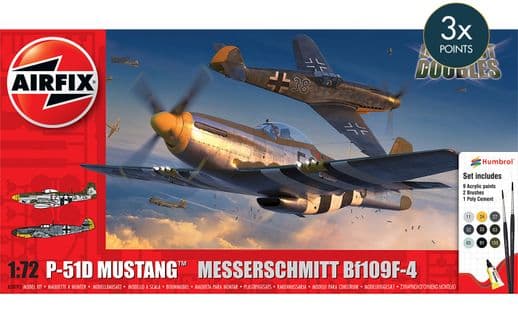
By the time the P-51D Mustang was in widespread service, the Messerschmitt Bf 109F-4 was mainly used by fighter training units, however, these would often be required to undertake combat operations and in the hands of an experienced pilot, was still a match for America’s famous Mustang.
Despite the much vaunted reputation of the Messerschmitt Bf 109 series of fighters, by the time the USAAF had introduced the magnificent North American P-51 Mustang, particularly in its ‘D’ variant, the Luftwaffe was very much on the decline. Perhaps more than this, a shortage of fuel and pilots ensured that the overwhelming numerical superiority enjoyed by the Allies was having an ever increasing adverse impact on Luftwaffe operations, be that combat operations, or simply the training of new replacement pilots.
Even if they were able to get aircraft into the air, they were rarely in numbers likely to cause the Allies much concern and with Allied fighters released to go hunting for the Luftwaffe, at no time could any German fighter pilot ever relax whilst in the air. This must have been a frightening situation, because piloting a high performance fighting aeroplane was challenging enough by itself, without having the firepower of the Allied air forces potentially raining down upon you at any moment. The threat Allied fighters posed began from the second a pilot taxied their aircraft out on their home airfield, to the moment they climbed out of the cockpit at the end of the mission.
From an operational perspective, as the Bf 109F had been replaced by the much more numerous ‘Gustav’ by 1944, Mustang pilots could come across the ‘Friedrich’ during combat operations, however, these were likely to be aircraft operated by one of the flight training units and as such, they would either be flown by novice pilots, or incredibly experienced veterans. On its day and if flown by a competent pilot, the Messerschmitt Bf 109F could still prove a difficult adversary, irrespective of the Allied aircraft they were facing.
When he arrived in England during the summer of 1944, fighter pilot Urban Drew had already had something of an ‘eventful’ time in the USAAF and things weren’t about to change now he was in Europe. With a reputation as something of a prankster and someone who didn’t care much for authority, Drew attracted the attention of his new commander almost as soon as he arrived with the 375th Fighter Squadron at Bottisham airfield in England.
Having enjoyed a rather enthusiastic night out with fellow pilot and his long time partner in crime Bill Kemp the day before, Drew surfaced from his quarters later than his fellow pilots, only to be met outside by his commanding officer Colonel Thomas Jonathan Jackson Christian Jr who was looking less than pleased. He shouted at Drew, ‘Get your gear, were taking off soon!’
What Drew had inadvertently stumbled into was arguably one of the most famous aircraft photoshoots of the Second World War, a series of colour images featuring four of Bottisham’s Mustangs taken in beautiful clear blue skies, a publicity stunt to mark the continued successes of USAAF units in Europe.
In the skies above Bottisham airfield on the 26th July 1944, four Mustang fighters of the 375th Fighter Squadron/ 361st Fighter Group formed up on the starboard side of a Boeing B-17 Flying Fortress camera ship, to be the stars in a series of colour images which would go on to become some of the most widely published images of the air war, pictures which would become synonymous with USAAF operations in Europe during WWII. The images featured four yellow nosed Mustang fighters of the 361st FG, with these pictures going on to be known as ‘The Bottisham Four’. Each of the Mustangs were fitted with long range fuel tanks and appear to be embarking on their latest bomber escort mission deep into Germany, rather than just performing a staged publicity photoshoot.
Interestingly, the Mustangs in the formation represented several different variants of the Mustang in service at that time, with one razorback P-51B, two early P-51D fighters without the dorsal fin fillet extension fitted and one with the latest tail modification addition. The lead aircraft, but the one appearing second from the camera in these famous pictures was 44-13410/E2-C, the personal mount of Group Commander Col. Thomas JJ Christian Jr, a highly decorated aviator and national hero – his Mustang is thought to be one of the most famous and heavily photographed Mustangs of the Second World War.
Full scheme details of this most famous P-51D Mustang, one of the much published ‘Bottisham Four’.
Although outclassed by the middle of 1944, the Bf 109F-4 could still give an extremely good account of itself in a combat scenario, particularly if flown by an expert pilot.
The aircraft flying closest to the camera during the ‘Bottisham Four’ photo sortie and the only one of the Mustangs sporting the tail fillet extension was 44-13926/E2-S, or ‘Easy 2 Sugar’, as she was known to base personnel, with this aircraft being flown by Urban Drew on the day. This aircraft was actually assigned to another pilot, but was being flown by Drew on the photoshoot sortie because he was actually on a rest day and his usual aircraft, E2-D ‘Detroit Miss’ was being used by another pilot.
Highlighting the savage nature of air combat operations in the European Theatre during WWII, none of these aircraft would survive the war and indeed three would be destroyed within 7 weeks of these famous ‘Bottisham Four’ pictures being taken, with two of the pilots tragically being lost. Col Thomas JJ Christian Jr. would be killed whilst flying his famous Mustang ‘LOU IV’ on 12th August 1944, on a mission to support a large 8th Air Force raid against targets in northern and central France.
Urban Drew would continue making a name for himself, claiming his first ground victory on his very first combat mission and being one of the first Allied pilots to achieve a solo victory against a Messerschmitt Me262 jet fighter – most previous victories had been accredited as shared by several pilots. Indeed, he would score a double 262 jet victory on 7th October 1944, when he caught two aircraft attempting to take off from their home airfield at Achmer.
Seemingly always intent on making a name for himself, Drew also shared in the destruction of the largest aircraft in the world at that time, when he noticed a Blohm & Voss BV238 flying boat on the surface of Lake Schaal when flying home on 18th September 1944 at the end of an escort mission. With three Mustangs flying line abreast, they gave the mighty aircraft everything they had, leaving it burning on the lake. So, Urban Drew would ultimately have victories against the largest, and the fastest aircraft of the Second World War to his name.
Scheme B – Messerschmitt Bf 109F-4 ‘Blue 38’, 4./Jagdgruppe Ost, Weidengut Airfield, Germany, 1944.
By the time large numbers of USAAF Mustangs were regularly escorting bombers to their targets deep into Germany, the Luftwaffe was on the verge of ceasing to be a viable combat force. Yes, they could still muster significant numbers on any given day and claim multiple victories against the Allies, but those days were now few and far between and even if they did bring down enemy aircraft, they would invariably lose some of their own number as well, losses which they were unlikely to replace.
The established Jagdgruppe or training school network may have been under severe pressure during the second half of WWII, but the system of rotating experienced ‘expert’ pilots through the schools would at least prepare new pilots for operational flying, if only by listening intently to the stories being told by their battle hardened instructors. Unfortunately for them, by the end of 1943, the Luftwaffe had lost the vast majority of the ace pilots they had started the war with and it has been estimated that during the first six months of that year, they lost more than 1,100 fighter pilots, a figure which represented about 60% of their strength at the start of that year.
Further highlighting their growing plight, of the 100 plus Aces credited with scoring over 100 victories during WWII, just eight of them began their combat flying careers after 1942. As experienced pilots were needed to defend their homeland from incessant Allied bomber attacks, the quality of training new pilots could hope to receive began to slip dramatically and as a consequence, so losses from accidents also increased. There didn’t appear to be a shortage of new fighters available for flight operations, however, a perpetual shortage of fuel and the continual degradation of the new pilot training program meant that the air war in Europe was only going in one direction, and it wasn’t a good one for Luftwaffe pilots.
From early 1944 onwards, the flight training a new Luftwaffe pilot recruit could hope to receive wasn’t great and was getting worse. Not only was there a severe shortage of experienced instructors, but Luftwaffe high command issued directives to continually shorten the time student pilots spent in training, first to 160 flight hours, then down to 112 hours. Just prior to the D-Day landings, newly qualified pilots were sent straight to front line units after only completing their basic training and in some cases, young pilots were reporting for combat flying having spent just 15 hours in the air – the Luftwaffe were effectively sending their young men to their deaths.
Full scheme details of the Bf 109F-4 which was operated in a Fighter Training School role towards the end of the war.
This beautifully unusual scheme option presents a late war Messerschmitt Bf 109F-4 which flew with one of the fighter training units attempting to prepare fledgling fighter pilots to face the overwhelming strength of the Allied Air Forces. The main purpose of the unit this aircraft flew with was to prepare young pilots for service with units on the Eastern Front and would usually involve the input of instructors who had extensive combat experience in that theatre of operations.
The airfield at Weidengut appeared to be an ideal location for the training of new fighter pilots, as it was remote enough a location and far enough into German held territory that flight operations could usually take place without attracting the attentions of Allied aircraft. Unfortunately, as the war progressed, nowhere proved to be safe and students ran the very real risk of coming under attack whilst on their latest training flight – these training aircraft might also be required to fly combat operations on occasion, so desperate was the plight of the Luftwaffe at that time.
The airfield was used by Jagdgruppe Ost until November 1944, when the airfield was taken over by combat units hoping to stem the inexorable tide of advancing Soviet forces to the east.
As discussed earlier in this review, modellers haven’t been particularly well served when it comes to the choice of available kits if you were looking to build a scale example of the Bf 109F variant of Messerschmitt’s famous fighter, but happily, that situation has changed over the past few days. Delighted to be welcoming our new Bf 109F-4 Starter Set to the range this week, just like buses, when we’ve been waiting so long for a ‘Friedrich’, multiple Messerschmitt kits turn up at the same time. Keeping the individual Starter Set kit company, both of the Dogfight Double sets featured in this latest update are also now available, meaning that we currently have THREE Messerschmitt Bf 109F-4 kits to choose from, two of which come with examples of their famous aerial adversaries in the same box.
To take a closer look at any of the new kits, please use these Starter Set and Dogfight Double links to be taken straight to the relevant section of the Airfix website.
A trio of new Messerschmitt Bf 109F-4 box artwork delights, starting with the new standalone Starter Set Kit and followed by the Spitfire versus Messerschmitt Dogfight Double set and finally the Mustang versus Messerschmitt Dogfight Doubles set. If we’ve been waiting for a model kit of a Messerschmitt Bf 109F variant, we’re certainly spoilt for choice this weekend.
We are afraid that's all we have for you in this latest edition, but we will be back next Friday with more project development updates and the very latest Airfix kit exclusives. In the meantime, we are always keen to hear your views on all things Airfix and in particular, any thoughts and opinions you may have regarding our Workbench blog. If you would like to drop us a quick line, could we please ask that you use our workbench@airfix.com email for all correspondence.
To re-visit any of the Airfix blogs we have produced over the past seven years or so, please head to our main Workbench hub, where you will find our entire blog back catalogue and all the Airfix design projects we have already covered.
All our dedicated official social media sites can be accessed by clicking the respective link icons at the foot of this page, or by heading to the Airfix homepage. Other useful Airfix links are:
Facebook, YouTube, Twitter and Instagram official sites
Please join us for more Airfix updates next week and thank you for your continued support.