
Welcome to this latest edition of our Workbench blog and all the news, updates and modelling exclusives from the fascinating world of Airfix.
If there's one thing the Workbench blog can always be relied upon to deliver, that thing must surely be subject variety. Over the course of the previous few editions, we have featured the RAF's latest cutting-edge dominator of the skies, a breathtakingly beautiful 'Supercar', arguably the most famous bomber aircraft the world has ever known and a ubiquitous load-lugging truck from the Second World War, an enigmatic modelling grouping if ever there was one. This week, we will be making a welcome return to the modelling comfort zone of our Vintage Classics range, a collection of classic Airfix releases which have brought pleasure to so many people over the years and have been checked, in some cases renovated and released once more, to allow modelling audiences old and new to discover/re-discover the delights of kits which hold such a significant position in Airfix history.
Our subject for this week is a beautiful little model kit which was first released into an Airfix range back in 1972 and at that time, really was staple modelling fayre for those active in the hobby, the Brewster Buffalo. An aircraft which at the time most of us would have thought interesting and may have even described it as being cute, if displaying the finished model next to a Spitfire, Messerschmitt Bf 109 or Mitsubishi Zero, it really didn't take long to see why this unusual looking fighter might have had a few problems in combat. The aim of this latest update is not only to welcome the Buffalo into the ranks of our Vintage Classics kits, but also to offer an alternative view of this much maligned fighter, looking at the details behind its design and why it was actually quite the aviation pioneer at the time of its introduction. We will also see how its Vintage Classics debut will see the Buffalo kit released with two extremely appealing scheme options, one for the home team and one for an overseas operator.
By the time we have finished, whilst this particular aviation ugly duckling might not exactly be a swan in everyone's eyes, it might hopefully be viewed much more sympathetically and possibly even earning our admiration ... well, we can only hope.
In its element, when the prototype Brewster Buffalo took to the air in December 1937, it was one of the most advanced aircraft in the world and interestingly, only the second aircraft ever designed by the Brewster Aeronautical Corporation.
It would probably be true to say that if ever an aircraft type was in need of a little support and enthusiast affection when it came to its historic perception, that aircraft must surely be the Brewster F2A Buffalo. An ungainly looking single engined, single seat fighter from the mid 1930s, the Buffalo is often described in terms such as an 'unlikely fighter', something of an aviation 'flop' and even at the extreme, possibly the 'worst aircraft of WWII', however, we would argue that these commentators have not looked deeply enough into the subject and whilst the Buffalo was certainly no Mustang, it was quite the aviation history maker in its time and is deserving of much more considered understanding than it usually receives.
Before we go on to look at the development and service record of the Buffalo, it really is quite important to go back to the 1930s and to look at the establishment of the Brewster Aeronautical Corporation of Queens, New York. A company which had established an enviable reputation for the quality production of horse drawn carriages and later, automobile bodies, when in the 1930s they decided to enter the booming world of aviation, their reputation resulted in their immediate acceptance as a quality supplier of aircraft components, such as floats and panels for sea plane designs.
During the financial austerity of this period, a project engineer at the company saw an opportunity to purchase the aero division following a downturn in orders, which he did in 1932, with the intention of expanding the business into the design and production of their own in-house aircraft designs, competing for some potentially lucrative military contracts at that time. The first Brewster aircraft design ever to take to the skies only did so in April 1936, when their single engined XSBA-1 proved successful in a US Navy requirement for a new single engined scout bomber. Although of relatively advanced design for the time, the aircraft would only be produced in small quantities and by the time it entered service in 1941, it was basically obsolete and would never see combat during its limited service life.
Of much greater significance to the Brewster Aeronautical Corporation, a 1935 US Navy requirement for a new dedicated naval fighter was a contract they felt they could win, bringing many of the design features of the XSBA-1 into this smaller, more agile aircraft. Initially, the specifications for this new aircraft changed quite radically and with some regularity, first for a dedicated fighter, then for an aircraft which was capable of taking on other roles and finally reverting back to a specialised fleet defender, but not before the competing aircraft companies had already started work on their design projects. As a result of this, it could be argued that all three competing designs had been compromised from the start.
To put things in a little historic perspective, the Brewster Buffalo prototype made its first flight in the same year that the RAF introduced the Gloster Gladiator.
The aircraft the Navy were looking to replace was the stubby little Grumman F3F biplane fighter, a development which you might think would favour the Grumman company however, their design for the new fighter, their XF4F-1, was another rather portly biplane design and as the other two competitors were monoplanes and with the sight of the latest designs taking to the skies in Europe fresh in their minds, the heads of Navy officials had already been turned and they wanted a monoplane, so it was back to the drawing board for Grumman.
The second competing aircraft design was the Seversky XFN-1, an unusual looking aircraft which was itself rather portly and one which was basically a navalised version of their existing P-35 monoplane fighter. The P-35 was actually quite a successful design which incorporated many 'firsts' for an American aircraft at that time and indeed was produced in decent numbers for the USAAC, however, modifying this into what the Navy were looking for was viewed as too much of a compromise and therefore also saw it overlooked.
That just leaves the eventual winner, the Brewster XF2A-1 monoplane fighter, an advanced design which as we now know, was just the second aircraft produced by the Brewster Aeronautical Corporation. Even though that was the case, the fact that the Navy were looking to procure a 'Special Fighter', no quarter was given to the company when it came to manufacturing flexibility and Brewster were forced to stick rigidly to all the specification requirements, particularly to the weight limitations stipulated. For that period in history, the Brewster fighter was a highly advanced design, a modern all-metal, flush riveted fighter powered by a 950 hp Wright R-1820-22 Cyclone radial engine which gave it a top speed of around 280 mph. The new naval monoplane fighter also featured a fully enclosed cockpit, hydraulically operated retractable undercarriage and heavy armament and after the prototype aircraft later had the benefit of being assessed during wind tunnel testing, underwent further modifications which gave it an impressive 10% increase in both speed and efficiency.
Subsequently, the US Navy duly placed an order for 54 Brewster F2A-1 fighters, which would become the first monoplane fighter type in their history. Unfortunately, this is the point where the story of this aircraft begins to unravel. As a very young aviation company, the Brewster Aeronautical Corporation were not geared up for the mass production of a modern aircraft type, with their facility in Queens being an old automobile manufacturing plant with several floors. Components were produced at one level, transported to another on large lifts so that fitting works could be carried out, only for them to be taken apart again and transported by truck the fifty-five miles to Roosevelt Field for final assembly and flight testing - not exactly ideal.
In addition to this, the management structure of the company and worker relations were flawed, with officials over-promising on capability and timescales which led to the company gaining a reputation for always being late and having less than industry leading manufacturing quality. Amongst the rather militant workforce, there were rumours of enemy sympathisers, fraudulent activities and even intentional sabotage of components, none of which helped the reputation of this fledgling aviation company. With regard to the actual design, the nimble fighter which was first shown to US Military officials was subjected to almost constant alterations and the installation of ever more equipment, all of which would have a detrimental impact on its performance. In fact, the final variant of the Buffalo to enter service, the F2A-3, was almost 75 percent heavier than the prototype, without having the benefit of a corresponding powerplant upgrade. Ultimately, with limited development potential, the Buffalo would be ignominiously side-lined in favour of a new aircraft, Grumman's re-designed F-4F, an aircraft which would become something of a naval air power classic, the Wildcat.
As the US Navy's first monoplane fighter to enter service, operating this new type of fighter was not without its challenges. On 19 March 1940 U.S. Navy Lt. John Smith "Jimmy" Thach tipped this Brewster F2A-1 Buffalo (BuNo 1393) onto its nose on the flight deck of the aircraft carrier USS Saratoga.
Despite the fate which ultimately awaited it, when the first Brewster F2A-1 fighters were delivered to the US Navy, it became the first monoplane fighter type to enter US Navy service and as such, occupies quite a significant position in aviation history. In fact, these and the subsequently modified F2A-2 variant were well liked by the Navy pilots who flew them and were even described by future ace pilot Pappy Boyington as a "Pretty sweet ship, fast and able to turn and roll in a phone booth". In his memoirs, he would go on to describe how weighing the aircraft down with extra equipment and armour plate effectively took away all its fighting qualities and didn't give the Buffalo a chance against the latest modern monoplane fighters of the day.
At the time of its initial introduction and if operating against contemporary designs of the mid 1930s period, the Buffalo was actually quite the potent performer, however, just as proved to be the case with many of the technologically advanced 'first' monoplane designs produced during the mid 1930s, the pace of aviation advancement at that time didn't allow these aircraft to revel in their achievements for long and within just a matter of a few short months, were overtaken by superior designs.
The US Navy unit which took the honour of introducing the Brewster Buffalo F2A-1 into service was Fighting Squadron 3 (VF-3) on 8th December 1939. Assigned to the USS Saratoga Air Group, VF-3 received ten of the eleven Buffalos delivered to the US Navy, however, as a sign of things to come, saw the outstanding 43 aircraft declared surplus and subsequently sold on to Finland. With war now raging in Europe, US officials visiting the UK reported back that the current crop of American fighters were no match for the latest European combat aircraft and how even the pilots of the American volunteer Eagle Squadrons were flying Hawker Hurricanes in combat and not the Buffalos supplied to Britain. These aircraft were shipped off to fight less capable types in the Far and Middle East, or were retained for secondary duties and training at home.
With the world now at war, there was an immediate requirement for Allied air forces to procure as many modern aircraft as they could lay their hands on and as a consequence, Brewster received export orders for hundreds of their fighters, mainly from Britain, but also from Finland, Belgium and the Dutch East Indies.
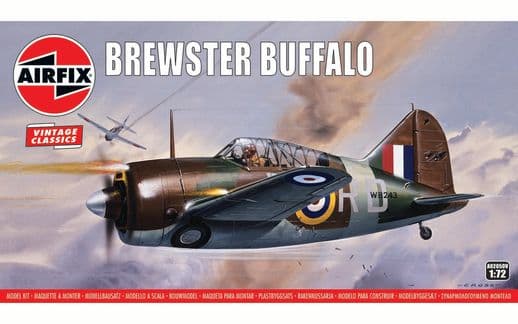
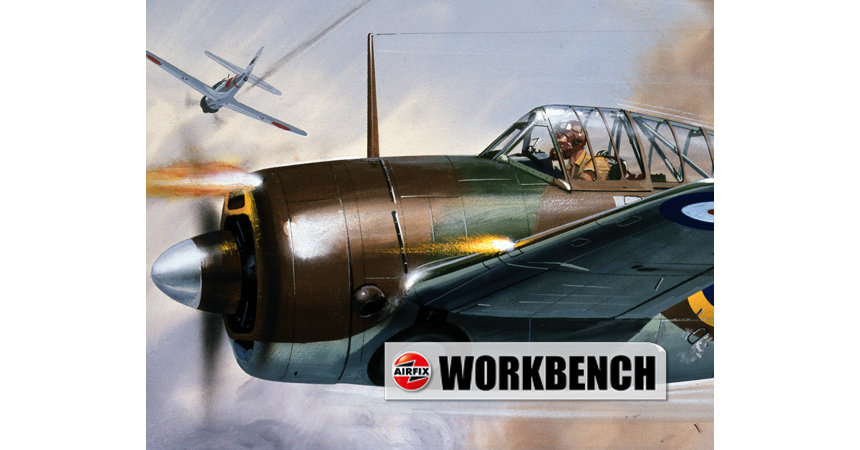
Real Airfix box artwork royalty, the original Roy Cross Brewster Buffalo artwork produced in 1972 in all its glory - no wonder we love this hobby!
One experience probably shared by many Airfix modelling enthusiasts is how as we worked our way through the smaller kits in the range back in our youth, how these wonderful models also opened up the fascinating world of aviation for us. With so many different aircraft shapes, sizes and colour schemes to admire, they really did cry out for some extra investigation to be carried out and probably led to many a happy afternoon spent scouring the local library for information. In fact, modelling probably served as the catalyst for producing many an aviation enthusiast, as the sheer variety of kits available introduced us to this engrossing and enduring subject.
For this reason, when one of the kits which proved so fascinating to us back then is about to take its place in the Vintage Classics range, it can almost be like welcoming an old friend back into our lives again, a feeling many of us will no doubt have had when looking at this beautiful Brewster Buffalo artwork once again. With tooling moulds which were run for the first time in 1972 and a project which benefited from the significant artistic talents of Mr Roy Cross, this new kit was an instant success following release and underlined the continuation of the impressive subject diversity Airfix have always been famous for.
The latest version of the Buffalo artwork, complete with its Vintage Classics branding.
If you were one of the first to buy this kit, it would have been in the early bagged kit presentation, with the parts on display beneath the header card, which featured artwork, potted history and assembly instructions. For most of us though, our first Buffalo experience will more likely have been with one of the later boxed incarnations of the kit, probably still featuring Roy Cross' artwork, but maybe one of the later versions produced. Once completed, the model was a little cracker, so appealing due to the fact that it was just so different to something like a Spitfire or Messerschmitt Bf 109 we probably already had on display and as our minds were like little sponges back then, the unusual looking Buffalo really tempted us to find out more about it - why was the first US Navy monoplane in RAF markings? If ever a model addition to any built kit collection provided a greater visual representation of why aeroplanes are so captivating, then I would certainly like to see it.
In any case, we are delighted to confirm that this latest blog update marks the impending arrival of the Brewster Buffalo into the 2023 Airfix range and as a true Vintage Classic, it's only fight that we take a closer look at the two scheme options which will accompany its triumphant return.
With Belgium looking to quickly modernise its Air Force during increasingly volatile times in Europe, they approached the Brewster company to ask if they would be willing to develop a land based variant of their Buffalo naval fighter for them. With a positive outcome, they placed an order for 40 aircraft which carried the internal company designation B-339B (Belgium), aircraft which were basically de-navalised F2A-2 fighters, powered by a modified Wright R-1820 engine which had been cleared for export purposes.
Unfortunately, due to the deteriorating situation in Europe, only one fighter had arrived in France by the time Germany launched their Blitzkrieg attack and this aircraft was impounded. A further six machines were subsequently marooned on the island of Martinique, never to be flown, with the remainder of the fighters ordered by Belgium re-directed to Britain. These aircraft were tested and later supplied to the Fleet Air Arm.
In order to bolster the number of aircraft available to British forces at a time when they could barely make good the losses they were incurring, the British Purchasing Commission was established to procure as many US built aircraft as it could during the early stages of the war, one of which was the Brewster Buffalo. Aware of the aircraft ordered by Belgium, the British placed a large order for 170 of the fighters to be designated Buffalo Mk.I in British service, but referred to as the B-339E (England) by Brewster. These aircraft were certainly a welcome addition to the RAF's inventory, however, on their arrival in the UK and after subsequent testing, they were found to be not exactly what the RAF had been hoping for.
An impressive line-up of RAF Buffalos in the Far East about to face the might of the Japanese onslaught.
The most numerous enemy aircraft the Buffalo would face during the Far Eastern campaign was the Nakajima Ki 27 'Nate', an aircraft it was well placed to overcome in combat. If they came up against a Mitsubishi Zero, that would be a very different story.
A less capable version of the US Navy's F2A-2, despite the fact that they had naval equipment removed, the addition of other British equipment made the aircraft significantly heavier. To make matters worse, the export variant of the Wright Cyclone engine had produced significantly less power than the unit used on US Navy fighters and with even a shortage of these, it was reported that some of the British Buffalos had engines which had been 'borrowed' from Douglas DC-3 airliners. Flight evaluation testing highlighted the fact that the Buffalo did not have the performance to operate against the Luftwaffe in the West, so were subsequently shipped out to the Far East in a development which preserved the RAF's supplies of new Spitfires and Hurricanes for home based operations.
From December 1941, around 150 Buffalo Mk.I fighters formed the main aerial defensive force for Burma, Malaya and Singapore and whilst you might think this impressive force could have held its own against the impending Japanese onslaught, things didn’t turn out quite that well. It wasn't a case of the Buffalo not being a good enough fighter, it was more the fact that Commonwealth forces were simply not prepared for what was heading their way. The aircraft the Buffalos were most likely to meet in combat was the Nakajima Ki 27 'Nate' and whilst this was an extremely manoeuvrable aircraft, it should have been no match for the Buffalo. The problem was that Allied forces were completely disorganised, often with more planes than pilots available and always with a lack of essential infrastructure. Perhaps even worse than this, they massively underestimated the capabilities and determination of their enemy and whilst the performance of the Buffalo has since proved to be something of an easy historic wartime target, the true failings actually lay elsewhere.
As an unfamiliar type being flown by inexperienced pilots, it could be argued that the Buffalos arrival in the Far East was a disaster waiting to happen right from the beginning and how the brave pilots who flew them in combat never stood a chance, not because the fighter was no good, more that their leaders had no idea how to deploy the force effectively. An illustration of the issues they faced comes when we learn that twenty aircraft were lost in training accidents during 1941 and how almost as many fighters were lost on the ground on unprotected airfields as were during combat engagements with the Japanese Army and Navy Air Forces.
Full scheme details for an RAF No. 67 Squadron Buffalo serving during the Far Eastern campaign and the defence of Burma.
In contrast to this, Finnish Air Force pilots flying basically the same Buffalos against Soviet aircraft which were as good as the Ki 27 or better, scored over 400 aerial victories with their 40 Buffalo fighters, aircraft which they lorded as their 'Sky Pearl'
The scheme offered here was carried by an RAF No.67 Squadron Buffalo Mk.I during operations in the defence of Burma, a unit which would be one of the few to spend almost its entire war fighting in the skies over Burma. Formed in Singapore during early 1941, the squadron fully equipped with Brewster Buffalo Mk.I fighters by the end of May, but by the following October had been transferred to Burma, leaving their aircraft to be operated by the pilots and ground crews of No.488 Sqn. RNZAF.
Once they had arrived in Burma, the squadron inherited the Buffalos of No.60 Squadron and would be heavily involved in actions against attacking Japanese forces during the invasion of Burma. Performing valiantly against an overwhelmingly superior and determined adversary, losses began to mount, eventually resulting in a withdrawal to India - highlighting the desperation of this situation, only ten serviceable Buffalos were able to make the transit to India. Buffalo Mk.I W8243 was one of the aircraft involved during the massive Japanese raid against Burma on 23rd December 1941 and is thought to have scored at least one victory against enemy aircraft on that day. Thought to be quite a lucky ship, she was one of the few aircraft to make the withdrawal to India, where she would continue to fly until struck off charge late in 1943.
Brewster F2A-2 Buffalo, Third Section Leader, US Navy Fighter Squadron VF-2, USS Lexington, 1941.
As far as Brewster Buffalo development is concerned, it's widely accepted that the most capable variant of the fighter was the F2A-2, an impressive balance of power, weight and firepower, although the pilots of the Finnish Air Force might have something to say about that. An upgraded variant of the first Buffalos to enter US Navy service, the F2A-2 benefitted from a more powerful Wright R-1820-40 engine, featured a modified electrically operated propeller to utilise all that extra power and included a host of additional safety equipment to make its operation over water potentially more survivable for pilots.
At that time, these little fighters were well liked by the Naval and Marine Corps pilots who were flying them, with this upgraded variant boasting a quoted top speed of an impressive 340mph. The 43 aircraft produced and delivered were direct replacements for the cancelled F2A-1 aircraft from the original US Navy order, with those aircraft actually being the ones subsequently supplied to the Finnish Air Force - at the time, it was decided that the Navy required a more capable version of their first monoplane fighter and would wait for this new variant. It's interesting to note that eight of the originally supplied F2A-1 aircraft would also later undergo upgrade works to bring them to F2A-2 standard.
Representing a US Naval aircraft of the pre-war period, this flamboyantly presented Brewster Buffalo F2A-2 probably marked the high point of its US service, one of the most advanced aircraft in service at that time and well-liked by the pilots flying it.
The second US Navy unit to be equipped with the Buffalo fighter was VF-2, receiving 18 F2A-2 machines in November 1940 and immediately beginning their work up for a deployment aboard the carrier USS Lexington and a proposed future training cruise to Pearl Harbor. With America not involved in the war at that time, military aviators were busy training for what lay ahead and those posted to fly the Buffalo were generally rather complimentary of the fighter, even giving it the endearing nickname of the 'Peanut Special'. The more potent FA2-2 variant was particularly well liked and one future ace pilot described at the time how landing a Buffalo on the deck of a moving carrier deck was about as much fun a man could have during peacetime.
The final production variant of the Buffalo was the F2A-3 model, an aircraft which was intended as a long range naval reconnaissance fighter, however, the additional weight placed on the aircraft seriously hampered its performance and when combined with continuing problems with undercarriage strength and the strained relationship with the Brewster Corporation, the need to find a more suitable naval fighter saw the Buffalo quickly relegated to secondary duties. Thankfully, all the time the Buffalo was trying to adapt to its role, Grumman had been perfecting their original XF4F-1 design, eventually releasing the excellent F4F Wildcat, an aircraft which would form the backbone of US Navy fighter defences during the early engagements with Japanese forces.
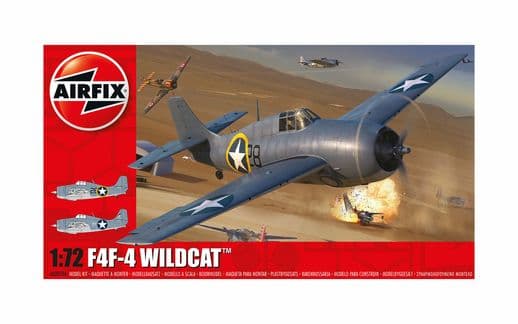
A further development of the aircraft the Buffalo beat during the US Navy fighter trials, thankfully Grumman didn't take their defeat personally and worked to produce the F4F Wildcat fighter, which would form the backbone of the US Navy's fighter force following their introduction into the Second World War.
For an aircraft which had the distinction of being the first monoplane fighter in the history of the US Navy, it's interesting to note that they would not be the largest customer for the Brewster Buffalo, with the majority of the 509 aircraft produced being sent to overseas operators. No US Navy pilots would attain 'Ace' status whilst flying the Buffalo, with that particular distinction going to at least four Commonwealth pilots and no fewer than 36 Finnish Air Force pilots.
As Workbench readers know only too well, it's possible to find interesting stories behind every subject chosen for inclusion in Airfix model kit ranges over the years, although few end up being as interesting as the Brewster Buffalo, even if we found ourselves having to defend its tarnished reputation somewhat. When it comes to covering aircraft types which have seen service with the Royal Air Force though, the Buffalo stands in stark contrast to the new Lockheed Martin F-35 Lightning II kit which was released this week and itself featured in several recent blogs. This aircraft is unquestionably the most technologically capable aircraft to ever see RAF service and most definitely does not need a Brewster Buffalo type blog charm offensive edition to be produced.
The Buffalo's coming - keep an eye out for this latest addition to the Vintage Classics range.
No matter what your opinion on the Buffalo, it really is an interesting little aeroplane and its welcome inclusion in the 2023 Vintage Classics range will hopefully bring this often overlooked, yet historically important aircraft to the attention of a new modelling audience.
We are afraid that's all we have for you in this latest edition, but we will be back next Friday with more project development updates and the very latest Airfix kit exclusives. In the meantime, we are always keen to hear your views on all things Airfix and in particular, any thoughts and opinions you may have regarding our Workbench blog. If you would like to drop us a quick line, could we please ask that you use our workbench@airfix.com email for all correspondence.
To re-visit any of the Airfix blogs we have produced over the past seven years or so, please head to our main Workbench hub, where you will find our entire blog back catalogue and all the Airfix design projects we have already covered.
All our dedicated official social media sites can be accessed by clicking the respective link icons at the foot of this page, or by heading to the Airfix homepage. Other useful Airfix links are:
Facebook, YouTube, Twitter and Instagram official sites
Please join us for more Airfix updates next week and thank you for your continued support.