

Welcome to this latest edition of our Workbench blog and all the news, updates, and modelling exclusives from the fascinating world of Airfix.
Don’t you just love it when a Workbench plan comes together! In a development which may have been by chance, but could hardly have worked out any better if we had planned it with military precision, it has proved entirely fitting that this blog which immediately follows our latest scale tribute to the enduring association we have with the Supermarine Spitfire should feature an aircraft type which shares many links with the Spitfire, both in terms of British aviation history and within Airfix kit heritage.
Our subject for this week is the beautiful Gloster Gladiator, an aircraft which is often described as the ultimate biplane fighter and one which was the pride of the Royal Air Force until the arrival of the Spitfire and Hurricane into squadron service. In addition to its lofty status in the annals of British Aviation history, the Gladiator was such an important aircraft to the British people that it was actually the second aircraft subject to be released in kit form by Airfix and in its original form, was the kit available for the longest time over subsequent range releases, so quite the historic subject from an Airfix perspective. The Gladiator was the subject of a new tooling project in 2013 and we will be marking this kit’s reintroduction into the 2024 range by first looking at why the Gladiator remains such a popular aircraft within the modelling world, before moving on to exclusively feature the new box artwork produced in support of this latest release, along with the two fascinatingly unusual scheme options included in this new kit.
Proving that two wings can sometimes be much better than one, we are delighted to be welcoming the Gloster Gladiator back to the Airfix range in this latest edition of Workbench.
Although the Gloster Gladiator occupies a rather significant position within the history of British aviation, there is currently just a single airworthy example of the aircraft to be found anywhere in the world and that’s at Old Warden, home of the Shuttleworth Collection.
The years which followed the end of the Great War may have been a time of austerity, as the world tried to put thoughts of the devastation of modern warfare behind it, however, it did see the world of aviation continue to advance at some pace, with the pursuit of one thing constantly driving this development – a desire to fly ever faster. In addition to this, as aviation and the aeroplane had already highlighted the fact that they would be crucial in any future conflict, the thinking was that if any nation’s air force was equipped with the fastest, most capable fighter aircraft, then surely this would serve as the ultimate deterrent against possible future aggression against them.
The relatively primitive aircraft which fought during the Great War gradually gave way to a new breed of fast, rugged and highly manoeuvrable interceptor fighters, still mainly biplane designs, but incredibly capable machines boasting increasingly powerful offensive armament. It’s always interesting to acknowledge that in the twenty years which separated the two world wars, Britain saw no fewer than ten major biplane fighter designs enter Royal Air Force service, each one proving to be more capable than the one which preceded it. Many of these aircraft belied the purpose of their intended use, as they were simply beautiful to look at, along with being some of the most accomplished machines ever conceived by man. With their incredible power and stunning good looks enhanced by polished metal panels and colourful squadron markings, it is any wonder these aircraft have become synonymous with what many people consider to be a golden era for the aeroplane.
Unfortunately, despite almost twenty years of continual development and refinement, the flamboyant era of the biplane fighter was almost over, as the gathering clouds of war would require a new breed of fast, heavily armed monoplane fighter aircraft.
The origins of Gloster Aircraft Company can be traced back to the latter stages of the First World War and the manufacture of aircraft components on a sub-contracted basis for the huge Airco Company. The need for Britain to produce large numbers of ever more capable aircraft saw the number of firms engaged in aircraft production increase dramatically during this period. One such manufacturer was The Gloucestershire Aircraft Company Limited based in Cheltenham and by the spring of 1918, the company were producing 45 new Bristol F2B Fighters each week, their significant contribution to the continuing war effort.
Following the end of the war and a challenging change in fortunes for some competitor aircraft manufacturing companies, the Gloucestershire Aircraft Company Limited saw an opportunity present itself, as the Nieuport & General Company announced their intended closure. They secured the services of their rival’s talented designer Henry Folland, along with the rights to build the Nieuport Nighthawk fighter. This proved to be a bold, yet significant move by Company officials, as Folland would go on to be behind the development of some of the most significant inter-war British fighter aircraft.
This previously released Gladiator Airfix box artwork depicts one of the RAF No.615 Squadron fighters sent to France as part of the air component of the British Expeditionary Force in 1939.
In 1926, the Gloucestershire Aircraft Company Limited would undergo something of an unusual change. As the company were now receiving international recognition, it became apparent that some overseas customers were having difficulty simply pronouncing the name of the company, let alone spelling it. A decision was taken that they should adopt a simplified version of their name, so it was changed to Gloster Aircraft Company from this date.
Over the next few years, Gloster’s design team went on to produce a series of impressive biplane aircraft projects, improving on traditional construction techniques, whilst also incorporating the very latest in engine and armament technologies. Aircraft such as their Grebe and Gamecock fighters were huge improvements on the aircraft which preceded them and were quickly adopted by the Royal Air Force. The Gamecock in particular illustrated how future aircraft design would have to evolve, as this diminutive aeroplane was coupled with the huge Bristol Jupiter radial engine. Despite the aircraft being fast and highly manoeuvrable, the torque produced by the engine, coupled with its narrow wing and control surfaces of the aircraft made the Gamecock something of a handful and subsequently, RAF Gamecock pilots would be involved in more than their fair share of landing accidents.
All of Gloster’s growing design expertise came together with the 1933 first flight of their impressive new Gauntlet fighter, which again added even more speed and power to the design courtesy of its Bristol Mercury engine, but also increased the overall size of the fighter’s fuselage, wings and control surfaces. As it entered RAF service in 1935, the Gloster Gauntlet was 56 mph faster than the Bristol Bulldog it replaced and was the fastest RAF aircraft between 1935 and the arrival of its Gloster built replacement in 1937. It’s interesting to note that the success of the Gauntlet actually owed much to the expertise of Hawker Aviation and their impressive construction techniques - as Britain’s aviation companies began a series of cost saving takeovers and amalgamations, Gloster Aircraft Company was taken over by Hawkers, even though they continued to trade under their traditional name. Use of the Hawker construction techniques on the Gauntlet production line made the aircraft much easier to manufacture and repair, helping it to become arguably the most important RAF fighter during the mid 1930s.
Even as their impressive new Gauntlet fighter was arriving with RAF squadrons, the Gloster design team were already working on an improved variant of the aircraft, one which aimed to satisfy an Air Ministry requirement for a four-machine gun armed, 250mph plus fighter, an aircraft which was initially referred to as their ‘Super Gauntlet’. What they went on to produce was a classic aeroplane in every sense of this description, an aircraft which represented the very pinnacle of biplane aviation performance and technology, but one which would ultimately mark the zenith of the British biplane fighter.
Such a beautiful aeroplane. The first Gladiators to enter Royal Air Force service were flamboyantly presented in their squadron markings and were the machines every young man wanted to fly.
The Gloster Gladiator was an extremely capable fighter aircraft, which eclipsed every RAF fighter which preceded it – fast and manoeuvrable, with impressive firepower, the Gladiator was a true pilot’s aeroplane, a delight to fly in the air, even if it was something of a handful on the ground. Powered by an 840 hp Bristol Mercury 9-cylinder radial engine, the Gladiator was capable of speeds up to 257 mph and once an enemy aircraft was in its sights, it stood little chance as its four .303 machine guns were brought to bear. The Gladiator was the first British fighter to feature a fully enclosed cockpit and with large flaps to help during the landing and take-off phases of flight, the aircraft proved to be a real performer.
Unfortunately for the Gladiator, despite the fact that the aircraft represented the very pinnacle of biplane fighter technology when it entered service in 1937, it also marked the emergence of the first monoplane fighter designs, aircraft which would come to dominate the world of aviation for the next decade or so and would contest the coming world war. Even though the Gladiator was undoubtedly the best of the best, it entered service at a time when the very pages of aviation history were turning, and it was about to be eclipsed by the next generation of fighting aeroplanes. That’s not to say that the capable Gloster Gladiator had any intentions of going quietly.
The Gloster Gladiator actually proved to be such an important British aircraft at the time of its introduction that under the RAF’s inter war expansion scheme, it was ordered in greater numbers than any of its fighting predecessors and as more RAF fighter units began to equip with the new aircraft, it was also proving to be quite the export success. Nations as diverse as China and Belgium were desperate to purchase the Gladiator, in an attempt to bolster their own defences with an effective and reliable fighter type, with the prospect of war now looking increasingly likely. From a total production run of 747 aircraft, 216 Gladiators would be exported to 13 countries around the world and it was to be under foreign skies that the Gladiator would contest the majority of its WWII combat engagements.
At the outbreak of war in September 1939, the backbone of Fighter Command was already made up of Hurricane and Spitfire fighters, however, they did still boast four squadrons of Gladiators ready to take on the might of the Luftwaffe. Two Gladiator squadrons were sent to France as part of the Air Component of the British Expeditionary Force, however, these units proved no match for the latest Luftwaffe fighters they came up against and were decimated within the first ten days of fighting following the German invasion of the country.
Always providing inspiration for the modeller, this Dogfight Double artwork depicts combat between RAF Gladiators and Luftwaffe Stukas during the air campaign in the Mediterranean Theatre.
Despite the fact that the French campaign had highlighted the vulnerability of the Gladiator as a front-line fighter when facing the latest enemy monoplane designs, two squadrons were retained for defensive duties during the Battle of Britain, however, they were only ever regarded as a stopgap force and were fortunate that Spitfires and Hurricanes were always available to take the lead in any combat situations they faced.
The Gladiator would perform valiantly in overseas skies during the Second World War, with some pilots using the aircraft to claim impressive victory tallies. From the Norwegian campaign to the skies above the deserts of North Africa, Gladiators were required to hold the line until more modern monoplane fighters could be spared, but fought as an aircraft bearing its name should have done, with tenacity and honour. Undoubtedly, the aircraft’s finest hour came during the heroic defence of Malta, where a handful of Sea Gladiators fought valiantly in the face of overwhelming odds to protect the island against incessant Axis air attacks, and with it, creating the aviation legend which is the Hal Far Fighter Flight’s Faith, Hope and Charity.
Although the timing of its introduction may not have favoured the Gladiator from an aviation history perspective, its position as the RAF’s most capable biplane fighter and the last of its kind, must surely make it an aircraft of note and therefore of interest to the modeller. If it doesn’t qualify using this criteria, then the fact that this is unquestionably one of the most attractive aircraft from any era of flight, must make this an appealing modelling subject, one which has as much right to some space in our display cabinets as any Spitfire or Hurricane.
Despite its lofty position within the history of British aviation, it’s interesting to note that of the 747 Gladiators build, just a single example is currently in airworthy condition and can be seen thrilling the crowds at the regular airshow events arranged by the Shuttleworth Collection at their delightful Old Warden airfield. The relatively intimate surroundings of this famous venue now serve as the performing arena for the Gladiator, and if you weren’t a fan before seeing it fly, you’ll certainly be a fully paid-up member after you do.
Just the second aircraft model kit produced by Airfix, this original Gloster Gladiator tooling spend more time in respective Airfix ranges than any other kit. This image is being shown courtesy of Jeremy Brook.
As we have just seen, the Gloster Gladiator occupies a unique position within the history of British aviation and as such, it will come as no surprise to learn that this classic fighter attracted the attentions of Airfix designers from the very earliest days of plastic kit production. In a similar way as the Gladiator biplane handed the fighter baton on to the monoplane Spitfire in the late 1930s, the first Airfix Spitfire kit handed the modelling baton onto a scale example of the Gladiator back in the mid 1950s. When it was first released back in 1956, the 1/72nd scale Gloster Gladiator was just the second aircraft kit release to bear the Airfix name and was seen as the ideal follow up release to the popular Spitfire kit which preceded it.
The initial release of the Airfix Gladiator saw the kit produced in the same bright blue plastic modellers would have been familiar with having just built the Spitfire released the previous year and as the Spitfire had been produced in such large numbers and proved so incredibly popular with the buying public, the company knew the Gladiator was going to be equally successful. Obviously, that first release was presented in the original type 1 polythene bag and header card format, with part and assembly information printed on the reverse side of the header card. It’s also interesting to note that this first release presented the aircraft with a three bladed propeller and rectangular display stand, two features which were changed with subsequent releases of the kit.
In addition to being just the second aircraft kit produced and released by Airfix, the Gladiator has the distinction of being the Airfix kit which has spent the most time in various Airfix ranges in its original tooling guise. Even though it did benefit from some tooling modifications and several release presentation changes over the years, the Airfix Gladiator kit could always trace its lineage back to that second aircraft subject release from 1956 and in this regard, may even eclipses the Spitfire in Airfix heritage terms.
Airfix kit heritage right before our eyes. Again with grateful thanks to Jeremy Brook of the Airfix Collectors’ Club, here are three different Gladiator header card presentations from a kit which possesses real Airfix heritage.
Always proving to be a popular subject with the modeller, our 1/72nd scale Gloster Gladiator attracted the attentions of the Airfix design team once more in 2012, when they embarked on a project to represent this famous aircraft in kit form using all the very latest design and manufacturing technologies the industry had to offer. The new Gladiator kit appeared in an Airfix range for the first time the following year and since then has provided modellers with a beautifully accurate scale representation of this classic fighter, one which continues to be amongst the most popular kits in any range in which it appears.
Over the past decade or so, there have been five kit releases featuring the newly designed 1/72nd scale Gloster Gladiator kit, each one presenting the fighter in different schemes and in the service of different air forces, with three being standard kit releases, one being a Starter Set and one in our popular Dogfight Doubles series. Our latest impending release presents the Gladiator in two fascinatingly unusual schemes, with the lead option being a Gladiator flown by one of the Norwegian Air Force’s ‘Few’, one of seven Gladiators sent to defend their country against the might of the Luftwaffe, following Germany’s attack against the country in 1940.
The second scheme presents an unusually presented Gladiator which was engaged in performing one of the secondary roles to which the fighter was assigned, that of an atmospheric research aircraft. Let’s take a closer look at the details behind both of the new schemes now.
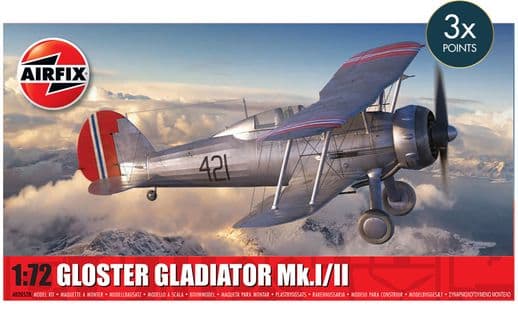
Our latest new box artwork reveal, this spectacular image shows the Gladiator flown by Lieutenant Dag Krohn of the Norwegian Army Air Service in 1940, a combination which would account for two German aircraft in a frantic day of fighting when Germany invaded Norway.
The Norwegian Government placed an order for six Gloster Gladiator Mk.I fighters in June 1937 and as their pilots embarked on conversion to their capable new aircraft, followed this initial purchase with a request to secure a further six Mk.II Gladiators. Unfortunately, delivery of this second order was subject to a delay, as production priority by that time was given to aircraft destined for Royal Air Force service, with the Norwegians only receiving this second batch of aircraft in December 1940. At that time, their Gladiator fighters were based at Fornebu airport near Oslo and as their pilots engaged in a hectic period of training, Europe was now at war and the entire nation must have been concerned that their neutrality may not continue to be honoured.
This period of intensive training would result in the loss of several Gladiator fighters, including some which had been fitted with skis and required to operate from frozen lakes, which by the time the Germans launched Operation Weserübung and their invasion of Norway on 9th April 1940, left the Norwegian Army Air Service with just seven serviceable Gladiators.
The morning of the 9th of April was a time of great confusion for Norway’s Gladiator pilots. Reports of military action started to circulate from the very early hours in the morning but were initially thought to be nothing more German aircraft straying into Norwegian airspace whilst attacking British shipping off the coast. By 0400 hrs however, the situation had become much clearer and the pilots at Fornebu knew they would be flying combat missions that day. The first patrol of the day proved uneventful, however, the second patrol saw a Gladiator engaging a Luftwaffe Messerschmitt Bf 110 Destroyer in combat. Whilst the pilot reported scoring hits against the German fighter, it made for the safety of cloud cover, so its eventual fate was uncertain.
Later that same morning, all the available Gladiators were scrambled to intercept a large raid of Luftwaffe aircraft heading in the direction of Oslo and when they eventually caught sight of the formation, it must have been both awe-inspiring and terrifying in equal measure. This handful of Gladiators were facing a force of approximately 150 Luftwaffe aircraft, a mixed force of fighters, bombers and transport aircraft, all heading for targets around the capital, in a lightning attempt to take control of the country.
Despite the odds, the Gladiator pilots immediately attacked the formation, with Lieutenant Dag Krohn in Gladiator 421 selecting a Heinkel He III as his initial target. Bringing all his guns to bear, he scored multiple hits on the Luftwaffe bomber, which came down not far from his home airfield, before turning his attention to another bomber, this time a Dornier Do17. The second bomber was also brought down, but Krohn’s Gladiator was immediately set upon by a pair of Bf 110 fighters and he was forced to seek the protection of cloud cover to evade their attentions.
Full scheme details for this heroic Gladiator, one which defiantly fought in the face of overwhelming numbers of enemy aircraft.
With fuel now low and the situation desperate, the remaining Gladiators looked for a place to land, having been informed that their home airfield had been strafed and was now under the control of German paratroopers. One of his fellow pilots had attempted to land on a frozen lake as they had practiced previously, however, the ice could not take the weight of the aircraft and it fell through as it came to a stop. Another Gladiator attempted to land on a different lake but had problems deploying its flaps, causing it to overshoot and crash into a bank of snow at the edge of the lake.
Lieutenant Dag Krohn did manage to land his aircraft safely, but his was now the only remaining Gladiator facing the might of the attacking Luftwaffe and stood little chance of any further success. With Norway being in a state of confusion at that time, some reports claim that Krohn and Gladiator 421 flew several further sorties, but was damaged on 21st April, finally ending this short but glorious chapter for Norway’s brave Gladiator resistance.
Lieutenant Dag Krohn made his escape from Norway later that year, embarking on a perilous journey which took him through Sweden, the Soviet Union, Japan and the US, to finally arrive in Canada. Initially serving as a flight instructor in Canada, he would later join the Royal Air Force flying transport aircraft on some high-profile clandestine missions, and would even be responsible for flying Winston Churchill to Tehran in 1945. His two aerial victories on 9th April 1940 made him top scoring Norwegian biplane pilot of the Second World War.
Whilst the majority of British and Commonwealth Gladiators had been fighting in the Mediterranean and North Africa, many of those which remained in Britain were assigned an important new task, one which was essential in providing military planners with regular, accurate weather information. Engaging in Meteorological reconnaissance and humidity flights, these aircraft would be worked extremely hard and were often required to fly at least two sorties each day, so important was the information they were gathering. The service took on increasing importance as the war progressed, with the need to provide forecasters with accurate, real-time information becoming something of a priority and Met Flight pilots becoming extremely proficient in gathering what the experts needed.
Initially serving with home-based units, Met Flight Gladiator pilots were regularly required to fly at the aircraft’s maximum rated altitude and as they weren’t equipped with pressurised cockpits, would be required to wear several layers of warm clothing to help them cope with the freezing temperatures. Although this restricted their movement in the cockpit, if they weren’t warm enough, they wouldn’t be able to effectively obtain the data they required, so the bulky clothing, in addition to their parachute proved to be something of a necessary evil. These Gladiators would also be equipped with a psychrometer and aneroid barometer to measure air humidity and atmospheric pressure respectively.
Home based units using Gloster Gladiators in this role were No.1401 Flight at Bircham Newton, No.1402 Flight at Aldergrove in Northern Ireland and No.1403 Flight at Mildenhall and each one of these units would later be elevated to Squadron status, so vital was the work they were conducting. The Gladiator would also be used in this role in Africa and the Middle East, where the general reliability of the aircraft made it an ideal choice for these regularly flown information gathering sorties. In some cases, where aircraft were regularly required to fly at higher altitudes, armament and ammunition were removed in an attempt to save weight, however, it isn’t known if any of these unarmed Gladiators were unfortunate enough to actually fall victim to enemy fighters.
A beautifully unusual Gladiator scheme – how on earth are we going to be able to chose between these two scheme options?
The scheme featured with this option is very different to any of the other schemes included with previous Gladiator kit releases and really does make for an appealing modelling subject. It wears the scheme adopted by RAF fighter aircraft from August 1941 onwards, and whilst the change is relatively subtle, it really is quite unusual to see a Gladiator wearing this scheme. More readily associated with the natural metal of the pre-WWII era, or the dark earth and dark green camouflage of an early war fighter, this scheme option will prove difficult for most of us to overlook and will surely ensure the continued popularity of this delightful little kit.
Now scheduled for imminent release, please keep an eye out for this latest Gloster Gladiator kit because it’s an absolute cracker and the continuation of our scale tribute to the ultimate biplane fighter to see Royal Air Force service.
Full box presentation layout for this beautiful new addition to the 2024 kit range.
We are afraid that's all we have for you in this latest edition, but we will be back next Friday with more project development updates and the very latest Airfix kit exclusives. In the meantime, we are always keen to hear your views on all things Airfix and in particular, any thoughts and opinions you may have regarding our Workbench blog. If you would like to drop us a quick line, could we please ask that you use our workbench@airfix.com email for all correspondence.
To re-visit any of the Airfix blogs we have produced over the past seven years or so, please head to our main Workbench hub, where you will find our entire blog back catalogue and all the Airfix design projects we have already covered.
All our dedicated official social media sites can be accessed by clicking the respective link icons at the foot of this page, or by heading to the Airfix homepage. Other useful Airfix links are:
Facebook, YouTube, Twitter and Instagram official sites
Please join us for more Airfix updates next week and thank you for your continued support.