
Welcome to this latest edition of our Workbench blog and all the news, updates and modelling exclusives from the fascinating world of Airfix.
From a modelling perspective, there are some aircraft types which are so distinctive and so historically significant that they have always proved incredibly popular subjects with legions of modellers over the years, instantly recognisable to anyone admiring the finished model. One such aircraft is the Heinkel He 111, Germany's ubiquitous medium bomber of the Second World War and an aircraft which will always be linked with the savage air battles in the skies above Southern Britain during the summer of 1940. Just as the word Messerschmitt was and is often still used in common parlance in reference to all Luftwaffe fighter aircraft of WWII, the whale-like fuselage and distinctive glazed front of the Heinkel allowed this aircraft to perform the same role in relation to its bomber force and even though it was widely regarded as being obsolete by the end of the Battle of Britain, it would remain in production until September 1944 and in service until the very final days of the conflict.
In this latest edition of Workbench, we will be marking the recent re-introduction of our 1/72nd scale Heinkel He 111 P-2 to the current Airfix range, something which is actually quite a significant development for the blog, but we will have more on this a little later. During the course of this update review, we will be looking at the spectacular box artwork, at the two scheme options included with this kit and the fascinating stories behind both of them. Most Workbench readers will have no doubt enjoyed spending time building a scale Heinkel kit in the past, however, over the course of the following article, we will hopefully be showing readers why this particular kit is one which is certainly worthy of encouraging a modelling return to this fascinating aviation subject once more.
The visually distinctive Heinkel He III was developed as a fast passenger/transport aircraft under the restrictions of the Treaty of Versailles, but this was very much an aviation wolf in sheep's clothing.
It seems as if so many of the aircraft kits we review here in Workbench are scale representations of machines which can trace their heritage back to the tumultuous 1930s, a time when most of Europe was trying hard to forget about the horrors of the First World War, but seemed to be moving inexorably towards another, potentially even more devastating conflict. A reunifying Germany knew that air power would be playing a significant role in any future conflict and was determined that the new Luftwaffe would be ready and equipped when called upon. Working under the restrictions imposed by the conditions of the Treaty of Versailles, German aircraft manufacturers produced a succession of designs which were advertised to the outside world as passenger and transport aircraft, but were clearly capable of being rapidly converted to more sinister offensive roles.
Crucially, this clandestine work was giving the German aviation industry valuable experience not only in designing high-tech, world-leading aeroplanes, but also in perfecting methods for the effective mass production of these machines, a much more overt indication of their actual intentions.
The Heinkel Aviation Company were amongst the most accomplished aircraft design and manufacturing companies in the world during the 1930s and would produce a succession of designs to compete for most contracts issued in Germany during this period. One of their most successful aircraft was the single engined Heinkel He-70 ‘Blitz’ (Lightning) four seat touring aeroplane, a machine which was extremely distinctive and one which would go on to set several significant aviation records from the moment it first leapt into the air. Many of its distinctive design features would be seen in a later, slightly larger design, an aircraft which would go on to become one of the most famous aircraft of the Second World War, and one which would become synonymous with the might of the all-conquering Luftwaffe, the Heinkel He III medium bomber.
A Luftwaffe Heinkel He III in action during the invasion of Poland. At that time, the aircraft was considered one of the world's most capable attack bombers, but it would begin to show its vulnerabilities once the conflict moved further west. Photo credit Bundersarchiv.
The Heinkel Company initially referred to their new aircraft as the ‘Doppel-Blitz’ (Double Blitz), as it was for the want of a better description a larger, twin engined version of the He-70, with the design retaining the large and distinctive elliptical wing of its predecessor and something of a traditional stepped fuselage layout. It was an attempt to produce a fast and sleek modern aircraft to capture the world speed record for a civilian aircraft and whilst it was outwardly presented as an airliner/transport aircraft to remain within the conditions of the Treaty of Versailles limitations, its impressive performance suggested this masked a more sinister intention. The aircraft made its first flight in February 1935 and was found to possess exceptional handling characteristics, particularly at lower speeds, something which made both the landing and take-off procedures relatively trouble free for pilots.
This aircraft and the ones which immediately followed it, would be handed to Lufthansa in an attempt to continue the subterfuge, with the type being unveiled to the German Public and the wider aviation world at Tempelhof Aerodrome on 10th January 1936. By this time, development of the military version of the aircraft was well underway, with Germany now no longer concerned with the pretence of trying to plicate the other European nations - Germany's 'secret bombers' were secret no more and Europe was on course for war.
The earliest versions of the Heinkel He 111 were quite different in appearance from the aircraft which took part in the Battle of Britain and the profile which we all now so familiar with. Although still adopting the large whale-like fuselage and distinctive elliptical wings and horizontal stabilisers, the nose of the bomber was very different, longer and more pointed in appearance, arguably a much more traditional design. Although these first aircraft did now feature the machine guns which clearly identified its military intentions, it has to be said that the aircraft wasn't exactly bristling with defensive armament. As this was one of the fastest aircraft in the world at that time and capable of outrunning most of the fighter aircraft in service with the world's air forces at that time, Luftwaffe officials did not envisage their new bomber having to defend itself against fighter attack, equipping it with just three light machine guns to ward off any such aerial challenges.
A fascinating picture of a Heinkel bomber under construction, with its prominent fully glazed front fuselage being such a distinctive feature of the aircraft. Photo credit Bundersarchiv.
From the Heinkel He 111 'P' model variant onwards, the bomber underwent a design change which would see it receive its most iconic features, whilst at the same time updating the aircraft's capabilities with a host of improvements. Adopting the ubiquitous Daimler-Benz DB 601 engine as its powerplant, this variant also saw the introduction of a redesigned cockpit and front fuselage section, an upgrade which made for a roomier, more streamlined working area for both the pilot and his bomb aimer. This development certainly gave the aircraft a much sleeker appearance and very much improved the frontal visibility of the bomber – with this shorter, taller nose section now completely glazed the Heinkel He 111 had its most distinctive feature, one which would make it amongst the most recognisable shapes of the entire Second World War.
In addition to giving the Heinkel its unmistakable profile, the new fully glazed cockpit also afforded the pilot an exceptional field of view, but on the down side, made a tempting target for enemy fighter pilots, affording the unfortunate crew very little in the way of protection in such circumstances. Sweeping all before them during the early stages of the war, the Battle of Britain would prove to be a chastening experience for Luftwaffe Heinkel crews, as the speed and manoeuvrability advantages the aircraft has possessed when it first entered service had now been overtaken and against the determined attacks of RAF fighters, Heinkel bombers had little chance unless protected by swarms of supporting Messerschmitt fighters. Although effectively obsolete as a bomber operating in contested airspace from this point of the war onwards, the Heinkel would have to soldier on in a variety of offensive roles for the remainder of the war, with around 6,500 of these distinctive bombers having been produced by the roll out of the final bomber built in September 1944.
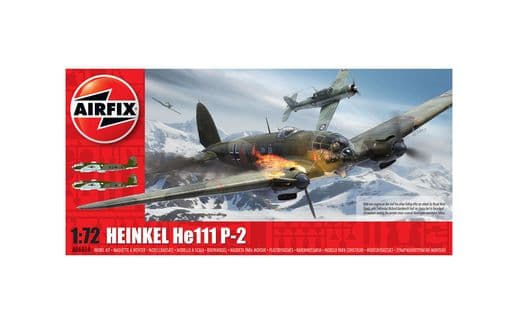
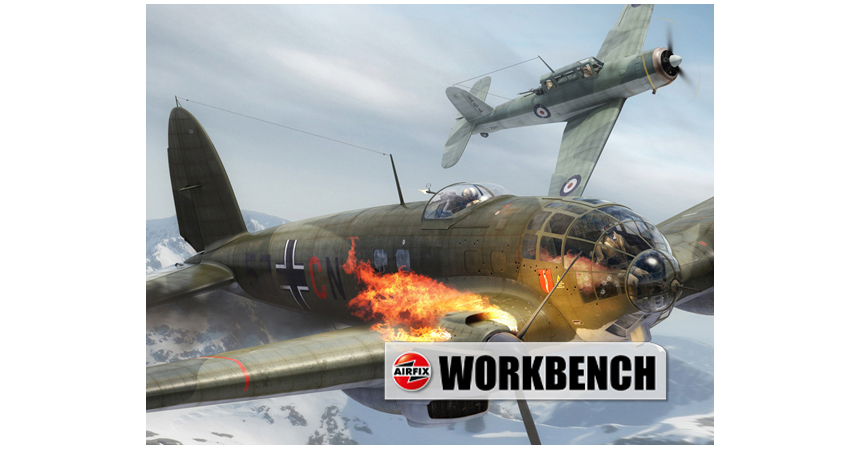
The stunning artwork produced to support the release of this new kit features the engagement which inspired the lead scheme choice and an aircraft which is now on display in the Norwegian Armed Forces Aircraft Collection at Gerdermoen, in Norway.
As one of the most famous aircraft of the Second World War, the Heinkel He 111 bomber has been available in Airfix kit form since the early 1960s and since that date, has probably been built by many tens of thousands of modellers all over the world. An aircraft which with the Messerschmitt Bf 109 and Stuka became the very aviation embodiment of German military might during WWII, the Heinkel has always been staple modelling fare within our beloved hobby, perhaps because it is such a distinctive looking aircraft, but maybe simply by virtue of the fact that so few remained after the war to find their way into museum collections around the world for us to admire - this rarity value certainly attracted our modelling interest.
With thanks to our Design Manager Matt, this is the first time that we have shown these Heinkel development images in a Workbench blog.
The Heinkel would attract the attentions of a new breed of Airfix product designers in 2014, when this magnificent aircraft was the subject of a new tooling project which brought all the latest design and manufacturing advances to bear in producing an updated and highly accurate scale representation of this famous bomber. First announced with the launch of our 2015 kit range, the new Heinkel tooling would go on to feature in just the fifth edition of our new Workbench development blog, where we exclusively revealed images of the additional component frames introduced to allow the Junkers Jumo 211 powered 'H' variant of the bomber to be produced.
Significantly though, despite the fact that the release of our Heinkel He 111 P-2 kit marks the return of the original new tooling release from back in 2015, this will actually be the first time it has featured within a workbench blog and we are therefore delighted to have the opportunity to bring you the stories behind the two interesting scheme options included with this kit now.
One of the most historic aircraft to be found in any of the world's aviation museums, this Heinkel was one of many German aircraft to be based and operated from Norway during the Second World War and despite having to make a forced landing in a snow covered mountainous region of the country following combat with British Skua fighters, is now on display in a stunning restored condition. Heinkel He 111 P-2 5J+CN was assigned to Kampfgeschwader 4 'General Wever', a unit which proudly carried the name of General Walther Wever, a senior German military official and pilot who was an outspoken champion in ensuring the new Luftwaffe would have a powerful strategic bombing force prior to the start of WWII.
On the morning of 26th April 1940, this aircraft along with two other Heinkel He 111s took off from Oslo/Fornebu airfield at the start of an armed reconnaissance mission, a mission which would prove to be rather eventful for all involved. Whilst the formation flew high over the Romsdalsfjord, 5J+CN was struck by anti-aircraft fire from the British cruiser HMS Manchester steaming in the waters below, but with the aircraft's crew oblivious to any damage to their aircraft, continued on to bomb the railway station at the coastal town of Åndalsnes.
A series of images taken during our research trip to see this historic Heinkel bomber at the Norwegian Armed Forces Aircraft Collection at Gerdermoen, courtesy of our Design Manager Matt Whiting.
A view from the aircraft's bomb bay compartment looking forwards towards the cockpit. The bombs are loaded vertically nose up in eight bomb boxes, four on either side of the bomb bay.
Such a fascinating piece of aviation history, the restoration team elected to leave the combat damage from the engagement with the two FAA Skuas when working on their Heinkel.
The iconic cockpit of the Heinkel afforded both the pilot and his bomb aimer an exceptional view. They would also have an unobstructed view of fighters attacking them from the front and could not expect any protection from the onslaught.
Immediately following their bombing attack, the Luftwaffe formation was attacked by Blackburn Skuas from No.810 Squadron Fleet Air Arm, which were operating from the carrier HMS Ark Royal and whilst the other two bombers escaped unscathed, 5J+CN was less fortunate. During an intense dogfight, the Skuas inflicted significant damage on the German bomber, with one crew member killed and another sustaining significant injury and with the aircraft with one seized engine on fire and now losing height, the pilot had no alternative but to look for a suitable place to make a forced landing.
With the aircraft flying over a snow covered mountainous region of the country, the pilot had few options available to him and was forced to bring his aircraft down at Digervarden, just south of Lesjaskog, where this fascinating story would take another twist. During the dogfight, the attacking Blackburn Skua (L2940) sustained damage to its own engine and after the fighter's crew had witnessed the Heinkel crash landing in the snow, had to themselves now look for a place to put their own badly damaged aircraft down. That spot proved to be the frozen lake Breiddalsvatnet and after making a textbook belly landing, both pilot and his observer were fortunate to be able to walk away from the incident uninjured. They immediately set fire to their aircraft to prevent it from falling into enemy hands and during the spring thaw which followed, the wreck slipped beneath the waters of the now unfrozen lake.
Full scheme details of the Heinkel which is now on display in the Norwegian Armed Forces Aircraft Collection at Gerdermoen, in Norway.
As for the Heinkel, its wreckage lay relatively undisturbed for the remainder of the war, but following the end of hostilities, it didn't take long before it started to become a popular attraction with locals looking to bag themselves a war souvenir. During the 1970s, following receipt of a detailed proposal prepared by the Norwegian Aviation History Association, the wreckage of Heinkel 5J+CN was recovered from its mountainous resting place and taken to the Forsvarets Flysamling Gardermoen, where it would be the subject of a lengthy and painstaking restoration project to as near to its wartime configuration as could be achieved. This magnificent aircraft is now on display as part of the Norwegian Armed Forces Aircraft Collection, one of the rarest examples of a combat veteran wartime Luftwaffe aircraft to be found anywhere in the world.
Henkel He 111 build number 1526 was constructed in 1938 as a P-2 variant of the bomber and would go on to play an active role in operations supporting the invasion of Norway, first flying from bases in Northern Germany and then from captured airfields in Norway itself. She is now a beautifully restored example of this important aircraft type, one of the few combat veteran Heinkels enthusiasts are able to see anywhere in the world.
Interestingly, the Blackburn Skua which shot this Heinkel down was also recovered from its Norwegian crash site during the 1970s and is now on display at the Fleet Air Arm Museum, Yeovilton, a rare occasion where two aircraft involved in the same combat engagement both crash landed and were later recovered to take their place in different aviation museums in Europe. It's interesting to know what encourages us modellers to select our next build project, however, if interesting wartime stories are our main criteria, then the details behind this Heinkel scheme will surely have us all adding this particular kit to our winter build schedules over the next few months.
Scheme B - Heinkel He 111 P-2 G1+HP, 6./Kampfgeschwader 55 'Greif', Villacoublay, France 1940.
With the 'H' variant of the Heinkel He 111 having entered Luftwaffe service immediately prior to the invasion of Poland, this latest variant of the bomber was in widespread service by the time of the Battle of Britain and as a consequence, it was unusual, but not impossible to find earlier variants of the aircraft committed to combat operations over Britain. Up until this point in the war, the He 111 had proved incredibly effective as a strike bomber and with their crews being supremely confident in their abilities and with their commanders confidence of a swift victory against a depleted Royal Air Force ringing in their ears, they looked forward to continuing their successes over England.
As we now know, this confidence was cruelly exposed as being over optimistic at best and perhaps even bordering on complacency. For the first time, bomber crews would be operating over enemy territory with the natural barrier of the English Channel making any technical problem or combat damage likely to at least knock them out of the war, but of even greater significance than this, they would be coming up against a determined, well organised enemy equipped with effective fighter aircraft. RAF fighters could return to their base, refuel, rearm and be back in the fight almost before the bombers had turned for home and even if fighter aircraft were shot down, there was a possibility that the pilot could be back with their squadrons and in the air fighting again in a matter of days. For the first time, the Luftwaffe did not have all the odds stacked in their favour.
In combat operations over Britain, the Heinkel proved to be extremely vulnerable to fighter attack and if intercepted by the RAF without the support of their own fighters, the Heinkel may not have been a sitting duck target, but they were at a huge disadvantage and would suffer terrible losses at the hands of Fighter Command's Spitfires and Hurricane.
Full scheme details of the second livery option included with this kit, and aircraft which has to be considered one of the most uniquely presented Heinkel bombers of the entire war by virtue of its stunning rudder artwork.
Built model images featuring a Heinkel finished in this fascinating scheme, with its unique rudder artwork.
Despite the bombers chastening experience during the fighting over Britain, they would go on to see service throughout the rest of the war with varying degrees of success, but in the knowledge that it was now outclassed as a daylight bomber type when operating in contested airspace and when facing a determined and well equipped enemy force. The lack of a suitable upgraded replacement aircraft would also prove to be a major contributory factor in the Luftwaffe's failure during the rest of WWII and place an increasing German reliance on having to introduce technologically advanced 'wonder weapons' in an attempt to stem the tide of Allied supremacy.
The particular Heinkel presented here has to be considered one of the most distinctive and interesting aircraft of its type in the entire war, by virtue of the impressive and unique artwork carried on both sides if the aircraft's rudder. Although a rather famous Kampfgeschwader 55 'Greif' Heinkel carrying the fuselage codes G1+HP operated over Britain during the Battle of Britain and actually fell into British hands, it is thought that this aircraft, Werk Nummer 1992, didn't make it to the air operations against Britain. It is thought that this Heinkel was brought down by RAF Hurricanes of Nos 1 and 73 Squadrons during the Battle of France, with the aircraft crashing and burning out on farmland between the towns of Mairie and Amblimont. Although spectacular, the origins of the rudder artwork remain unknown, so if any Workbench reader could shed some definitive light on this fascinating subject, we would be extremely interested to hear from you.
As a modelling subject, the Heinkel He 111 has to be considered one of the most popular in the scale modelling world and the reissue of this stunning kit with its two fascinating schemes is only going to enhance this enduring reputation. The unmistakable shape of this famous Luftwaffe bomber is a great addition to any model collection and the only question we have to ask ourselves is which of the two included scheme options are we going to finish our own example in. We are pleased to confirm that Heinkel He 111 P-2 A06014 is now available once more and awaiting its place on your winter workstation.
Full box artwork presentation which will surely have modellers reaching for this fabulous kit when they see it on display in their favourite model shop.
We are afraid that’s all we have for you this week, however, you can be certain that we will be back again, same time, same place, with plenty more Airfix project updates for your information and enjoyment.
As ever, we are always keen to hear your views on all things Airfix and in particular, our Workbench blog, so if you would like to drop us a line, please use workbench@airfix.com for all correspondence. To re-visit any of the Airfix blogs produced over the past seven years, please head to our main Workbench hub and scroll through the available pages.
All our dedicated official social media sites can be accessed by clicking the respective link icons at the foot of this page, or by heading to the Airfix homepage. Other useful Airfix links are:
Facebook, YouTube, Twitter and Instagram official sites
Please join us for more Airfix updates next week and thank you for your continued support.