

Welcome to this latest edition of our Workbench blog and all the news, updates, and modelling exclusives from the fascinating world of Airfix.
It appears as if sharkmouth adorned aeroplanes are all the rage at the moment, as for the second week running, the latest workbench update features a British aircraft sporting rather flamboyant shark teeth nose artwork. If last week’s subject was arguably the most famous fighting aeroplane the world has ever known, the aircraft which is the focus of our attentions this time has been described as the ‘Forgotten Fighter’, an aircraft which usually remains firmly in the aviation shadows, despite being such an incredibly important aircraft to the Allied war effort during WWII, particularly during the early years.
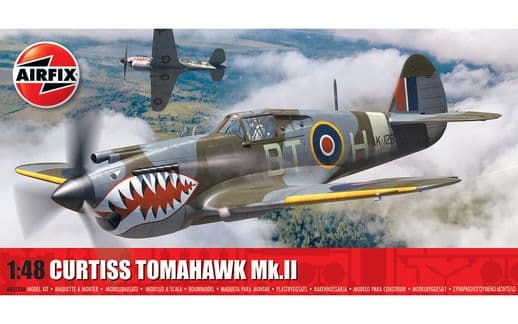
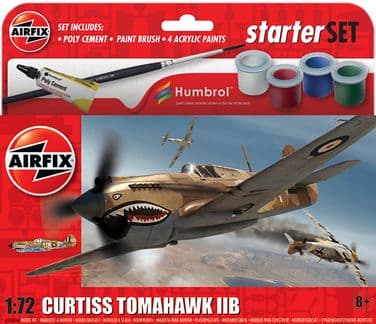
In this latest edition, we welcome our new 1/48th scale Curtiss Tomahawk Mk.II release to the current range by looking a little more closely at the important role this heavily produced American fighter played during the Second World War and how despite seeing service right across the globe, it rarely receives the recognition it deserves, except perhaps from within the modelling world. We also have our usual selection of box artwork imagery, scheme details and a selection of built model images to illustrate the feature, and two extremely unusual aircraft liveries for us to discover.
Blow away those post RIAT weekend blues with the latest edition of Workbench and a new Curtiss Tomahawk kit biting at your tail.
The original artwork produced in support of the initial release from our 1/48th scale Curtiss P-40/Tomahawk tooling back in 2016. The P-40 was purchased in greater numbers than any other American aircraft, when 524 fighters were ordered in April 1939.
With the strategic importance of the aeroplane coming to prominence during the devastation of the Great War, the pace of aviation development advanced at an astonishing rate both throughout the conflict, and the two decades which followed, in the clear knowledge that air power would play a significant role in any future conflict. Unfortunately, that development didn’t advance at the same rate across the world and as some nations prepared for another war, the rest of the world tried to ignore the possibility of a repeat of the horrors of the war to end all wars.
It can sometimes be surprising to consider that as the Wehrmacht rumbled across the Polish border on 1st September 1939, the Royal Air Force still had Handley Page Heyford biplane bombers and Gloster Gladiator fighters in service, yet just 30 months later, the prototype Gloster Meteor jet would take to the sky for the first time. During the period in between, the RAF was forced to fight for its very existence and rely on the support of their friends across the Atlantic to help bolster their aircraft inventory, remaining in the fight until the full weight of America’s military and industrial might could be added to the cause. Some of the aircraft supplied to Britain during that time may not have achieved the recognition the Spitfire and Hurricane enjoyed, however they were equally vital and arguably, some of the most important aircraft of the entire war. One such aircraft was the Curtiss Tomahawk, a rugged and reliable fighter and ground attack aircraft which is often overlooked as one of the leading fighter aircraft of the Second World War, but proved vital in allowing Britain to remain in the war.
Tracing its lineage back to an incredibly successful series of inter-war American biplanes which fulfilled several roles, the Curtiss Hawk series helped to establish its parent company as the leading aeronautical company in America at that time, in terms of aircraft and engine production. As the USAAF were looking to introduce a capable new monoplane fighter during the mid 1930s, it seemed logical that the Curtiss Company would be at the forefront of this project, and indeed their radial engined P-36 would prove significant. Fast, rugged, manoeuvrable and extremely reliable, the P-36 became an export success, where it would be known as the Hawk 75 and even though only 215 of these aircraft would be ordered for the USAAF, 900 would be produced for export customers, with 300 of these being supplied to the French Air Force.
Even as the P-36 was negotiating its US service trials, the aircraft’s designer Donovan Berlin was already exploring ways of improving the performance of the new fighter still further, as he had witnessed the introduction of the latest high-performance fighters in Europe, such as the German Messerschmitt Bf 109 and the British Spitfire. In his opinion, even the latest US designs were about to be outclassed by their European counterparts and he was determined to do something about the situation.
Design screenshot image first published in edition 6 of Workbench, way back in 2015.
His design investigations centred around the use of the powerful new Allison V-1710 V-12 in-line engine, a unit which had been developed to power a new generation of American pursuit aircraft which were all still on their respective drawing boards at that time. If he could adapt his P-36 design to take this new engine, surely this would give his fighter an impressive performance boost. Thankfully, Donovan had incorporated plenty of flexibility into his fighter’s design, and it was intentionally designed to accept new and more powerful engines, as they became available. To this end, he took the Hawk 75 prototype and began work on converting it to take the new Allison in-line engine.
Although clearly based on the existing design, the use of the Allison engine created a very different looking aircraft to its predecessor, with its long, slender nose and cockpit mounted way back along the fuselage giving the aircraft the appearance of a racing aeroplane. Using advanced technologies and a two-stage supercharger, the new aircraft may have looked great and been very fast, however, pilots hated the poor visibility from the cockpit and it was clear that this was no fighting aeroplane. To make things even worse, the conversion work proved to be eye wateringly expensive, making this a definite none-starter as a new fighter project.
Whilst the initial design had proved something of a disappointment, it did serve as an important development stepping stone in the production of the next Curtiss fighter, one which would become one of the most important aircraft in the history of aerial warfare, although it rarely receives the recognition it deserves.
In late 1938, the USAAF were looking to procure an advanced new pursuit fighter and invited the nation’s aircraft manufacturers to compete for the potentially lucrative contract, with Curtiss being well placed to be amongst the frontrunners. It has to be said that at that time, American military planners were thinking specifically about the defence of their nation and not about securing export successes for their aviation industry. As a consequence, the successful aircraft was to be more proficient at patrolling the vast coastline of North America than dogfighting, with range and reliability being the two most important attributes the aircraft should possess.
Utilising the Allison V-1710 V-12 in-line engine, the YP-37 looked more like a high-performance racing aeroplane than a modern fighter.
Learning from their experiences with the YP-37, the XP-40 test aircraft looks much more like the P-40 and Tomahawks we’re used to and would help Curtiss secure the largest aircraft order ever place in America at that time.
They were also of the opinion that the bomber would decide the outcome of any future conflict and how their own bomber force, bristling with machine guns, would be able to defend themselves in any future combat scenario. As the competition progressed and with several slightly more ambitious projects already at the advanced stages of development, they were chiefly looking for a stopgap aircraft, one which was reliable and capable, but one which could be put into production quickly, and subsequently allowing large numbers of aircraft to be put straight into service.
Once again based on their P-36 fighter and learning the lessons from their not so successful XP-37/YP-37 programme, the Curtiss company further developed their sleek Allison engined design, doing away with the complicated dual stage supercharger unit and moving the cockpit back to a more conventional position. Looking resplendent in its polished metal finish, the prototype XP-40 boasted stellar performance on paper, but actually proved quite a disappointment in the air, requiring almost constant modification and improvement in order to keep gaining additional performance from the fighter.
Thankfully for Curtiss, their long-standing reputation with both the US Navy and the USAAF, along with their aircraft’s low cost and ease of construction saw it emerge victorious and whilst this may not seem like a glowing reputation, Curtiss continued to modify and perfect their new aircraft, with successive upgrades all making this a more combat capable aeroplane, one which possessed a host of impressive qualities. Rugged, reliable and if used to its strengths, extremely combat effective, the Curtiss P-40 would become one of the most important fighter aircraft of the Second World War.
Artwork produced for the second release from our 1/48th scale P-40/Tomahawk tooling marked one of the aircraft used by the Royal Air Force in a low altitude reconnaissance and army cooperation role.
With the political situation in Europe worsening and with their need to embark on an immediate programme of modernization, the US Army Air Force placed an order for 524 Curtiss P-40 fighters in April 1939, the largest such order they had ever placed and one which really does underline the important role the new Curtiss fighter would play over the coming few years, but mainly away from American shores. One of the few modern American monoplane fighters in full production at the start of the Second World War, perhaps the most significant development in the history of this aircraft was the decision by the American Government to allow friendly European nations to procure the aircraft immediately.
With both France and Britain keen to secure as many of these new fighters as possible, the vast majority of the early variants would be destined for overseas customers, with just 215 joining USAAF units and an impressive 900 built for export, with no fewer than 300 of these ordered by the French. Ultimately, Curtiss P-40 fighters would go on to see service in the US, Europe, the Middle East, Africa, India, Burma, China, the Southwest Pacific and the Soviet Union and with almost 13,800 aircraft produced, would become the third most produced US fighter of WWII, after the P-47 Thunderbolt and P-51 Mustang. With that being the case, why don’t more people know about the P-40, or regard it as one of the important aircraft of WWII?
The first iteration of the P-40 was subjected to almost constant upgrade and improvement and by the time the French placed their impressively large order, the aircraft was a very different fighting aeroplane and much improved over the first aircraft to enter service. Incorporating many instrumentation changes to facilitate conversion to French Air Force service, many of the other improvements would be incorporated into all future P-40 production, however, with the aircraft still making their way down the production line, France was forced to surrender to invading German forces and the order would be taken over by the British.
Although the P-40 was the product of the impressive American industrial machine, it would be in the hands of Royal Air Force pilots that the new Curtiss fighter would make its combat service introduction, although it has to be said that its introduction proved to be less than inspiring. The first aircraft arrived in Britain during September 1940, with some even being delivered with their French instrumentation still in place. Service introduction trials highlighted the poor performance of the aircraft at altitudes above 15,000 and as European air combat operations regularly took place at altitudes greater than this, it was decided that the fighter, now christened the Tomahawk by the British, should not be used in an interceptor role.
Computer rendered image produced from the 1/48th scale Curtiss P-40/Tomahawk design files.
The aircraft did possess many impressive qualities, however, of those first aircraft, the majority were either allocated to training units, or engaged in helping to perfect Army cooperation tactics. As the first Tomahawk fighters arrived in Britain at the height of the Battle of Britain, there has been some discussion over the years as to the probability of these American fighters being used in combat against the marauding Luftwaffe, particularly as they needed as many fighters as they could get at that time.
As always, the answer isn’t a simple one. Firstly, the aircraft had to successfully negotiate their service acceptance trials, before training and conversion courses could be offered to squadron pilots. Secondly, an almost criminal lack of armour protection for the pilot and vital components, including the lack of self-sealing fuel tanks, made these early P-40s totally unsuitable for combat operations against the cannon armed Bf 109 fighters of the Luftwaffe, even if pilot conversion could be progressed at an astonishing rate.
What isn’t in question is that had the Battle of Britain been lost and German troops attempted to land on British beaches, every one of the RAF’s new Tomahawk fighters would have likely been committed in a ground attack role and against lower altitude aircraft attacks – thankfully, that wasn’t necessary.
British Tomahawks were also the subject of successive improvement and upgrade, with their classification being a little confusing to say the least. Basically, the original French P-40s were referred to internally as the Hawk 81A-1 and known as Tomahawk Is in RAF service. The upgraded P-40B was referred to as the Hawk 81A-2 in export variant and Tomahawk IIs and IIAs on RAF service, with the latter being equipped with .303 machine guns. The P-40C benefitted from self-sealing fuel tanks, better protection for the pilot and better radio equipment – these aircraft were known internally as Hawk 81A-2/3s and the RAF ordered 930 of this variant, however, these were not for service at home. These Tomahawk IIBs were destined for the Desert Air Force and combat in North Africa.
Talk about an aircraft intended to grab the attention, the new kit’s spectacular box artwork marks a unit of RAF Tomahawks which were involved in providing support for training Wellington pilots in air gunnery and defensive flying techniques.
With its service right across the globe during the Second World War and its position as the third most heavily produced US fighter of all time, Airfix have been a scale supporter of the Curtiss P-40/Hawk 81 series since the release of the first 1/72nd scale Kittyhawk model kit way back in 1964, a kit which Workbench readers will possibly remember as a staple of many an Airfix range. This little kit must have been a best seller over the years, because as a subject, it appeared to be one of those aircraft kits which was available in almost every place which carried Airfix kits, be that an actual model shop, a newsagents or general hardware store. As a consequence, we’ve probably all built this kit several times during our modelling lives.
The original kit presented the fighter in Rolls Royce Merlin powered P-40E Kittyhawk configuration, however, we were to get a newly tooled kit of the earlier Allison engine powered variant in 2011, the variant of the aircraft which really earned it its famous reputation, as this was the variant which first entered service with the Royal Air Force and would make its name as the mount of the American Volunteer Group, the famous Flying Tigers. Somehow, the shallower chin profile of the Allison engined P-40s really do lend themselves to the application of sharkmouth nose art, as these aircraft really do look like flying sharks, some of the most distinctive aircraft of the Second World War.
Curtiss P-40 fans were to be further spoilt in 2016, when the Airfix design team turned their attentions to this famous fighter in 1/48th scale, an altogether different modelling proposition and a kit which has always been highly regarded since making its first appearance. In fact, the existence of this project was announced in just the 6th edition of Workbench during the summer of 2015, when it was still negotiating the various stages of its development and was one of the first such projects we were able to follow from announcement right through to release.
The release of this latest kit from our 1/48th scale P-40/Tomahawk tooling is just the third to join an Airfix range and as a modelling project, really does build into one of the most attractive models to grace any display of scale aircraft kits. This latest release comes complete with two new scheme options to choose from, both international operators of the aircraft and both slightly on the unusual side.
Let’s take a closer look at both options now.
As a high-performance aircraft, the arrival of Tomahawks in Britain may not have bolstered the ranks of Spitfires and Hurricanes engaged in the point defence of the country and offensive fighter sweep raids into Northern France, but they did prevent large numbers of British built fighters being diverted from these roles to other home training and support duties which were only slightly less important. The new Tomahawks were generally used in either a training role, for low-level tactical reconnaissance, or for Army Co-operation duties, however, it would be a mistake not to regard these as extremely capable aeroplanes.
Anyone who has been fortunate enough to see one of the few airworthy restored Allison powered Curtiss P-40s which have operated on the UK Airshow circuit will be only too aware of the incredible noise these engines make and how that first experience with one of these aircraft leave you in do doubt that this is a serious performer.
At low to medium altitudes, the strength and survivability of the aircraft’s overall construction would make this a match for any fighter and it would have been quite the potent performer in a training or introductory role, an ideal lead in aircraft for something like a Spitfire, or even the Mustang Mk.Is which replaced it in its Army Co-operation role. In a combat situation, once pilots learned to use the aircraft in high-speed slash and run attacks and never to engage in slow, tight turning dogfights, the Tomahawk came into its own and would make ace pilots of more than 200 airmen.
Full scheme details and a pair of built models all showing this most appealing new scheme option for the latest 1/48th scale Curtiss Tomahawk release.
One of the more interesting uses of British based Tomahawk fighters were the aircraft of No.1686 Bomber (Defence) Training Flight at RAF Hixon in Staffordshire. The aircraft of this unit were required to fly simulated fighter attacks against Wellington bombers, giving air gunners the opportunity to hone their skills in a non-combat situation and give pilots the chance to practice evasive tactics and support their gunners in the effective targeting of attacking aircraft. These practice sorties provided invaluable experience prior to them taking part in their first operational missions, giving them an indication of the speed, sound and experience of aerial combat.
This particular Tomahawk is both appealing and fascinating in equal measure, mainly because it really was unusual for a home-based RAF fighter to be presented so flamboyantly. The fighter was repainted in the Temperate Land Scheme of Dark Green and Ocean Grey, but it’s the oversized sharkmouth nose artwork which makes this quite the unique aeroplane. There are official photographs which show this very aircraft taking off from a rather wintery looking RAF Hixon wearing this actual scheme and whilst these images do provide corroborating evidence of this interesting scheme, other reports paint a far less conclusive picture.
Some reports claim that this Tomahawk was transferred to the unit from the Desert Air Force and the famous RAF No.112 ‘Sharkmouth’ Squadron and simply retained its famous nose artwork, however this has proved difficult to corroborate. The fact that the aircraft has been repainted in this later day fighter scheme may make this appear unlikely. Whatever the story behind the aircraft, it does illustrate the wide variety of different sharkmouth styles applied to British Tomahawk, Kittyhawk and US Hawk fighters throughout the Second World War, something which surely makes these amongst the most photographed and distinctive aircraft of the entire war.
This rather distinctive Tomahawk was involved in a taxiing accident at RAF Hixon on 23rd December 1943, when RNZAF pilot F/Lt L.M. Ralph inadvertently struck a fuel bowser whilst heading either too or from the main runway at the airfield. Whilst he escaped the incident without sustaining serious injury, his aircraft was less fortunate and being classified as beyond economical repair, was immediately scrapped.
By the start of the Second World War, the Turkish Air Force had more than 500 aircraft on strength, making it the largest such force in the Balkan and Middle Eastern region. This was just as well, because a military alliance between Bulgaria and the Axis powers, swiftly followed by the Axis occupation of neighbouring Greece meant that their borders were now surrounded by potentially hostile forces, threatening the status of their neutrality. The Turkish Air Force mounted daily reconnaissance flights over vast areas of territory to keep an eye on Axis operations and to check for any unauthorised incursions into Turkish territory. At night, major cities observed blackouts and a large number of anti-aircraft battery sites scoured the skies for signs of hostile aircraft activity.
In order to maintain a strong and meaningful deterrent threat, a large percentage of Turkish national GDP was allocated towards the purchase of effective military equipment, buying from any nation willing to do business with them. From the perspective of aviation, Turkish student pilots were sent to Britain to undergo intensive training and tragically, more than a dozen young men would lose their lives in training accidents whilst in the UK – one airman would even be lost after he was shot down by a Luftwaffe fighter whilst undertaking a training flight.
During the war, the Turkish Air Force would operate an eclectic selection of aircraft types, as it struggled to create a credible defensive force, and one which also possessed the potential to launch a meaningful strike should their neutrality be challenged. Britain would be a major supplier and would send several marks of Spitfire over the years, plus such types as Hurricanes, Fairey Battles, Ansons, Lysanders, Beauforts, Beaufighters and Mosquitos. They would also supply around 42 former RAF Middle East operated Curtiss Tomahawk fighters to further bolster their capability, aircraft which were initially operated by the recently established XIV Battalion of the 3rd Regiment based at Gaziemir airfield, south of Izmir.
Now for the second scheme option, built sample models and full scheme details for this unusual Turkish Air Force liveried, British supplied Curtiss Tomahawk Mk.IIA.
Although Turkey gratefully accepted these aircraft, it was reported that they were in relatively poor, war weary condition and therefore of limited use from a deterrent perspective. They did help the Air Force in establishing a working infrastructure and give them a clear idea of the aircraft they would be needing as the Second World War progressed – they also gave Turkish pilots valuable training time in high performance aircraft. They would also be used to mount long, wide ranging reconnaissance patrols in the same manner the Americans had originally intended to use the fighter in patrolling the US coastline.
Clearly, if Turkey was going to retain their neutrality, they were going to need more capable, more modern fighter aircraft and their Tomahawks were replaced by British Spitfires, leaving the Tomahawks to serve as training aircraft for pilots selected to convert to Spitfires. Turkey would be quite heavy operators of the Spitfire over the years, taking various marks of the fighter across its production run. They would also be supplied a number of Rolls Royce Merlin powered Kittyhawk fighters as part of the Lend-Lease programme, in an attempt to help the nation retain its neutrality.
It's interesting to note that during its period of neutrality, the country attempted to maintain an equal distance between Allied and Axis powers during the Second World War and would purchase military equipment from both sides throughout that period. This added to the eclectic mix of aeroplanes the force operated, which included Gotha Go 145 trainers and Heinkel He III bombers, but undoubtedly, the most interesting procurement was the purchase of around 70 Focke Wulf Fw190A-3 fighters in exchange for raw materials so desperately needed by Germany. Apparently, Turkish pilots loved flying the German fighters and some reports have suggested that several of these aircraft may have been preserved and buried at Turkish airfields – I wonder if we will ever see these as the basis of a restoration project in the years to come, if this story is true of course.
An appealing new kit addition to the current Airfix range, this beautiful new model not only presents us with an accurate scale representation of this famous fighter, but also a pair of scheme options which are as unusual as they are interesting.
This unusual presentation of a wartime Curtiss Tomahawk fighter really does highlight the incredible international appeal this aircraft possessed and how when the world’s air forces desperately needed support, this third most heavily produced American fighter of the war came to answer their call.
This really is a beautiful model kit, building into a fine representation of this most famous fighting aeroplane. What is only the third release from this impressive tooling is available now and presents us all with two very different, yet rather unusual scheme options to consider finishing our models in. Undoubtedly, the Curtiss P-40/Tomahawk was one of the most distinctive and most important fighting aeroplanes of the Second World War and this fabulous kit really does allow us all to have a fine scale representation of a fighter which is definitely deserving of much more attention than it usually receives.
A05133A 1/48th scale Curtiss Tomahawk Mk.II is available now.
A first look at the full box artwork presentation of this incredibly appealing new model release.
We are afraid that's all we have for you in this latest edition, but we will be back next Friday with more project development updates and the very latest Airfix kit exclusives. In the meantime, we are always keen to hear your views on all things Airfix and in particular, any thoughts and opinions you may have regarding our Workbench blog. If you would like to drop us a quick line, could we please ask that you use our workbench@airfix.com email for all correspondence.
To re-visit any of the Airfix blogs we have produced over the past seven years or so, please head to our main Workbench hub, where you will find our entire blog back catalogue and all the Airfix design projects we have already covered.
All our dedicated official social media sites can be accessed by clicking the respective link icons at the foot of this page, or by heading to the Airfix homepage. Other useful Airfix links are:
Facebook, YouTube, Twitter and Instagram official sites
Please join us for more Airfix updates next week and thank you for your continued support.