
Welcome to this latest edition of our Workbench blog and all the news, updates and modelling exclusives from the fascinating world of Airfix.
As new model additions to this year's Airfix range are now arriving in our warehouse at quite a pace, we will be taking this latest blog opportunity to enjoy one final look at two new kit projects Workbench has been following since the start of the year, both of them just the second releases from their respective toolings and both of them undeniable future classics. We know that our readership loves nothing more than to hear about the latest new tooling projects in advance of their debut releases, however, this can often leave relatively new tooling additions to the range marking only their second releases in something of a modelling no man's land, and we were determined not to let that happen. In both cases, this also gives us the opportunity to admire some beautifully finished models built using advanced production sample components from each of the kits, providing us with all the inspiration and visual confirmation we might require in order to decide whether either one, or both will be in our 2023 build schedule. As became our usual practice in such circumstances last year, we will be posting each update as separate blog, just to make each model a little more visible for those coming to us via a basic web search. As ever, our Workbench blog back catalogue can be accessed by heading to the main Workbench hub and on that particular subject, can you believe that this coming summer, we will be celebrating eight years of Workbench and all that fascinating Airfix development detail.
As you will have probably guessed from the unambiguous title above, his post will be our final Workbench look at the new 1/72nd scale Hawker Tempest V kit, our scale tribute to one of the most potent piston engined aircraft ever to see Royal Air Force service and one which marks the transition from the ultimate piston powered designs, to the jet technology which drives aviation development to this day. In our second blog posting for this week, we will be focusing on a perennial modelling favourite and only the second release from our new de Havilland Mosquito tooling, this time in PR.XVI guise, the unarmed 'Wooden Wonder' which plied its trade spying on the enemy. Both updates will include a selection of exclusive built model imagery and we will also be re-visiting the details behind both of the scheme options included with each respective release. There isn't a jet engine in sight as we bring you our latest dual blog Workbench weekend update posting.
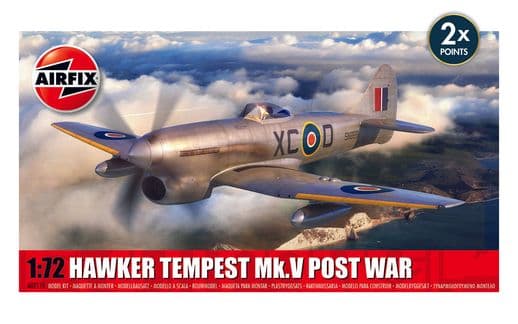
The new box artwork produced to support this release shows the Hawker Tempest in a sleek natural metal post war scheme, the lead decal option for what will only be the second release from this spectacular new tooling.
When posing such a thought provoking question as the section title above, you can be absolutely certain that discussions which arise from it will be as vociferous as they are convincing and you will end up with as many people agreeing with the statement as arguing against it, but there is one related statement which few will argue against. Had there been a stronger Luftwaffe to engage in combat following the introduction of the Hawker Tempest V, surely this potent piston engined fighter would have become the scourge of the Luftwaffe and an aircraft they would have hated to have met in the skies above Europe.
The Tempest was the culmination of Hawker Aircraft Limited's long standing desire to produce a worthy successor to their famous Hurricane, an aircraft which could dominate the skies and be capable of living up to their self-imposed 'Super Hurricane' tag. It would be a further development of the Hawker Typhoon which preceded it, a real brute of an aeroplane and one which was an aviation attempt to marry the most powerful piston engine available at the time with a relatively diminutive, yet robust airframe. Although developed as a medium to high altitude interceptor fighter, it quickly became apparent during development trials that Hawker's new fighter would not be suitable for such a role, as the thickness of the aircraft's wing actually hampered its performance at higher altitudes.
Of greater concern than this, the Typhoon would be forced to endure quite a troubled development and protracted service introduction, to the point where cancellation of the entire programme was seriously considered at one time. In the end, thanks to continued development and the steadfast support of Hawker test pilot Roland Beamont (who would later demonstrate the effectiveness of the aircraft in operational environments), the Typhoon would go on to find its operational niche as a hard-hitting ground attack aircraft and one which would come into its own during preparations for the Allied invasion of Normandy and the months of intense fighting which followed.
Although there was no doubting the fact that the Typhoon possessed huge potential, it did become clear quite early in its development that it wouldn’t be able to fulfil its intended role as Britain's next high performance interceptor and as a result, Hawker's search for their 'Super Hurricane' would go on. Nevertheless, much of the design and flight data information secured during its development would subsequently be used as the starting point for a new fighter project, one which would incorporate many significant improvements over the Typhoon's design, a project which was initially referred to as the Typhoon Mark II project (within the Hawker circles at least). Prior to its maiden flight, the name of the new aircraft was changed to 'Tempest', but just like its predecessor, it was a real brute of an aeroplane.
An exclusive first look at built models finished in both of the new scheme options offered with this second release from our new 1/72nd scale Hawker Tempest V tooling.
Although the Tempest was still relatively large for a single engined fighter, its airframe was extremely light, but was powered by an upgraded and more mature variant of the incredibly powerful 24 cylinder Napier Sabre engine which powered its predecessor. Making its first flight on 2nd September 1942, the Hawker Tempest featured a newly designed laminar flow wing which was much thinner than the one used on its predecessor and allowed the new fighter to slip through the air at incredible speeds. When viewing the aircraft from most angles, the Tempest V bears more than a passing resemblance to the Typhoon which preceded it into service, however, this was a very different aircraft and one which was destined to become the RAF's premier piston engined fighter of the day.
If a Tempest and Typhoon were placed side by side, it wouldn't be difficult to spot some distinct differences in the design of each, however, when looking at a Tempest in flight, this distinction can be a little more challenging to confirm. The most significant distinguishing feature between the two types is their respective wing design, with the Tempest employing a much thinner laminar flow design for better performance at higher altitudes, one which conveniently also happens to be a completely different shape to the one used on the Typhoon. With a straight leading edge and distinctive elliptical trailing edge profile, the Tempest’s wing was designed for speed, even though it could still be adapted for use in a ground attack role. Other Tempest design differences include a slightly longer nose and a tail section which appears to be much larger, with a more generous vertical stabiliser and pronounced dorsal fillet.
During the prototype aircraft’s maiden flight, it would post an impressive top speed of 477 mph in level flight, to the delight of both the design team and the watching Air Ministry.
The mighty Hawker Tempest V entered Royal Air Force service in early 1944 and in order to ease the transition of pilots and ground crews onto this powerful new fighter, it was decided that the first two squadrons to receive the type should both have previously operated its predecessor, the Typhoon. It was thought that managing the incredible power generated by the Tempest’s mighty Napier Sabre engine could pose problems for pilots converting from other aircraft types, but how former Typhoon units would at least have prior experience in managing that power, thus ensuring a more effective service introduction for the new fighter.
From this angle it's easy to see how the wing shape of the Tempest V was very different to that of its predecessor, the Hawker Typhoon.
It's interesting to note that the first 100 series 1 Tempest fighters were built by Hawkers at their Langley factory and actually made use of many components from Typhoon production. These aircraft featured the Hispano Mk.II cannon, with their positioning in the wing meaning that the guns protruded beyond the leading edge, something which serves as the most visible identifier between these early aircraft and subsequent production runs of the fighter. The Series 1 Tempests also incorporated the tail strengthening ‘fish plates’ which were used on the Typhoon, with this additional reinforcement dictating that these particular aircraft did not have a detachable tail unit. These first 100 Series 1 Tempests were all fitted with larger Typhoon main wheels and allocated serial numbers with a JN prefix.
The next 300 Series 2 Tempest fighters were fitted with the new short barrelled Hispano Mk.V cannon, a weapon which could be completely housed within the wing of the aircraft, leaving just the gun ports visible in the leading edge of the wing. The reinforcement measures applied to the first 100 (Series 1) machines were now deemed unnecessary, which meant that from this series onwards, the tail assembly of the Tempest could be detached, with additional provision for two underwing 45 gallon drop tanks to be fitted if required. The first 300 of these Series 2 Tempest V fighters were built by the Gloster Aircraft Company and had serial numbers prefixed by the letters EJ. Two further additional orders for Series 2 Tempests would be placed, bringing the total production of the Mark V variant of the fighter to 801 aircraft.
As the Tempest represented the very pinnacle of piston engined fighter performance and entered service relatively late in WWII, the aircraft would remain in service during the uncertain period which followed the war, even though the major world powers were now looking towards jet power for their front line fighter units. Interestingly, the two scheme options which accompany the second release from our new Tempest V tooling both represent aircraft which were in service during this period and from a presentation perspective, could hardly be more different - let's take a look at them now.
During the final months of the war, there was some competition between Tempest units and those operating the new jet powered Meteor, an aircraft which may have pointed to the future of aviation, but at that time, was still in the very early stages of its technological development. Proud of their new jet fighter, the RAF were happy to allow the misnomer that the Meteor was the only British aircraft fast enough to catch the German V-1 Doodlebugs which were being hurled towards Britain in the weeks and months which followed D-Day, but this is simply not the case. Any former Tempest pilot will tell you in no uncertain terms that their aircraft was more than capable of chasing down a V-1 and indeed, many more Doodlebugs would fall to the guns of Tempests than they would to any other aircraft type. This determination to put the record straight was made all the more important for them as Tempest units were prevented from joining the rest of the RAF in immediate post D-Day operations. As the RAF's most potent fighter, they were held back for home defence duties, however, the V-1 onslaught gave them their opportunity to make a telling contribution to the air war.
RAF No.26 Squadron would actually spend their time in preparation for D-Day by retraining to perform a vital naval gunnery spotting role, using their Spitfires to provide real-time information to naval gunners engaged in the bombardment of strategic coastal targets. By the end of the year, they would revert to a traditional reconnaissance role, flying operations over Holland using their new Mustangs, but by the spring of the following year, would once again be called upon to provide their specialist naval gunnery support. In April 1945, the squadron would spend two weeks supporting French warships as they targeted pockets of remaining German resistance off the French coast, which they quickly neutralised.
Just look at that panel detail. In this natural metal finish, you really do get a much clearer appreciation of the beautifully clean lines of this stunning aeroplane, one of the most potent piston engined fighters to have ever taken to the skies.
Following their final naval spotting commitment, the squadron would go on to operate from bases in Germany, but with the end of the Second World War, the 2nd Tactical Air Force, or the British Air Force of Occupation as it was renamed, would undergo quite a period of change. In April 1946, No.26 Squadron was disbanded, but on the same day, No.41 Squadron was re-numbered No.26 Squadron and as part of No.135 Wing, would fly their Tempest fighters at Wunstorf for the remainder of the Tempests service in Germany. It does have to be said that before Tempests were finally withdrawn from Germany the Bristol Centaurus powered Tempest II had replaced many of the earlier Mk.V variants in service.
From a modeller's perspective, perhaps the most interesting period of RAF Tempest operations came from March 1945 onwards, when orders were issued that Fighter Command could dispense with wartime camouflage and replace it with either a silver doped or natural metal finish. Despite this, aircraft already in service and those already in production would generally retain their wartime markings, so during this period, the appearance of silver and natural metal aircraft proved to be the exception rather than the rule. By 1946, a firm order was issued for the removal of all camouflage from fighter aircraft and the drab, weathered appearance of war weary Hawker Tempests was transformed almost overnight, with gleaming natural metal speedsters emerging from paint shops in RAF Germany and didn't they look spectacular!
Making for an interesting subject change from building a Spitfire, the Hawker Tempest was reputedly the Allied aircraft Messerschmitt Me 262 pilots would least like to come across during operational sorties.
It's interesting to note that the subject of this lead scheme, Tempest SN228, was the former personal mount of New Zealand ace Wing Commander Evan Dall 'Rosie' Mackie, in his role commanding No.122 Wing, the 'Tempest Wing'. Mackie would end the war as the most successful New Zealand fighter ace of WWII, with 21.5 confirmed aerial victories and 5.5 of this number scored whilst flying the Hawker Tempest. SN228 would later pass to the care of No.41 Squadron and was still there in April 1946 when the unit was re-numbered No.26 Squadron. There, it would become the personal aircraft of Squadron Leader Henry 'Poppa' Ambrose, during whose tenure the aircraft would be stripped of its camouflage paint scheme and presented in a smart natural metal finish, showing of the purposeful lines of this most potent fighter aircraft.
Our Researcher Luke wanted to have this as the lead scheme option for this second Tempest release because it was just so different to the two finishes included with the first release from this impressive new tooling and many of us will find this an irresistible option when building our kit. During his Tempest research, he came across an interesting logbook entry whilst searching through artifacts held at RAF Manston History Museum. He discovered an entry which detailed a logged flight by Sqn Ldr Henry 'Poppa' Ambrose at the end of April 1946, where he returned to RAF Manston in his natural metal Tempest having recently taken part in dive-bombing exercises on the Fassberg Ranges in Germany. This inspired Luke to commission the stunning artwork which will be featured on the box of this future release, commemorating not only a beautifully presented Hawker Tempest, but also one of the most impressive modes of transport anyone could have ever used as their personal conveyance. When Sydney Camm envisaged what his 'Super Hurricane' would look like, surely it must have looked something like this.
Hawker Tempest V deliveries to front line RAF squadrons began from April 1944 and by the end of the following year, seven squadrons would be equipped with this most potent of fighting aeroplanes. Initially used in the home defence role combatting the V-1 Doodlebug menace, RAF Tempests would later be released to forage for enemy targets over enemy occupied Europe, hunting down potential V-1 launch sites and helping to quell the threat posed by the Luftwaffe's Messerschmitt Me 262 jet fighter. During air combat engagements with a depleted Luftwaffe, RAF Tempest units reported a combat success ratio of 7:1, with this number only falling to a still impressive 6:1 when engaged with Luftwaffe single engined fighters. The top scoring Tempest ace was an American pilot flying with a RCAF unit, with Sqn Ldr David Fairbanks scoring an impressive 12 victories before he himself was brought down over enemy territory, to become a prisoner of war.
Ultimately, the wartime career of the Hawker Tempest would only last for around a year, however, during that time and despite the Luftwaffe being seriously depleted and unable to regularly challenge the Allies in anything like significant numbers, Tempest units still managed to claim a large number of enemy aircraft destroyed. In fact, following the end of the war, Luftwaffe Messerschmitt Me 262 jet pilots who were interviewed by Allied interrogators described how the aircraft they feared most whilst engaged in their final combat sorties was the British Tempest - fast, manoeuvrable and heavily armed, the German jet was no match for the British fighter if it were not already at combat speed.
Now which one do we go for? We thought the first scheme option made for such a nice change, but when looking at this, what on earth are we going to do?
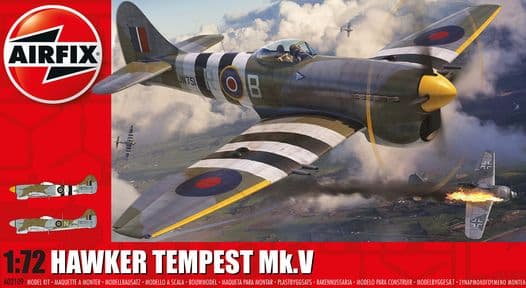
RAF No.80 Squadron was assigned to the air defence of Britain around the time of the D-Day landings and whilst other similar units were fully engaged in Operation Overlord preparations and would later move to Advanced Landing Grounds in Normandy, No.80 Sqn would remain in the UK. Trading their Spitfire IX fighters for Hawker Tempests, they would themselves be fully committed to 'Operation Diver' and the defence of southern Britain against the terrifyingly indiscriminate threat posed by the German V-1 flying bomb campaign. Once this threat had diminished following the advance of Allied troops into the launch site areas, No 80 Squadron would also be sent to the continent, continuing to fly in the fighter/air defence role until the end of the war, then going on to form part of the British Air Force of Occupation in Germany.
No.80 Squadron would fly patrol and armed reconnaissance sorties from their base at B.116 ALG Wunstorf during this increasingly volatile period of European history, but would be relocated to Hong Kong in July 1949, having previously traded their Hawker Tempests for Supermarine Spitfire Mk.24s. Tempest V EJ865 was one of 300 Series 2 aircraft built by the Gloster Company and is an example of one of Britain's most potent fighting aeroplanes of the piston powered era.
A brute of an aeroplane, the Tempest V can trace its linage back to the Hawker Hurricane fighters which fought during the Battles of France and Britain and was unquestionably one of the most capable piston engined fighters to have ever seen service with the Royal Air Force.
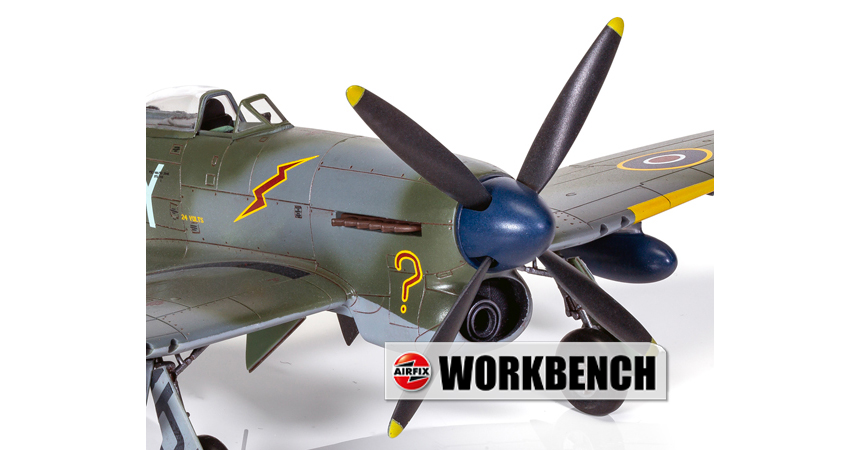
This second scheme option sports an unusually flamboyant compliment of fuselage markings and when combined with its blue 'flight' coloured spinner and single drop tank, and lightning flash motif, will make for a particularly attractive addition to any model display. As some late war Tempests were required to change units several times in a relatively short period of time, the yellow bordered red lightning flash on this aircraft (EJ865) is a link to the aircraft's time serving with RAF No.274 Squadron, which would later be re-numbered to No.174 Squadron. The end of WWII would see a gradual reduction in RAF unit numbers based in Germany and No.174 Squadron would be disbanded, with EJ865 passing into the care of No.80 Squadron at Wunstorf as a result.
On joining No.80 Squadron, EJ865 was allocated to 'B Flight' and as such, inherited a blue spinner and interestingly, blue long-range fuel tanks, although on operations, the aircraft would have presumably flown with whatever tanks were serviceable at the time. We are less certain about the origins of the question mark which appeared on both sides of the aircraft's radiator/air intake scoop and would appreciate any information our knowledgeable readers could share with us. Nevertheless, the two scheme options which accompany this second Tempest release could hardly be more different from one another, despite the fact that both are incredibly appealing in their own right. Which of the two scheme options do you prefer?
As is the case with the new Photo Reconnaissance Mosquito, the new Hawker Tempest V kit is available now and with the lead scheme/box artwork being inspired by information uncovered by our researcher Luke during his investigations, this stunning natural metal finish option will prove difficult for most of us to overlook when it comes to finishing our model builds.
Now in good model shops everywhere, the new Hawker Tempest Mk.V kit is the one to look out for during your next visit.
How on earth are we going to choose between these very different but equally appealing schemes?
We are afraid that's all we have for you in this latest edition, but we will be back next Friday with more project development updates and the very latest Airfix kit exclusives. In the meantime, we are always keen to hear your views on all things Airfix and in particular, any thoughts and opinions you may have regarding our Workbench blog. If you would like to drop us a quick line, could we please ask that you use our workbench@airfix.com email for all correspondence.
To re-visit any of the Airfix blogs we have produced over the past seven years or so, please head to our main Workbench hub, where you will find our entire blog back catalogue and as this is a dual blog release week, please don't forget to check out the de Havilland Mosquito PR.XVI update edition posted separately.
All our dedicated official social media sites can be accessed by clicking the respective link icons at the foot of this page, or by heading to the Airfix homepage. Other useful Airfix links are:
Facebook, YouTube, Twitter and Instagram official sites
Please join us for more Airfix updates next week and thank you for your continued support.