
Welcome to this latest edition of our Workbench blog and all the news, updates, and modelling exclusives from the fascinating world of Airfix.
In the previous edition of Workbench, we marked the release of our latest scale model kit tribute to the Supermarine Spitfire by looking at the heritage of this magnificent aircraft, not only the famous prototype aircraft, but also the Schneider Trophy winning seaplane series from which Britain’s new fighter took inspiration. In aviation terms, there are few aircraft which could even attempt to follow the incredible legacy of the Spitfire as a blog subject, but one which would fit the bill perfectly, the Spitfire’s traditional adversary, the Messerschmitt Bf 109.
In addition to the impressive aviation credentials possessed by the Messerschmitt Bf 109, the timing of this scale modelling related tribute could hardly be more appropriate, as this month marks the 90th anniversary of the first flight of the prototype aircraft, an aircraft which would go on to be produced in even greater numbers that the Spitfire. An aircraft type which was in service from the first day of the Second World War to the very last, if any aircraft could claim to rival the Spitfire in terms of the impact it made on the aviation world, then it must surely be the Bf 109. We will be taking this opportunity to look at the lineage of this most famous fighter, along with how it has been represented within the Airfix kit range over the years, across all the various scales.
Marking the birth of modern monoplane aviation, we find ourselves once again in the company of one of the world’s great aeroplanes in the latest edition of Workbench.
Intended as a short range interceptor to work in conjunction with the army and to prevent enemy reconnaissance aircraft from operating in contested areas, the Messerschmitt Bf 109 would become much more than that.
For an aircraft which presented the Luftwaffe with one of the finest fighting aeroplanes ever to take to the skies, and one which would place them at the very forefront of aviation technology during the second half of the 1930s, it can be interesting to learn that the aircraft didn’t exactly have the best of starts, and because of a high profile clash of personalities, almost didn’t even get off the ground. When the prototype eventually did make it into the sky, it only did so thanks to a British Rolls-Royce engine.
There is an old saying in business that states, it’s not what you know, it’s who you know, and for the chief designer at Bayerische Flugzeugwerke Willy Messerschmitt, this was certainly something he would have agreed with. Flowing the death of a famous test pilot whilst flying one of his transport aircraft designs, he made a staunch enemy of Erhard Milch, a Great War ace pilot and influential State Secretary of the Reich Air Ministry. The pilot killed in the crash was Hans Hackman, a close personal friend of Milch, who was devastated by his demise, with the situation being made personal by Willy Messerschmitt’s perceived lack of remorse, or compassion at the loss. In his position of significant influence, Milch was determined to make those he viewed as being responsible for his friend’s death pay a heavy business price, and went out of his way to undermine them at every opportunity.
Thankfully for Messerschmitt, he had a reputation for being one of the most innovative minds in world aviation at that time, a man who had also managed to cultivate his own friends in high places, meaning that this personality class didn’t prove too detrimental in the end.
The origins of the new Messerschmitt fighter go back to 1934, and specifications issued by the RLM for the production of a new breed of aircraft, a fast and manoeuvrable monoplane interceptor, at a time when the aviation world was dominated by biplane designs. As Germany was still bound by the restrictive terms of the Treaty of Versailles, Willy Messerschmitt had gained significant design experience in the production of advanced sports touring aeroplanes, such as the Bf 108 Taifun, an exceptional little aeroplane which incorporated a host of advanced features, and was regarded as an exceptional design.
Adopting a similar design philosophy to their existing Messerschmitt Bf 108 Taifun sports/touring aircraft which made its own first flight in 1934, and was introduced the following year, the new fighter utilised lightweight construction principles and from the very beginning, was designed with the intention of being mass produced. The design incorporated the use of large and robust brackets at the firewall bulkhead, serving as anchor points for the lower engine mounts and main undercarriage pivot points. Whilst this did allow the wings to be removed with a minimum of fuss for transportation or whatever, it did give the fighter its characteristic narrow track undercarriage, something which always made ground handling somewhat challenging.
The Messerschmitt Bf 108 Taifun was an advanced four seat sports touring aeroplane, one which unlocked many design secrets on the fighter project Messerschmitt turned their hand to next.
As the prototype aircraft neared the date of its first flight, the project was in danger of suffering significant delay, as the new Junkers Jumo engine was still some way off being available, something which forcing a radical solution to be sought. That solution proved to be a deal struck with the Rolls Royce Company in Britain, whereby four Kestrel VI engines were secured in exchange for a Heinkel He 70 Blitz aircraft, which the British company used as an engine testbed for future development programs. Powered by the Rolls Royce engine, the prototype Bf 109 (V1) made its first flight at the end of May 1935, however, it would be a further twelve months before the Junkers Jumo powered prototype took to the air.
Historically, the Germans used the summer Olympics of 1936 to reveal their capable new fighter aircraft to the watching world and whilst everyone marvelled at the achievements of the world’s greatest athletes, military officials across Europe watched with trepidation as this new fighter took to the skies, immediately stepping up their own regeneration programmes, as the threat of future conflict had just increased exponentially.
Entering Luftwaffe service in February 1937, the Messerschmitt Bf 109 fighter also equipped the German Expeditionary Air Force which took part in the Spanish Civil War, where the performance of the fighter was later evaluated, and improvements made after allowing service pilots to make their recommendations. In fact, with over 34,000 aircraft eventually produced, the Bf 109 was subjected to almost constant improvement and development throughout its service career.
The most heavily produced of all the early Bf 109 variants, these aircraft made use of the Daimler Benz 600 series engine, one of the great aero engines of the 20th century.
The first four production variants of the Messerschmitt Bf 109 were all powered by the Junkers Jumo 210 engine, an advanced unit which was Germany's first truly modern engine design, however, front line fighter aircraft are always looking to benefit from ever greater speeds, and this search would lead to the first major re-design of the Bf 109 with the introduction of the 'E' or 'Emil' variant, the aircraft which was in widespread service during the Battle of Britain. This mature version of the fighter adopted the more powerful Daimler Benz DB600 series powerplant, a 33-litre direct fuel injected inverted V12 unit which made the Luftwaffe's main fighter even more combat effective – the French and British air forces would have their hands full with this capable warbird.
The adoption of this new engine did require extensive design modifications to be adopted, not only around the areas of the mounting frame and engine cowling to shoehorn this larger, more powerful powerplant into what was actually a relatively small fighter aircraft, but also to add additional cooling ducting around the inner wing sections, to provide effective cooling for this beast of an engine. In fact, it's interesting to note that the development of both the Messerschmitt Bf 109 and its famous British adversary, the Spitfire, went hand in glove with engine development, ensuring that both could remain at the forefront of world fighter performance and more specifically, competitive with each other.
Earlier variants of the lightweight Bf 109 had to be upgraded once the Germans learned that the new British Hawker Hurricane and Supermarine Spitfire fighters would be equipped with eight machine guns each, forcing the Messerschmitt to take on greater firepower and the resultant increase in weight that brought with it. Forming the backbone of the Luftwaffe’s fighter force, around 200 Messerschmitt Bf109 fighters were committed to the attack against Poland, where around 60 would be lost, mostly to ground fire.
As the Wehrmacht turned its attention towards the west, the excellent close coordination between air and ground forces saw them roll through Europe to the French border in a frighteningly short period of time, however, with France being the next country to face the might of the modern German military, the Germans would surely be facing a much stiffer test. The two opposing forces were of a similar size and strength and in many respects, the French would have the upper hand when it came to ground forces and anti-aircraft defences.
The Messerschmitt Bf 109 met its match when facing Fighter Command, starting with the air battles above the beaches of Dunkirk, and more famously during the Battle of Britain. Surely this has to be the most famous aerial duel pairing in the history of conflict.
Unfortunately, the French had organised their military forces in line with outdated concepts and doctrines and a lack of radar effectively relegated their air force to mounting standing patrols and being on the back foot from the start. With around 1,000 Bf 109 fighters allocated for the coming offensive against France, the Luftwaffe was now a well-oiled fighting machine and in less than a week, they managed to deplete the French air force to 1/3rd of its fighting strength and in the month from 10th May 1940, the Allies had lost 1,850 aircraft, with 950 of these being French.
Operationally, the Messerschmitt Bf 109 was an impressive aeroplane indeed, with the ‘Emil’ being the first fully mass-produced variant of the fighter. The design of the fighter intentionally made ease of access to its systems a priority, so ground crews could easily work on the aircraft when they were deployed at forward operating airfields. Guns, cooling and electrical systems could all be accessed easily, and the engine cowling featured large removable panels, which were secured using robust toggle latches, which were incredibly simple to operate. Should an engine need to be changed completely, the design of the aircraft allowed the entire process to be completed by an experienced team in just a matter of minutes.
Despite many people believing that the Battle of France was an easy victory for the Germans, from an aviation perspective at least, the Luftwaffe didn’t have it all their own way. Although a great many Allied aircraft were lost, the Luftwaffe would also lose a significant number of aircraft, including large numbers of Messerschmitt Bf 109 fighters. Indeed, those Allied airmen who fought so valiantly during the Battle of France believed that their efforts in weakening the Luftwaffe proved to be a major factor in their subsequent inability to overcome Fighter Command during the Battle of Britain.
Ultimately, around 53 Luftwaffe pilots would attain ‘Ace’ status during the Battle of France, with Wilhelm Balthasar of JG.1 being the most successful, with 23 victories to his name. As the Luftwaffe’s Jagdgeschwaders moved to new bases in Northern France in advance of operations against Britain, their pilots may have been supremely confident in their abilities, however, things would be very different when fighting over the English Channel.
Despite the Messerschmitt Bf 109 becoming arguably the most famous aircraft operated by the Luftwaffe during the Second World War, and the one most feared by Fighter Command, certainly during the summer of 1940, it’s interesting to note that it wasn’t seen as the most important aircraft type from an operational perspective, immediately prior to the start of the Second World War. That was reserved for the much vaunted Zerstörer force favoured by Hermann Göring, larger, more powerful aircraft, which were seen as bomber destroyers and airspace dominators. Wherever the Wehrmacht was on the advance, it was the Zerstörer force that would be sweeping the skies clear of enemy aircraft.
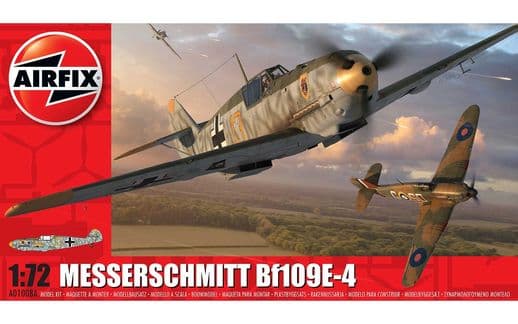
Classic Airfix box artwork representation showing a pair of Battle of Britain era Messerschmitt Bf 109E-3s.
Initially at least, the Messerschmitt Bf 109 was seen as a point defence aircraft, working closely with, and protecting ground forces, whilst also required to deny the enemy the ability to mount reconnaissance sorties in the airspace above them. In fact, despite the fact that more of them were produced, they were of much lower importance than the larger Messerschmitt Bf 110, the heavy fighter so championed by Göring.
Early combat operations following the start of the Second World War soon changed that thinking, with the Bf 109 quickly showing its operational effectiveness. Small and highly manoeuvrable, almost like an armed aerobatic aircraft, the Bf 109 was much more adept at clearing the skies of enemy aircraft, whilst the larger Destroyers proved inferior against lighter, single engined fighters, and were much more suited to supporting ground forces, with their range and heavier firepower.
In addition to this, the single engined Bf 109 was much easier and cheaper to produce than their twin engined counterparts, were able to operate from more basic airfields, and were highly flexible when it came to moving forward to recently captured enemy airfields. Messerschmitt Bf 109 pilots wasted no time in showing what their aircraft could do, and at the same time redressing the strange favouritism the twin engined heavy fighters initially had over them. Willy Messerschmitt’s diminutive little war eagle was here to stay.
The Bf 109 Friedrich was a thoroughbred fighting aeroplane, sleek and cultured to look at, but a deadly adversary in combat.
When we think about the aerial struggle for air supremacy during the Second World War, even though this was contested for six long years and involved many aircraft types and their crews from many nations, there are two aircraft in particular which have historically become almost inseparable, airborne gladiators in an amphitheatre amongst the clouds, the Spitfire and Messerschmitt. Although both names have become synonymous with successful fighter aircraft, both are used to describe a successful series of fighter designs which saw service throughout WWII, with both undergoing almost constant development during that time. In both cases, the aircraft variants which remained in service in 1945 were very different to the ones which fired their guns in anger for the first time in 1939.
Although the Messerschmitt Bf 109 fighter had already earned a fearsome reputation by the time the first skirmishes of the Battle of Britain started to take place, the fighter variant which was preparing to take on the Royal Air Force was a very different aircraft from the ones which had entered service just over three years earlier. Undoubtedly one of the most famous fighting aeroplanes in the history of flight, the Bf 109 was at the forefront of world fighter design, combining a light and diminutive airframe with a powerful engine and heavy armament, everything an aeroplane required to enable it to dominate the skies.
The first four variants of the Messerschmitt Bf 109 were all powered by the Junkers Jumo 210 engine, an advanced unit which was Germany's first truly modern engine design, however, front line fighter aircraft are always looking to attain ever greater speeds and this search would lead to the first major re-design of the Bf 109 with the introduction of the 'E' or 'Emil' variant, the aircraft which was in widespread service during the Battle of Britain. This more mature version of the fighter adopted the more powerful Daimler Benz DB600 series powerplant, a 33-litre direct fuel injected inverted V12 unit which made the Luftwaffe's main fighter even more combat effective – the RAF would have their hands full with this warbird.
The adoption of this new engine did require extensive design modifications to be carried out, not only around the areas of the mounting frame and engine cowling to shoehorn this larger, more powerful powerplant into what was actually a relatively small fighter aircraft, but also to add additional cooling ducting around the inner wing sections, to provide effective cooling for this beast of an engine. In fact, it's interesting to note that the development of both the Messerschmitt Bf 109 and its famous British adversary, the Spitfire, went hand in glove with engine development, ensuring that both could remain at the forefront of world fighter performance and more specifically, competitive with each other.
By the time of the Battle of Britain, there were some major differences between the engines powering the two leading fighters in the conflict which are certainly worthy of note. Although both engines were roughly the same in terms of size, weight and performance, the Merlin III had a capacity of 27 litres, whilst the Daimler Benz unit sported 33.9 litres, however, the main difference came in a combat situation. The direct fuel injection system of the DB 601 gave the Messerschmitt fighter a distinct advantage in how fuel flow to the engine was maintained during all manner of manoeuvres, something the carburettor fed system of the Merlin could not match.
In either an attacking situation, or if a Messerschmitt pilot found himself in trouble, pushing the control stick forward and diving for the ground, or by rolling inverted would invariably allow the 109 to escape, with the Merlin engine of British fighters coughing and spluttering as they attempted the same manoeuvre, with the fuel flow to their Rolls Royce Merlin engine being temporarily disrupted due to centrifugal forces.
A less well-known difference between the Merlin III and Daimler Benz DB 601 engines was that the German powerplant had been designed from inception to be a mass-produced unit and as such, was much less complicated a design than the Rolls Royce Merlin. In fact, there were half as many components in the German designed engine, meaning that they were both quicker and easier to manufacture unit for unit.
Where the Germans eventually lost this engine development advantage, however, was how their engineers appeared preoccupied with experimental research, rather than making incremental updates to existing powerplant technologies, something Rolls Royce proved to be extremely proficient at doing. Had the Messerschmitt Bf 109 benefitted from regular, incremental engine upgrades, the second half of 1940 could have been even more problematic for the RAF's Fighter Command than it proved to be.
Nevertheless, even whilst the Luftwaffe and Royal Air Force were contesting the Battle of Britain, a capable new variant of the Messerschmitt had been negotiating the final stages of its development programme, a new fighter which would take the capabilities of this fearsome fighter to new heights, the Bf 109F or ‘Friedrich’.
Having enlisted the support of fighter pilots who served through the Polish campaign and onward to the strike west, Messerschmitt designers began work on producing a new, more capable variant of the Bf 109 in early 1940 and by the end of the year, pre-production examples were already taking to the air. Powered by the latest 1175hp Daimler Benz DB601E engine, the ‘Friedrich’ also introduced a host of other improvements and design changes which were to give this variant a very different appearance.
Featuring a lengthened, more streamlined cowling to house the new engine, this was a much more refined design than its angular predecessor and with its much larger spinner, shorted propeller blades and retractable tail wheel, this new variant was a much more cultured Messerschmitt in every respect. The wings would also be the subject of redesign, with wing armament deleted completely on the new model to increase the strength of the wings, and the square wing tip design of the ‘Emil’ replaced by rounded tips on the ‘Friedrich’. Fast, highly manoeuvrable and hard-hitting, the Bf 109F was a lightweight fighter pilot’s aeroplane in every respect and the Luftwaffe loved them. More than a match for the latest variant of Spitfire, the Bf 109F would become the mount of aces, a true dogfighting aeroplane in every sense of the word.
Although still a competent fighting aeroplane, if a Friedrich came up against one of the latest breed of Allied fighters towards the end of the Second World War, there would probably only be one winner.
The Friedrich would join combat units from the late spring of 1941 and would see extensive service on both the Western and Eastern Fronts, in addition to serving in some numbers above the deserts of North Africa, with a great many pilots using this aircraft to build up impressive victory tallies against their adversaries. In North Africa, celebrated ace pilot Hans Joachim Marseille used the ‘Friedrich’ to claim the majority of his 158 aerial victories, and it was claimed that he was so attached to his Bf 109 ‘Friedrich’ fighter, that he flatly refused to upgrade to the latest ‘G’ variant, until directly ordered to do so by Luftwaffe officials. He felt the new aircraft was too heavy and less manoeuvrable than his current mount, which in his mind were both deficiencies which would negate his combat advantage.
The only aspect of the Messerschmitt Bf 109F’s design pilots wished could be improved was its lack of firepower, even though they knew only too well that the subsequent increase in combat weight would adversely affect the aircraft’s almost legendary manoeuvrability. Unfortunately for the Luftwaffe, the war was evolving at quite a rate by this stage, and with USAAF bombers now attacking targets deep into Germany itself, the Luftwaffe needed an even more powerful fighter to combat them, one which could operate at higher altitudes, and be able to bring much greater firepower to bear, the Bf 109G ‘Gustav’.
The most manoeuvrable of all the Messerschmitt Bf 109 series of fighters would be required to give way to a more ‘universal’ variant, one which may well have been more powerful in every respect, but one which was also significantly heavier than its agile predecessor. Although the ‘Gustav’ would become by far the most heavily produced variant of the Messerschmitt Bf 109 series of fighters, the most cultured, the most manoeuvrable and the best dogfighting variant of this famous fighting aeroplane was unquestionably the ‘Friedrich’.
As a bomber killer, the Bf 109G was ruthlessly effective, however, the additional weight of its heavy armament made it less effective as a dogfighter, and therefore at risk of becoming prey to the bombers ‘Little Friends’.
With the basic Bf 109 airframe proving adaptable enough to accept modification and upgrade throughout its service life, the availability of more powerful engines was always an opportunity taken by Messerschmitt designers to provide their famous fighter with another performance boost. Unfortunately, this would usually come at the same time as re-design and the addition of further offensive capability, all of which added additional weight to the aircraft.
By far and away the most heavily produced variant of the Messerschmitt Bf 109 series was the G, or ‘Gustav’, the aircraft variant which immediately superseded the ‘Friedrich’, and one which introduced some much needed firepower to the 109. A variant of the fighter which was intentionally introduced to allow the aircraft to be adapted to perform a variety of different tasks with a minimum of fuss, the Gustav was the variant of the Bf 109 tasked with defending the Reich against the increasing intensity of USAAF daylight bombing raids heading deeper into European airspace, where ever heavier calibre weapons were needed to bring down these mighty four-engined heavy bombers.
The first Gustavs to enter service may have incorporated a host of modifications and improvements, but they still closely resembled the F-4 variant it replaced. The work of up-gunning the fighter soon resulted in the fighter taking on a much less visually appealing appearance, with lumps and bumps beginning to sully the appearance of the sleek and purposeful fighter. The use of more powerful nose mounted MG 131 machine guns required the need to add bulges to the top forward section of the fuselage, just in front of the canopy windscreen, to accommodate the breech blocks of the guns, a development which underlined the fact that this variant of the Bf 109 was intended to be highly adaptable.
This model also made use of the latest variant of the Daimler Benz engine, the DB605, which whilst providing the fighter with a welcome boost in horsepower, was required to pull the weight of an ever heavier aeroplane. Field modification packs would also allow the aircraft to be equipped with additional weapons under the wings which were specifically intended to bring down bombers, with heavy calibre cannon housed in gondolas under the wing, and 210mm Werfer-Granate 21 unguided air-to-air rockets being carried by aircraft in the same position. These weapons were all intended to bring down Allied heavy bombers, without Messerschmitt pilots having to stray too close to the withering firepower the tight box formations of bombers could hurl in their direction.
This picture perfectly illustrates why we modeller’s find the Messerschmitt Bf 109 so fascinating – it just looks so sinister. No frills, no gimmicks, this was an aeroplane designed to shoot down other aeroplanes, and it went about its task with ruthless effectiveness.
Despite all the ingenious weaponry these Messerschmitt ‘gunboats’ could bring to bear, the Luftwaffe’s situation was becoming ever more perilous, and despite the brave efforts of pilots now fighting to protect their homeland, the tide of the air war had turned against them, and the outcome was now inevitable.
In service throughout the Second World War, the Messerschmitt Bf 109 fighter would undergo almost constant development and upgrade, as designers attempted to keep pace with the constant requirement for ever increasing performance, range and firepower, a feature which serves to underline the effectiveness of the aircraft’s basic initial design. The final ‘Kurfürst’ K-4 variant of the fighter was the fastest of the Daimler Benz powered 109s, and was capable of speeds in excess of 440mph, some 110mph faster than the ‘Emils’ which had fought the Battle of Britain during 1940.
Constantly developed and upgraded, these sleek and cultured late war machines bore little resemblance to the angular fighters which swept across Europe in the early months of the Second World War, despite the basic airframe remaining almost the same. Contrary to common misconception, the Messerschmitt remained an extremely competent fighting aeroplane throughout the Second World War, and in the hands of an experienced pilot, was more than capable of challenging all the very latest Allied fighters in an aerial combat situation, right through to the last days of the war.
The Messerschmitt Bf 109 has to be regarded as one of the most important aircraft in the history of flight, one which was first committed to the design drawing boards at Bayerische Flugzeugwerke in 1934, but would go on to see service and remain in production throughout the Second World War. Although essentially mirroring Britain’s Spitfire from a development perspective, with the two aircraft locked together in a constant duel for aerial supremacy, whilst the Spitfire continues to be held in great public affection, the Messerschmitt Bf 109 has something of an infamous reputation. This may have something to do with its sinister looks, but is more likely because of the regime it represented, a regime which was intent on imposing its will on the rest of the world.
With more than 34,000 aircraft produced, the Messerschmitt Bf 109 is the most heavily produced fighter and single seat aircraft in history, one which was responsible for creating more fighter ‘ace’ pilots than any other - a true war eagle of the skies. Although perhaps not as aesthetically pleasing as the Spitfire, the Bf 109 was bred for combat, and no matter what the angle you look at it, it makes the hairs stand up on the back of your neck, because you know this fighter wants to make you its latest victim.
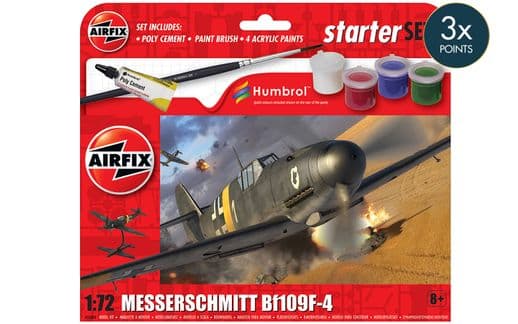
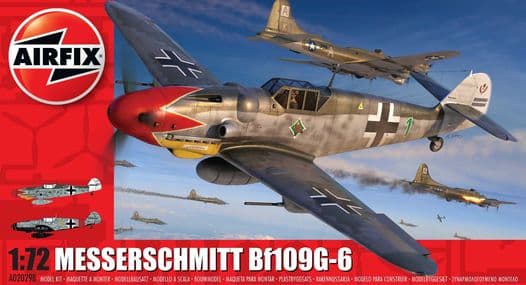
For an aircraft possessing such incredible pedigree as the Messerschmitt Bf 109, it will come as no surprise whatsoever to learn that the single engined fighter with which the Luftwaffe started the Second World War has long been a favourite with Airfix modellers. First appearing back in 1956, just one year after our first aircraft kit was released (Spitfire BT-K), this first Messerschmitt kit proved to be so successful, that it was superseded by a new upgraded tooling just ten years later, the classic Bf 109G-6 bagged kit, which will be familiar to many thousands of modellers the world over.
It is difficult to explain the popularly of the Messerschmitt as a model kit subject, particularly when built examples are often displayed next to its aviation nemesis, the Supermarine Spitfire. Where the Spitfire is all about grace and aesthetic appeal, something of an aviation thoroughbred, the Messerschmitt Bf 109 is much more the dogfighter, with its appeal being the fact that it looks like the aggressive warplane it was designed to be, and being completely unapologetic in the fact.
The fascination with the Messerschmitt is that it is beautiful in a rugged, purposeful and almost sinister way, the perfect embodiment of an enemy aircraft. In any case, everyone knows that a Spitfire has to be chased by something, right? Clearly, the fact that this aircraft represented the enemy during WWII and how very few survive to this day, only adds to its fascination, which is why it’s not that surprising that this diminutive fighter continues to captivate modelling enthusiasts to this day, and to convince model companies that introducing newly tooled examples of this aviation heavyweight is a commercially sound decision.
As an Airfix modelling subject, the Messerschmitt Bf 109 has been an incredibly important feature of many a kit range over the years, with several different variants of the fighter being produced in all our aviation kit scales since that first model was released back in 1956. Indeed, the current range can boast no fewer than EIGHT kits featuring one Bf 109 variant or other in both 1/72nd and 1/48th scales, underlining the importance the aircraft had to Luftwaffe operations during WWII, and the enduring popularity of the 109 as a modelling subject to this day.
As a modelling subject from a hobby perspective, the Messerschmitt Bf 109 has few equals, so with that being the case, we’re delighted to say that as we prepare to mark the 90th anniversary of the first flight of the prototype Messerschmitt Bf 109 V1, we here at Airfix can do so in some style. It does remain to be seen what our next scale model tribute to this magnificent aircraft will be, however, you can be sure it will be continuing this proud tradition.
We are afraid that's all we have for you in this latest edition, but we will be back next Friday with more project development updates and the very latest Airfix kit exclusives. In the meantime, we are always keen to hear your views on all things Airfix and in particular, any thoughts and opinions you may have regarding our Workbench blog. If you would like to drop us a quick line, could we please ask that you use our workbench@airfix.com email for all correspondence.
To re-visit any of the Airfix blogs we have produced over the past seven years or so, please head to our main Workbench hub, where you will find our entire blog back catalogue and all the Airfix design projects we have already covered.
All our dedicated official social media sites can be accessed by clicking the respective link icons at the foot of this page, or by heading to the Airfix homepage. Other useful Airfix links are:
Facebook, YouTube, Twitter and Instagram official sites
Please join us for more Airfix updates next week and thank you for your continued support.