
Welcome to this first edition of our Workbench blog for 2026, and all the news, updates, and modelling exclusives from the fascinating world of Airfix.
Having just completed another year of bringing our loyal readers weekly Workbench development updates, and with our latest range launch now just days away, we thought that we might try something just that little bit different for this latest edition of our blog, particularly as new models and new model tooling projects are going to be dominating our attention over the coming weeks. With a full year of numbers and statistics now available for evaluation, we thought it might be an interesting exercise to discover which kits proved to be the most popular releases over the previous twelve months, and whether new toolings totally dominated this chart, or if the re-introduction of some updated classics managed to muscle their way in there.
Taking this final opportunity to reflect before we embark on our 2026 modelling voyage of discovery, we will be looking at TEN of the most popular kits from 2025, featuring box artwork, built kit photography and details behind at least one of the scheme options available with each kit release. For those of us who have one, or several of these kits either in our stashes, or already in our display cabinets, this will serve as clear confirmation that we really do have our fingers on the pulse when it comes to modelling matters, and for those yet to sample these scale delights, what on earth have you been doing all year?
We would be delighted if you joined us in reviewing another year of Airfix kit releases in this second edition of Workbench for 2026.
As adults, we all know that Christmas is a time for giving, making sure that our loved ones receive the gifts they either want or need, and how getting something in return never even enters our heads, but that wasn’t always the case. Each and every one of us will have our own stories relating to Christmas and our love of modelling, but for those of us with a few years invested in this hobby, what lay wrapped under the Christmas tree with our name on the tag each year was of vital importance to us.
Although the current Airfix catalogue was one of our most treasured personal possessions in those days, and a reference tool usually for our eyes only, the need to effectively inform our parents which kits we were interested in required that this hallowed publication needed to be left in strategic locations at the optimum times, and even required it to be defaced with indicators which clearly identified which kits needed to be in the frame. Failing that, and if we’d been good all year (or at least for a week), a discussion about the merits of the latest Airfix box artwork and the incredible machines which inspired it might suitably focus the minds of our elders and betters, but clearly leaving them enough time to act on the guidance being provided.
In truth though, at that time, modelling was such an important aspect of our lives that any kits Santa was kind enough to bring us were gratefully received, no matter what the subject and no matter what the manufacturer, just as long as we could start our own personal kit stash for the coming year, and continue on our modelling journey. Indeed, for most of us, modelling subject variety was one of the most appealing features of the hobby, but having said that, something like a 1/144th scale Boeing 747 Jumbo, or a 1/24th scale Hawker Hurricane would always be exciting kits to receive on any Christmas Day morning.
In some way, we probably should feel a little sorry for today’s youngsters, because of the sheer number of distractions, social pressures and electronic gadgetry they have to contend with. Although we probably didn’t think so at the time, we were much more used to making our own entertainment and happy to do our own thing despite what others might be doing, particularly as many would be doing the same thing as us in most cases, happily modelling.
Thankfully, the enjoyment of modelling still features in the lives of a great many people and with kit manufacturing technology currently being better than ever, modelling can provide a healthy and welcome distraction from the pressures of everyday life, if only youngsters would take the opportunity to try it. For the rest of us, our enjoyment of the hobby continues undiminished, and it really does seem as if modelling is in a good place at the moment. Even if not the undiluted pastime pleasure it was during our own formative years, it’s definitely still alive and kicking – it could even be described as punching well above its weight at the moment.
That being the case, which were the Airfix kits which appealed most to hobbyists during the previous twelve months, and would these be the ten kits you would have suggested yourself? From a general list housekeeping perspective, we do have to say that they haven’t been ranked in any order, but were the most popular releases of the previous year, and clearly feature quite a number of new tooling projects. From a team perspective, they’re also really significant indicator for us, and are particularly important to our designers, as they are always interested to see how their latest projects are received by the wider hobby following their release.
So, with all that being said, without further ado, let’s get started.
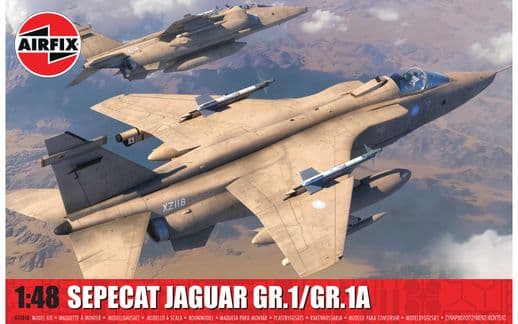
SEPECAT Jaguar GR.1/GR.1A
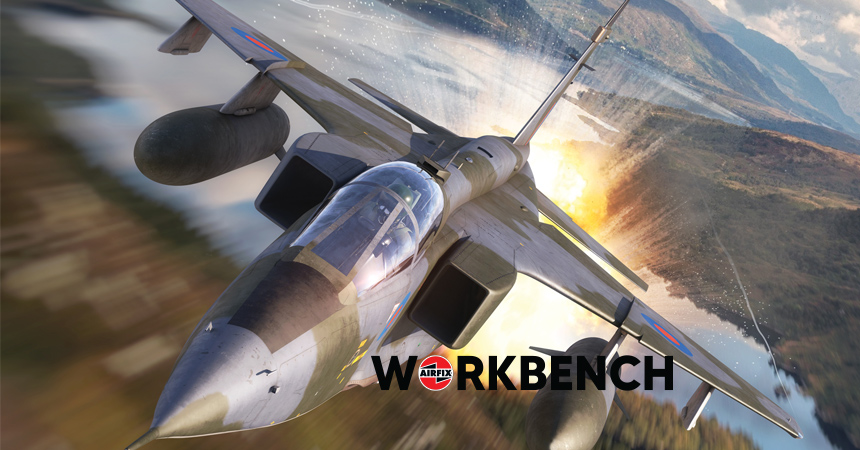
It will come as absolutely no surprise whatsoever to hear that our recently released 1/48th scale SEPECAT Jaguar kit was one of our most popular releases of the year, as it has been arguably our most heavily requested enthusiast new tooling subject for several years now. Event attendance at Scale ModelWorld and various modelling/Airshows throughout the year, always allows the team to gauge enthusiast opinions on all things Airfix, particularly the subject of new design projects – you lot have never been backwards at coming forwards. That being the case, we were in absolutely no doubt whatsoever that the Jaguar was going to be well received by a great many people following release, backed up by truly spectacular pre-order numbers following project announcement.
Right from the beginning, we knew the Jaguar was going to be something special, and Workbench was in the ideal position to bring our readers full details of the project’s development throughout the year, starting with a DOUBLE designers input editions at the start of the year. These can be access by using these Jaguar Part 1 and SEPECAT Sensation links.
Inspiration for the box artwork came from SEPECAT Jaguar GR.1A XZ118/Y ‘Buster Gonad’, Operation Granby/Desert Storm, Muharraq Airport, Bahrain, October 1990 – March 1991, details of which can be found below.
By the late 1980s, some observers were of the opinion that the RAF’s Jaguars were becoming less effective than other comparable aircraft in world service, but nevertheless, the Iraqi invasion of Kuwait in August 1990 would bring about a significant overseas deployment for the RAF’s Big Cats. The UK Government ordered the deployment of an expeditionary force, and Coltishall’s Jaguar Wing was told to prepare aircraft for imminent deployment to the Gulf. Twelve Jaguar GR1A aircraft were prepared for deployment, with the most significant visual preparation being the application of a new desert scheme, a temporary was which consisted of a Desert Sand alkaline-removable temporary finish scheme designed to make the aircraft more suitable for operations in the Gulf region.
Each aircraft was equipped with external fuel tank, AN/ALQ-101 jamming pod and additional self-protection equipment, and would subsequently be the first British aircraft to arrive in theatre. By the time they arrived, crews had unofficially proclaimed themselves and their aircraft to be the ‘Desert Cats’ and after moving to Muharraq International Airport in Bahrain, a period of additional training took place in preparation for the unit’s first operational sortie. That first mission came on 17th January 1991, when a Jaguar four-ship attacked Iraqi Army facilities in Kuwait.
The primary mission role for RAF Jaguars in the Gulf was Battlefield air interdiction, with a range of targets attacked including missile sites, artillery positions, munitions storage areas, airfields, armoured columns and troop concentrations, but all aimed at preventing Iraqi forces from either mounting a credible opposition, or advancing against coalition forces. Once again demonstrating the professionalism and application of British forces during times of war, the Jaguar’s Gulf deployment was impressive and even though the Jaguar force constituted less than one sixth of the RAF fast jets deployed, but went on to fly almost one third of all the offensive strike sorties.
Working under extreme conditions and flying the aircraft very hard, all twelve aircraft were invariably serviceable when called upon, a real testament to the work of Jaguar ground crews. With no aircraft losses to combat damage, only seven sorties were lost to technical issues, with the Desert Cats mounting 158 sorties during their Gulf deployment. This was further broken down to 618 individual aircraft sorties, with aircraft spending 922 hours in the air on operational sorties.
One of the most interesting facts relating to the Jaguar’s Gulf War deployment is how the majority of the aircraft received impressive nose artwork whilst there. Jaguar GR.1 XZ118 was adorned with the slightly risqué nose artwork featured on this scheme option, a character from a much loved British comic magazine at the time, with some being commissioned by the pilots, whilst others miraculously appeared during quieter periods on the airfield.
This particular Jaguar made its first flight on 12th May 1976 and was delivered to the RAF early the following month, where she embarked on a long service career, which included deployment to the Gulf described above. At the opposite end of her career, she was sent to the Defence Aviation Repair Agency at St. Athan at the end of September 2005 for spares recovery, then was sold to Everett Aero at the former RAF Bentwaters.
In an unusual turn of events, this aircraft was later used as the basis of a major art exhibition at the Tate Britain Gallery in London, with the aircraft displayed on its back, with the undersides facing upwards. The aircraft had all its paint removed and had been polished to within an inch of its life, showing of the beautiful lines of the Jaguar in some style. After the exhibition, the aircraft was recorded as being sold to the Slimelight Nightclub in Islington, but by the following year had been scrapped.
At the end of her Gulf War deployment, in addition to her nose artwork, Jaguar XZ118 was noted as displaying an impressive 38 mission symbols on the side of her fuselage.
Ferret Scout Car Mk.I
From a wider range perspective, it’s always nice when a non-aviation subject muscles its way in to the top 10 chart, particularly when it’s the second release from that particular tooling. Our 1/35th scale Ferret Scout Car joined the range back in 2023 and received a spectacular welcome from modellers who had almost given up hope of having a high quality, large scale kit of this incredibly popular military vehicle. The Ferret was the first major design project for one of our youngest designers (back then), and to say we were pleased with his efforts might just be the understatement of the year. His initial Ferret design introduction edition of Workbench can be accessed HERE.
In 2025, the Ferret was back, often available alongside the original kit, but this time presenting this British Army Scout Car in Mk.I configuration and with box artwork which drew attention to the incredible longevity of this popular vehicle. The details behind the box artwork scheme Ferret Scout Car Mk.1/2, 7th Armoured Brigade, Operation Granby, Saudi Arabia/Kuwait, British Army, 1991 can be found below.
When we think about the awesome firepower at the disposal of Allied Coalition forces, particularly the British, at the start of the Gulf War of 1991, you’d probably think of Challenger 1 main battle tanks and Warrior infantry fighting vehicles, all AFVs designed to provide British forces with the latest battlefield equipment to assist in their dangerous work. What you wouldn’t expect to see was a small force of lightly armed scout cars which at that point, had already been in service for 40 years.
The battlefield attributes of the Ferret which made it an ideal reconnaissance, liaison and security armoured car when it was introduced during the early 1950s, were still in demand when British forces deployed to the Gulf in response to this crisis, and amongst the collection of impressive modern armour in theatre, there was also a small, but noteworthy ‘Ferret Force’ supporting them. Wearing a smart new paint scheme appropriate for these new operating surroundings, Gulf War Ferrets would actually play quite a significant role both during preparations for the ground operations, and throughout the subsequent attack, always there to offer their unique attributes in ensuring the enemy were kept on the back foot.
In the light observation role, Ferrets would often be at the head of troop and equipment columns as they headed towards their attack staging points prior to the ground assault taking place, leading armoured columns into their correct positions, mainly under the cover of darkness. Reconnaissance Ferrets could also be the home of very senior commanders, as they probed the front lines looking for breaches in enemy defences and plotting minefields which would cause problems once the assault began in earnest. Using their speed and low profile, Ferrets operated effectively in these advanced roles, often leading the way for much more modern and much more expensive assets to follow along.
Seeing combat operations 40 years after the vehicle had originally entered service, the Ferret really was an exceptional armoured vehicle, one which just didn’t know when to quit.
Once the attack began, Ferrets were called to check enemy positions which had been neutralised, making sure nothing dangerous remained, whilst also performing the grim task of marking the positions and identities of fallen troops. If they did discover casualties, they could arrange for medical services to be dispatched to the location. On more than one occasion, Ferret crews were called upon to take the surrender of large numbers of Iraqi troops, numbers which dwarfed the crews of the vehicles themselves. Clearly a dangerous time for those few soldiers involved, crew members had to search and possibly disarm enemy troops, before keeping them all under guard until relief forces could take them to holding centres.
Once a ceasefire had been arranged, Ferrets and their crews were again dispatched to find and plot enemy positions, inspecting bunkers and strongpoints to ensure all weapons had been collected and made safe, and that no booby traps had been left for the unwary. Underlining the fact that these were always intended as military vehicles, one of the final tasks Ferret crews were required to undertake was the grim task of proceeding along the Basra Road to ensure that any enemy combatant casualties both injured and deceased were dealt with in the appropriate manner.
This particular Ferret appeared to be particularly well-loved by those who came into contact with it during the Gulf War, as there are an impressive number of colour pictures available online which stand as a record of this vehicle’s service during this conflict. In a modern coalition ground campaign, there was still a need for a Ferret Force of 40 year old Scout Cars.
When researching this scheme, we were delighted to make the acquaintance of Alister ‘Connie’ Constantine, a man who served in this very Ferret during the Gulf War, who provided us with details and pictures of his time with this vehicle. This proved so fascinating that it required a Workbench post all of its own, and if you needed any inspiration to embark on a modelling project, Connie provided it by the bucketload – no wonder the latest Ferret kit release made our Top Ten list.
Eurofighter Typhoon FGR.4 Starter Set
From a hobby perspective, the fact that one of our Starter Set kits has managed to make it into our Top Ten list for the year has to be viewed as a really positive thing, because although not exclusively for novice/first time modellers, they have certainly been designed to support early steps into our hobby. That being said, if it’s a great kit incarnation of a great subject, then it’s probably going to appeal to everyone.
With that being the case, we were certainly expecting great things from our 1/72nd scale Eurofighter Typhoon FGR.4 Starter Set, and it didn’t disappoint. Zoom climbing to the top of the sales charts immediately following its release, the Eurofighter Typhoon was born from an international design collaboration which aimed to produce an agile air defence fighter (European Combat Fighter Project) for service with several European air forces. Such a collaboration held the prospect of keeping costs to more manageable levels for all those involved, as they were being shared across the partner nations, although each would ultimately have their own requirements, something which would put a strain on both costs and working relationships.
The multinational consortium consisted of the aviation industries of Britain, Germany, Italy and Spain and as the project progressed, it was clear that the new Eurofighter was going to be an extremely advanced aeroplane indeed. Designed to be aerodynamically unstable at all speeds, the aircraft was controlled by a powerful suite of computers, which combined to endow the fighter with exceptional agility.
Making extensive use of composite materials, the aircraft was to be powered by a pair of Eurojet EJ200 engines which propelled the fighter to a maximum speed of Mach 2.35 and the ability to supercruise without the use of afterburner. These engines were just as advanced as the aircraft itself and were designed in 15 fully interchangeable modules, with everything monitored in real-time to ensure the early indication of any potential problems with the unit. This was all designed to keep the aircraft serviceable and ready for action.
Equipped with an impressive array of targeting and defensive technologies, the Typhoon can also carry a seemingly endless selection of ever more capable weapons, as it has developed from its original air superiority fighter designation, into an exceptional multi-role platform, one which is truly at the forefront of military aviation technology. Now at the midpoint of its service life, the Typhoon is expected to remain in service until 2040 and beyond.
From an Airfix kit range perspective, we fully expect this fantastic kit to be playing a significant role in the success of respective ranges for many years to come, and if you’ve yet to sample the delights of this magnificent kit, there’s no time to waste in 2026.
Messerschmitt Bf109G-5/6
When it comes to significant kit releases in our beloved hobby, there really is something special about an Airfix Superkit, particularly when it’s a newly tooled large scale example of one of the most famous/infamous fighters in the history of aviation. The fact that this kit was only announced at Scale ModelWorld in November last year, yet still managed to make our Top Ten list is nothing short of astonishing, and really does underline the current healthy state of modelling as a hobby activity.
When it comes to fighting aeroplanes of the Second World War, arguably no other aircraft type represents the inter-war hostile intentions of the German nation than the diminutive Messerschmitt Bf 109 series of fighters, an aircraft designed to dominate the skies, and one which pointed the way towards the very future of fighter aircraft performance. From a development perspective, it would also mirror the Spitfire for development potential and airframe adaptability, with the two types locked in a duel for aerial supremacy for the duration of the war.
By far and away the most heavily produced variant of the entire Messerschmitt Bf 109 series was the ‘G’, or ‘Gustav’, the aircraft variant which immediately superseded the thoroughbred ‘Friedrich’, and one which introduced some much needed firepower to the 109. A later variant of the fighter introduced to allow the aircraft to be adapted to take on a variety of different operational tasks with a minimum of fuss, the Gustav was the variant of Bf 109 tasked with defending the Reich against the incessant USAAF daylight bombing raids heading deeper into German controlled airspace, where heavier calibre weapons were needed to bring down these mighty four-engined leviathans.
The first Gustavs to enter service may have incorporated a host of modifications and improvements but visually at least, they still closely resembled the F-4 variant they were superseding. The work of up gunning the Bf 109 soon resulted in the fighter taking on a much less visually appealing appearance, with several lumps and bumps starting to degrade the appearance of this sleek and purposeful fighter, if presenting it with a more aggressive profile. The use of more powerful nose mounted MG 131 machine guns required the need to add bulges to the top forward section of the fuselage just in front of the canopy windscreen, to accommodate the breech blocks of the guns, a development which underlined the fact that this variant of the Bf 109 was intended to be incredibly adaptable.
The development edition of Workbench produced in support of this spectacular kit will probably still be fresh in everyone’s minds as it was only published late last year, so we won’t loiter too much with this particular list entry, but we can all expect Gustav to be playing a significant role within the 2026 Airfix range, due to be unveiled next week.
Supermarine Spitfire Tr.9
When it comes to Airfix and Spitfires, the two go together like hands and gloves, and can now boast a heritage in kit form which now goes back almost 70 years. Even though this heritage clearly underlines the popularity of the Spitfire in kit form, whenever we add a newly designed Spitfire kit to the current range, some sections of the enthusiast community like to have a little fun on social media by posting comments like ‘not another Spitfire from Airfix’, or when a new model announcement is due, come back with something like, ‘I bet it’s a Spitfire!’
We know that this is all just a bit of fun and always taken with a pinch of salt, but when Spitfires continue to appear in our Top Ten list, this clearly shows that Britain’s most famous aircraft is still relevant to the modelling world and Workbench readers alike.
A post war variant of the Spitfire, but one which is now making an important contribution to the continuing legacy of this incredible aircraft, the two seat Tr.9 Spitfire has become a regular sight in Britain’s skies over recent years, and at one point just a couple of years ago, almost every Spitfire under restoration at that time was to Tr.9 configuration.
It does seem strange that for an aircraft which represented the very pinnacle of aviation technology back in the 1930s, and was very different to most fighter aircraft in service at that time, that no two seat training variant of the Spitfire saw service during the Second World War, to help with that transition. Even though this was proposed and explored by Vickers Armstrong during the early 1940s, the Air Ministry had absolutely no intention of disrupting existing Spitfire production lines for an aircraft they deemed unnecessary from a pilot conversion perspective.
Vickers would resurrect the idea in early 1945, buying back Spitfire Mk.VIII MT818 from the Air Ministry to serve as their project donor airframe for their Type 502 Spitfire High Speed Trainer prototype. Making its first flight on 9th September 1946, the aircraft would embark on a rigorous period of testing and evaluation trials, in the hope that she would attract potentially sizeable orders from the Air Ministry.
The scheme which inspired the beautiful box artwork for this hugely popular 2025 addition to the Airfix range features Supermarine Spitfire Tr.9 No.161 (formerly PV202), B Flight, Irish Air Corps/An tAerchór, Baldonnel Aerodrome, Dublin, Republic of Ireland/Poblacht na hÉireann in 1951.
As mentioned earlier, whilst the official Vickers-Armstrong two-seat Spitfire MT818 G-AIDN was demonstrated but overlooked by officials from the British Air Ministry, she went on to serve for several additional years as both a demonstration aircraft, and an air racing aeroplane. One of the more significant appointments she had to attend was when she was dispatched to Baldonnel airfield in early January 1950, to allow members of the Irish Air Corps to examine and fly her.
Late the previous year, the IAC retired the last of their Miles Master advanced training aircraft, leaving their student and refresher course pilots facing a gap in their training programme, and effectively having to jump from the Miles Magister basic trainer, on to the much larger twin engined Avro 19 (Anson). Following the visit and a period of further consultation, the Irish Department of Defence placed an order for six Spitfire trainers, to carry the serial numbers 158 to 163, to be delivered starting from May 1951.
The aircraft were to be painted in an overall grey/green scheme which was similar to RAF cockpit green, with the first two aircraft being delivered in a matt finish, but the final four aircraft sporting a gloss sheen. Later, aircraft numbers 158, 161 and 162 would be finished in an extremely smart silver finish, sporting a large black cowling section which extended down past the aircraft’s exhaust manifolds, and from the front of the cockpit right up to behind the aircraft’s spinner.
These aircraft must have been a beautiful sight in the skies above the Dublin area, with the good people of Ireland gaining their appreciation of these two-seat training Spitfires much earlier than the rest of us did. Withdrawn from service in April 1960, these magnificent aircraft were transferred to the care of the Technical Training Squadron at Baldonnel, but when finally offered for sale from 1961 onwards, found themselves in the dawning of the UK Warbird movement, and the people who were thinking about producing a rather significant aircraft related movie.
Significantly, of the six aircraft purchased and operated by the Irish Air Corps, five remain in existence to this day, with all five either being in airworthy condition and offering air experience flights, or under restoration to do so soon. Only aircraft number 160 (MK721) doesn’t survive, as she was damaged beyond economical repair following a landing accident on the grass runway at Baldonnel on 15th February 1957.
The Spitfire Tr.9 scheme shown above has quite a rich history and was originally built as a Mk.IX fighter during the late summer of 1944 and initially allocated to No.33 Squadron operating in Northern France in October the same year. During her time spent with No.33 Squadron in France and Belgium, she helped support the Allied drive towards Germany itself and flew 20 operational missions in the hands of 10 different pilots, men who heralded from Britain, Denmark, Holland and South Africa.
In early 1945, she was transferred to No.412 Sqn RCAF, in the colours of which she would go on to complete a further 76 operational sorties, and was credited with downing at least three Luftwaffe aircraft, two Focke Wulf Fw190s and a Messerschmitt Bf 109.
For most of us, if we’re ever going to experience the thrill of flying in a Spitfire, it’s going to be in one of these magnificent aircraft, so it should really come as no surprise that our scale tribute to the two seat Spitfire has seen it taking its place as one of the most popular releases of 2025.
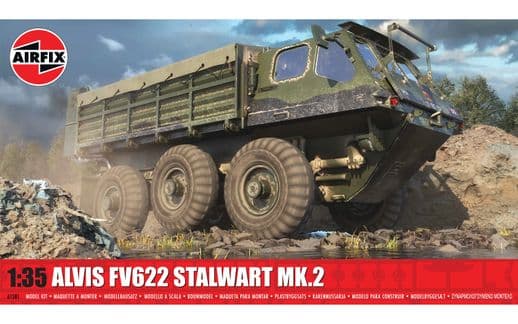
Alvis FV622 Stalwart Mk.2
Isn’t it great to have TWO new 1/35th scale military vehicle kits in our Top Ten list for 2025! Our second entry in this annual overview has to be considered one of the most distinctive machines ever to see British Army service, almost looking like a vehicle you might expect to see emerging from the pod beneath Gerry Anderson’s Thunderbird 2 rather than being a high mobility load carrier for the British Army, the Alvis Stalwart Mk.2 earned something of a go anywhere, fear nothing reputation during its 30 year service career.
The Alvis Stalwart Mk.2 was an extremely capable amphibious 6x6 cargo truck, introduced to keep Army units supplied with fuel, ammunition and general supplies during times of conflict. Initially developed as something of a private venture, the Stalwart can trace its lineage back through a series of successful 6x6 vehicles, the majority of which saw British military service, such as the Saladin armoured car and Saracen armoured personnel carrier. The Stalwart shared many components with its predecessors, but was charged with performing a very different role from them – from a kit design perspective, our review introduction edition of Workbench can be accessed HERE.
Entering service from 1966 onwards, the Stalwart certainly lived up to its name, with its impressive off-road performance giving it something of a go anywhere, fear nothing reputation. Featuring an intricate drive and suspension system, the Stalwart afforded its crew an extremely comfortable ride when operating over uneven terrain, however, even though the vehicle was capable of speeds approaching 40 mph on open roads, the handling of the Stalwart could be challenging, with each bank of wheels constantly trying to outpace those on the opposite side.
A true amphibian, the Stalwart boasted watertight seals to protect all vital components, enabling it to deliver its cargo across bodies of water not served by bridges or temporary crossings, climbing out of the water on the other side if the ground was shallow or compact enough to support its weight. In the water, the Stalwart Mk.2 featured improved waterjet power and could reach speeds of 16 km/h in optimum conditions.
To support the Stalwart's operation both in the UK and during extensive service in Europe, the driving position in the distinctive cab of the vehicle was centrally located and even though lugging cargo was the main role of the Stalwart, it could also be used to transport up to 38 fully equipped troops in the same amphibious manner. The Stalwart finally relinquished its support duties once the RAF's latest variants of heavy lift helicopters took over the vital role it had successfully performed for years.
Westland Wessex HC.2
The first of two Westland produced aircraft in our Top Ten list and the only Helicopter entry, the announcement of our 1/72nd scale Wessex HC.2 kit may have come as something of a surprise to many, but has proved an extremely popular addition to the range.
Just as they had previously done with the Whirlwind, Westland took an already successful American helicopter design and made it even better, preparing it for life with Britain’s armed forces. The main difference with the new Wessex was its adoption of a turboshaft engine, as opposed to the piston engines used on American machines, which was quite the innovation back then. The Wessex HAS.1 was developed for the Royal Navy as an anti-submarine, search and rescue, and general utility helicopter, an aircraft which was powered by a single Napier Gazelle turboshaft engine, but with the design being flexible enough to accommodate different powerplants in future developments.
Developed for the Royal Air Force, the Wessex HC.2 was an uprated derivative of the original Royal Navy machines, one which used a pair of de Havilland (Bristol Siddeley) Gnome H.1200 turboshaft engines for power, and were distinctive by the large metal dustbin engine exhausts positioned either side of the forward fuselage. Entering service in 1962, RAF Wessex helicopters took on several roles successfully, including troop and supply transportation, ground support and air evacuation duties, however, it would be their use as Air Sea Rescue helicopters which made these some of the highest profile aircraft to see service in the post war era. The Wessex represented the pinnacle of rotary technology at the time of its introduction and could operate from, and into places where other aircraft simply couldn’t go.
The box artwork for this new tooling release featured Westland Wessex HC Mk.2 XR505/WA from No.2 Flying Training School, Royal Air Force Shawbury, Shropshire, West Midlands, England, 1995.
Helicopters arrived at RAF Shawbury during 1976, with the Gazelle and Wessex helicopters of No.2 Flying Training School becoming a regular sight in the skies above this beautiful part of the country. Despite the fact that No.2 FTS disbanded in 1997, the airfields association with helicopters and helicopter training continues to this day, as it’s now home to the Defence Helicopter Flying School, a unit which provides training support for all branches of Britain’s military, a helicopter association which now spans almost half a century.
The location of RAF Shawbury could hardly be more appropriate for helicopter training activities, as it’s situated in the middle of a sparsely populated area of farmland, with vast expanses of open countryside to the west and south, were Wales and Herefordshire are situated. Whether rotary students are practicing manoeuvres around the airfield, or flying cross country through the adjoining countryside, they will be able to do so without too much outside interference, hopefully using their time at Shawbury to secure a posting an operational helicopter unit, or prove proficient enough to be ‘creamed off’ and sent directly to be trained as a helicopter instructor.
This particular Wessex is a fine example of an RAF HC.2 machine, and one which appears to have been particularly fond of attending Airshows during its service career. Built during 1963, she would make her first flight on 1st October that same year, before embarking on a busy service life, which would later include the training of new medium lift support helicopter pilot training at Shawbury.
This aircraft appears to have been a popular subject with the nation’s enthusiast photographers, with 1995 being a particularly busy year for her, as she was photographed on static display at both of the UK’s largest Airshow events, those at Mildenhall and Fairford. She also carried the name ‘Aries’ on her sliding cabin door in many of the pictures available online, but if anyone has any information regarding the name and when or why it was applied, we would be interested to hear from you.
For everyone with links to RAF Shawbury, the name ‘Aries’ is incredibly important, as it was carried by Avro Lancaster PD328 in late 1944 when it was about to become the first RAF aircraft to complete a circumnavigation of the earth, an achievement which took 53 days to complete. The base has continued to mark this significant achievement by allowing various aircraft based at Shawbury to sport the ‘Aries’ name, including Wessex XR505 and Juno ZM528.
This particular Wessex was eventually sold to the Uruguayan Navy in 1998, where she is thought to have become the last ‘in service’ Wessex to fly in the world, but we’ll have more about that in just a moment.
North American P-51D Mustang
Underlining the fact that kits produced in the traditional, smaller 1/72nd scale still have a huge part to play in our hobby, one of the least expensive model entries in this year’s Top Ten list was a kit which first entered the range back in 2023, but still continues to be a staple build project for many thousands of modellers the world over. Almost rivalling the Spitfire for enthusiast popularity and occupying a position as one of the most important aircraft of the Second World War, the North American Mustang is inextricably linked with Britain and British requirements, with its design being initiated by a British request for North American to build Curtiss P-40 fighters for the Royal Air Force in 1940.
The North American Company thought that they could do better than that, promising a better fighter than the P-40, and one they could have in the air in just a matter of months. That aircraft was the Allison V-1710 powered Mustang I, and whilst this was an extremely capable fighter, particularly at lower altitudes, the later marriage of the Mustang airframe with the Rolls Royce Merlin engine produced an aviation classic, and a world-beater of a fighting aeroplane.
The new Merlin powered P-51B Mustang entered service in the European theatre from December 1943 and immediately presented Allied commanders with an aircraft with which to clear the skies of Luftwaffe aircraft in advance of the proposed Normandy landings. Equipped with new lightweight external drop tanks, USAAF daylight bombing raids could now be supported by fighter protection all the way to their targets and should the Luftwaffe make an appearance, Mustang pilots were only too happy to show them what their impressive fighter could do. The European air war had shifted significantly in favour of the Allies.
The scheme option available with this beautiful little kit is North American P-51D Mustang 44-72437 'Pauline', Aircraft flown by Lt Col Joseph 'Joe' L Thury, 505th Fighter Squadron, 339th Fighter Group, 8th Air Force, RAF Fowlmere, Cambridgeshire, England, 1944.
This aircraft was the personal mount of ace USAAF pilot Lieutenant Colonel Joseph L. Thury of the 505th Fighter Squadron during the late summer of 1944. A native of St Paul Minnesota, Thury began his flying career when accepting a place on a cadet training course in June 1941. Qualifying by February the following year, he was assigned to various units in the US, before eventually joining the 505th Fighter Squadron, of the 339th Fighter Group in August 1943.
The 339th FG were sent to fight in the European air war in early 1944, arriving at Station 378, the former RAF Fowlmere on 4th April 1944, with the distinctive red and white chequerboard noses of their fighters helping to identify them to other friendly USAAF units. The airfield at Fowlmere was the satellite airfield for RAF Duxford and during the Battle of Britain, a series of famous pictures showing RAF pilots enduring what appeared to be rather basic facilities at Manor Farm helped to create the legend of the 'Few' and how nothing could deter them from stopping the Luftwaffe from taking control of Britain's skies.
By the time the USAAF took up residency at Fowlmere, the airfield had expanded to accommodate an entire fighter group and was much more appropriate for the significant job at hand. From August of 1944, Joe Thury had been given command of the 505th Fighter Squadron and led his squadron in a hectic period of fighting in preparation for D-Day.
The 505th Fighter Squadron would become a specialist unit engaged in these airfield strafing operations, with its pilots destroying twice as many Luftwaffe aircraft on the ground as they did in the air. Joe Thury and his Mustang 'Pauline' would prove to be particularly successful in gaining air to ground victories, with his tally of 25.5 aircraft destroyed marking him as the second most successful strafer in the Eighth Air Force, only 1.5 victories behind the 55th Fighter Group's Elwyn Righetti, who took the top honour.
Lieutenant Colonel Joseph L. Thury would survive the war with 25.5 ground victories and a further 4 aerial combat victories to his name, with two of these victories shared with other 339th Fighter Group pilots. North American P-51D Mustang 44-72437 'Pauline' would be lost on operations on 17th January 1945, whilst the fighter was being flown by another USAAF pilot.
Supermarine Spitfire Mk.Ia
Our second Spitfire entry in this year’s list is something of a classic, a 1/72nd scale model release which was re-introduced into the Airfix range back in 2024, yet is still clearly attracting plenty of hobby support. We suppose this attractively priced kit was always going to do well in a Battle of Britain anniversary year, however, the rate at which this Spitfire kit flew off the shelves in 2025 even took us by surprise.
The first Spitfires which arrived at RAF Duxford in August 1938 were fitted with a twin-bladed fixed pitch propeller made of wood, a unit which whilst being effective, was a unit which limited the performance of the Merlin engine, in the same way that fitting a bicycle with just a single gear is less than ideal. From around the 80th production aircraft onwards, this first propeller was exchanged for a de Havilland three bladed, two pitch (position) propeller, which significantly enhanced the performance of the aircraft. This essentially allowed the aircraft to be configured for the challenging landing and take-off phases of flight, but then once in the air and increasing speed, alter the propeller pitch to obtain maximum performance from the engine.
Modifications were not just directed towards the performance of the fighter, but also to more effective operation of the Spitfire in general service/combat situations. The original ‘flat’ canopy which was a feature of the first Spitfires was replaced with a taller canopy, one which also featured ‘blown’ sides to allow for much improved visibility for the pilot. Later still, a quick release mechanism was introduced to the canopy design, making it easier for a pilot to exit the fighter in case of emergency. Initially a manual and bespoke modification, many pilots fitted a car mirror to the canopy frame in an attempt to give them some rearward vision when engaged in aerial combat.
One of the most celebrated RAF pilots to serve through the Battle of Britain, Brian Lane joined the Royal Air Force in 1936 at the age or 19, accepting a short service commission and completing his flight training by the end of that same year. Initially posted to RAF Duxford and No.66 Squadron as a Pilot Officer, Lane would later move to RAF Northolt and No.213 Squadron, before returning to Duxford to take up a position as Officer Commanding ‘A Flight’ of No.19 Squadron, flying Spitfires.
Sent to operate from RAF Hornchurch in support of the evacuation attempt at Dunkirk in May 1940, No.19 Squadron engaged in its first full force combat over France on 26th May, where several enemy aircraft were shot down, but for the significant loss of the unit’s Squadron Leader at that time, Geoffrey Stephenson. Stephenson famously crash landed his stricken Spitfire N3200 on the beach at Sangatte, near Calais and was taken prisoner by the Germans. His Spitfire was recovered from the crash site in 1986 and is now restored to airworthy condition, one of the most historic aircraft ever to display on the UK Airshow circuit.
Officially assuming command of No.19 Squadron on 5th September 1940, at a crucial stage of the Battle of Britain, Brian Lane’s favourite Spitfire was reputed to be P9386/QV-K, an aircraft which has subsequently also become a favourite with modellers over the years. This particular Spitfire is noteworthy as it features oversized fuselage roundels, along with a distinctively thick and rather blocky representation of the aircraft’s fuselage codes, not to mention the fact that it was flown by one of the most celebrated pilots of the Battle of Britain period.
In addition to this aircraft being a perennial modelling favourite, it has also been the subject of much enthusiast discussion over the years, with those discussions mainly focussing on the colour of the aircraft’s spinner. With the few period photographs taken of this Spitfire all being in black and white, the definitive identification of the colour is the subject of shade difference interpretation and opinion, with most choosing to depict the spinner in yellow, but with others thinking either white or sky the more likely colour.
What isn’t disputed is the fact that this Spitfire was flown by Squadron Leader Brian Lane during the Battle of Britain and was used by him to bring down a Messerschmitt Bf 110 on 7th September 1940, followed by a further two Luftwaffe ‘Destroyers’ four days later.
This little kit is truly an Airfix classic and rightly takes its place amongst the most popular releases of 2025.
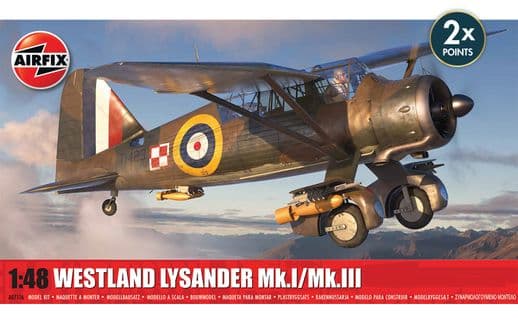
Westland Lysander Mk.I/Mk.III
The final entry in our Top Ten list for 2025 is the second scale subject homage to a Westland produced aircraft, and unquestionably one of the most impressive kits to ever take its place within an Airfix range. A kit which was unleashed on an unsuspecting modelling world in the very first edition of Workbench last year, the unusual looking Westland Lysander has been nothing short of a revelation since joining the range, providing this unsung hero of an aeroplane with some long overdue enthusiast recognition, and benefitting display cabinets everywhere with a truly spectacular looking aeroplane model.
Produced in response to a British Army requirement for an aircraft which could take on a variety of specialist roles, including reconnaissance, artillery observation, general duties and light bombing, the Westland designed was an unusual looking, if rather advanced aeroplane for the time, but one which wasn’t without its vices. The high-set cockpit and extensive glazing used afforded both the pilot and his observer an exceptional field of view, with the high mounted, unusually shaped wings not only helping to support this, but also incorporating a few little design tricks of its own. The wing design included the introduction of an automatic slat and flap arrangement which gave the aircraft exceptional low speed and short field performance, but due to its design, did have to be managed carefully.
Another significant design feature of the Westland aircraft was its rugged, fixed undercarriage, something which made it easy to operate whilst on the ground, with the rigidity to allow it to be operated from all but the most uneven of landing grounds. The wheel spats themselves were streamlined, but also housed a pair of fixed, forward firing Browning machine guns, which were away from the arc of the propeller and therefore didn’t require the use of interrupter gear.
As you would expect, a release of this magnitude required the creation of spectacular box artwork, which in this case took inspiration from Westland Lysander Mk.III T1423, which operated with No.309 Polish Fighter-Reconnaissance Squadron, Royal Air Force, Renfrew, Glasgow, Scotland in 1940.
Formed as one of the 15 Squadrons of the Polish Air Force in exile in an agreement between Britain and the Polish Government in 1939, No.309(Polish) Squadron was initially formed as an Army cooperation unit in early October 1940, with the intention of using them in conjunction with those elements of the Polish Army which managed to escape the fighting following Germany’s invasion of France. The British knew that if it came to a ground war in Britain, deployed Polish troops would need the close support of aircraft if they were to be effective, and how Polish speaking aircrews would be important in providing the support they were going to need.
The fighting in France proved to be disastrous for the RAF’s Westland Lysander Squadrons, with only around 50 of the deployed 174 aircraft managing to limp back to Britain. These aircraft were gathered at a temporary airfield home in Kent, where their condition could be assessed prior to dispersing them to several different locations around the British Isles, to be joined by further newly constructed Lysanders as and when they became available.
One of these units was the newly formed Polish manned No.309 Squadron at Renfrew near Glasgow, a site which has been in use since before the start of the Great War, but one which was remote enough to allow this unit to train without too much interference from the Luftwaffe. They would operate the Lysander for 30 months from October 1940, initially in an Army cooperation role, with some target towing activities thrown in for good measure, but would later take on a much more offensive role flying the Mustang I in an armed tactical reconnaissance role. Although these aircraft were required to fly armed reconnaissance sweeps into northern France, they worked alongside their fellow pilots flying Lysanders, with their activities carrying on unaffected.
By March 1943, No.309 squadron had relinquished their association with the Lysander, trading their aircraft entirely for the Allison powered Mustang I by then, but later also trading these for Packard Merlin powered Mustang IIIs and IVs.
So, there you have it, our most popular model kit releases for 2025 – how many of these made it onto your own workstations over the past few months, or reside in your kit collection awaiting future attention? We purposely didn’t rank this selection in order of actual popularity and there are a number of factors which have to be considered when collating the information provided to us, but the list does make for an interesting subject for discussion, and definitely includes some impressive model kits.
If you had to rank the ten models in ascending popularity order, what would be your top three? If you feel like doing so, please do drop us a line with your suggestion, as we would all be interested to see the results, and to compare them with the actual figures. If we get enough responses, we might just come clean in a forthcoming edition of Workbench.
Having looked back at another great year for Airfix and the world of scale modelling in this latest edition of Workbench, it’s time to look forward with huge optimism to arguably the most significant event in the Airfix calendar, range launch day.
An annual early year occasion which usually sees thousands of modellers doing their level best to melt the Airfix website due to sheer traffic activity, we will be bringing you details of our latest range of kits from 4pm (GMT) on Wednesday 14th January, and we can’t wait to show you what we have for you this time around.
With our usual selection of Vintage classics, returning kits, updated and modified releases, along with our headline new tooling announcements, the Airfix website is the only place to be next Wednesday afternoon, but if you find the website a little slow in the minutes following launch, please do come back a little later, because we have a lot to show you. As always, our Head of Brand, Dale, will be on hand to talk you through all the range highlights on our official YouTube channel, and will probably tease you all with our usual caveat that we do reserve the right to introduce additional new models as ‘Secret Releases’ throughout the year.
As always, Workbench will be on hand to provide all the exclusive development details behind all the new model announcements as they advance towards release throughout the year, and hope you will join us for another exciting year of Airfix modelling updates.
Until Wednesday then!
We're afraid that's all we have for you in this latest edition of the Airfix blog, but we will be back next Friday with more project development updates and the very latest Airfix kit exclusives. In the meantime, we're always keen to hear your views on all things Airfix and in particular, any thoughts and opinions you may have regarding our Workbench blog. If you would like to drop us a quick line, could we please ask that you use our workbench@airfix.com email for all correspondence.
To re-visit any of the Airfix blogs we have produced over the past TEN years or so, please head to our main Workbench hub, where you'll find our entire blog back catalogue and all the Airfix design projects we have already covered.
All our dedicated official social media sites can be accessed by clicking the respective link icons at the foot of this page, or by heading to the Airfix homepage. Other useful Airfix links are:
Facebook, YouTube, Twitter and Instagram official sites
Please join us for more Airfix updates next week and thank you for your continued support.